



Warning: It is strictly forbidden to transport children in a child restraint system installed in the front seat facing forward unless the front passenger airbag is deactivated; a description of how to deactivate the airbag is given in the subsection below.
When transporting children up to approximately one year of age and weighing less than 10 kg (up to 9 months) or 13 kg (up to 18 months) optimal protection is provided by cradles and convertible seats (respectively group 0 or 0+), installed on the rear seat against the direction of travel of the car and secured using a seat belt or ISOFIX/Top Tether design.
Note: Convertible seats, unlike cradles, are more functional, as they can also be installed in the direction of travel, and they are designed for a child weighing more than 9 kg (but also up to one year).
For children aged approximately one year and weighing between 9 and 18 kg, forward-facing child seats (Group 1) are intended. Children aged 3 to 7 years (weighing from 15 to 25 kg) should be seated in additional seats (group 2). Children aged 6 to 12 years (weighing from 22 to 36 kg) can be seated on special cushions (group 3). Restraints of groups 2 and 3 are also secured with a seat belt.
Warning: Do not use booster seats or cushions that have only a lumbar belt; do not place the seat belt under the child's arm or behind his back.
Detailed instructions for use (for what age and weight category), placement and installation of devices to ensure the safe transportation of children must be accompanied by instructions for these devices; if necessary, please contact your Skoda representative for advice.
Restraints in the car, whether or not they are currently being used for their intended purpose, must be secured to avoid injury in an accident. Also, do not leave restraints in direct sunlight, or check their temperature before placing the child in them, as they may get burned.
If you need to place a teenager or a child over 12 years old in the front passenger seat, move the seat as far away from the front airbag as possible and fasten the child with a seat belt. You can place an additional cushion on the seat to ensure that the seat belt is positioned correctly on the teenager's body.
The front passenger seat and the rear seats are equipped with special points for attaching the ISOFIX restraint system, marked with labels with the appropriate symbols (see illustration 8.1a). These mountings are compatible with child restraints of the following ISOFIX classes: (according to ECE-R 44). To install the ISOFIX child seat, insert the holders (A) into the ears (B) and then insert the child seat anchors into them in the direction of the arrow until they click into place. Finally, check that the child seat is securely fastened by tugging it.
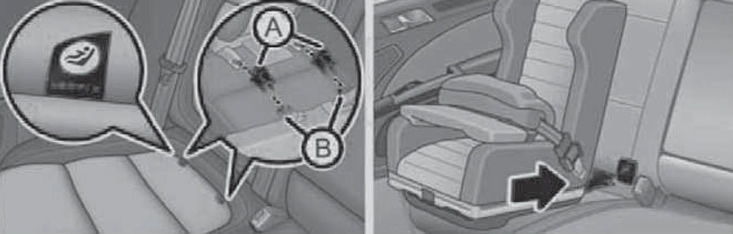
8.1a Lower ISOFIX restraint anchorage points
When purchasing an ISOFIX restraint device, check its weight category and size for the intended installation location.
Child seats can also be equipped with the "Tor Tether" fastening system. To fasten such child seats to the rear seat of the car there are brackets behind the backrest (see illustration 8.1b). When installing child seats with the "Top Tether" attachment, follow the instructions included with the seat.
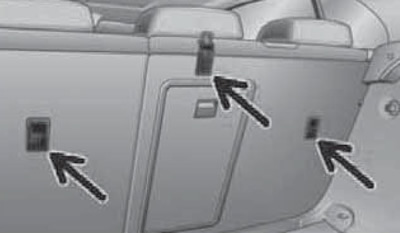
8.1b Attaching the Top Tether Straps to the Luggage Compartment
Deactivating the front passenger airbags
Caution: Remember to activate the front passenger airbags after removing the child seat.
Using the switch (see illustration 8.2), located in the main glove compartment, you can turn the front passenger airbag on/off.
Note: This switch is installed by Skoda representatives as an option.
Other airbags and inflatable curtains can only be disabled at a workshop with the appropriate diagnostic equipment. If the airbags are disabled using the diagnostic tool, the SRS indicator in the instrument cluster lights up for approximately 4 seconds after the ignition is turned on, and then flashes for 12 seconds at 2-second intervals.
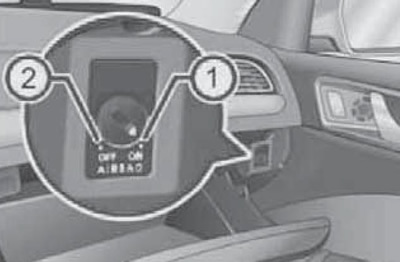
8.2 Front passenger airbag switch
To deactivate/activate the front passenger airbag with the ignition off, turn the switch with the key to the "OFF" or "ON" position, respectively. Successful deactivation can be judged by the lighting of the corresponding indicator lamp "PASSENGER AIR BAG OFF" on the center console approximately 4 seconds after the ignition is turned on (28 in illustration 12.1). In addition, the SRS K/L in the instrument cluster lights up for 4 seconds after the ignition is turned on.
Caution: If the front passenger airbag is deactivated, the K/L "PASSENGER AIR BAG OFF" does not light, flashes, or lights up together with the SRS light in the instrument cluster (see Section 13), you should not transport a child in the front seat, as any faults found in the SRS system may cause the airbags to deploy. Contact a Skoda representative to have the SRS system checked as soon as possible.