



Note: In auto-dimming rearview mirrors (in electrochromic mirrors) contains liquid electrolyte, which, if the mirror is damaged, may leak out and cause irritation of the skin, eyes and respiratory system. This applies especially to people suffering from asthma or other similar diseases. In this case, it is necessary to provide intensive ventilation with fresh air. If electrolyte gets on your skin, eyes or respiratory system, on clothes or shoes, wash it with plenty of water (rinse your mouth). If electrolyte gets on plastic trim parts, remove it as soon as possible with a damp sponge or rag.
Note: The exterior rearview mirrors are curved, which increases the field of view, but objects reflected in the curved parts of the mirrors appear further away than they actually are. Such mirrors are intended for assessing the traffic situation and should not be used to determine the distance to an object.
The interior rearview mirror can be turned manually. To reduce the brightness of the reflected light from the headlights of a car moving behind you at night, move the interior mirror dimming control towards you (see illustration 9.6a). When equipped with an interior rearview mirror with an automatic dimming function, this function can be turned on or off using a switch (2 in illustration 9.6b), - the mirror will automatically darken when bright light hits the sensor (3), and the indicator (1) will light up. This function is automatically switched off when the interior lighting or reverse gear is turned on.
Note: When the automatic dimming of the interior mirror is turned off, the dimming of the exterior mirrors is turned off. Do not cover the sensor to avoid disruption of the automatic dimming function. The mirror only works properly when the rear window shade is retracted. Do not install an external navigation system or video recorder display on the windshield next to the electrochromic mirror, since the glow of this display may cause inadequate operation of the mirror electronics.
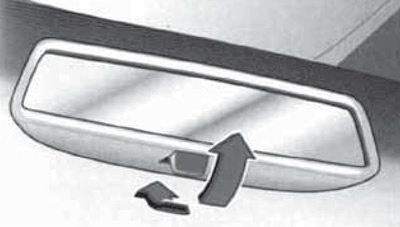
9.6a Dimming control for regular interior rearview mirror
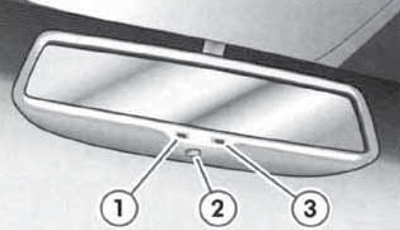
9.6 B Interior rearview mirror with automatic dimming
The outside rearview mirrors have a heating function and electric adjustment, and on some models - electric folding. Automatic dimming of the outside mirrors is turned on and off together with the automatic dimming of the interior mirror (see paragraph above). Automatic dimming is switched off when the interior lighting is turned on, as well as when reverse gear is engaged. A handle is installed in the driver's door to control the electric adjustment drive (16 in illustration 12.1). In the lower position "0" no adjustment is made, folding of mirrors and their heating are switched off. When turning the handle to the "R" or "L" position, it becomes possible to adjust the right or left mirror, respectively. To adjust, tilt the regulator in the corresponding directions (up/down and left/right). If the electric drive is faulty, the mirror can be adjusted by simply gently pressing on the edges of the reflective element.
You can select the adjustment algorithm for the outside mirrors via the "Settings→Comfort→Mirror settings" menu on the instrument cluster display. To adjust the mirrors individually, select "Individually". If "Synchronized" is selected, the right mirror will move with the left mirror when you adjust it; if necessary, then adjust the right mirror by moving the switch to the "R" position.
To see the curbstone in the right mirror when reversing, you can leave the switch in the "R" position - then when you engage reverse gear, the right mirror will tilt down slightly. The mirror returns to its original position when you disengage reverse gear, as well as when driving at a speed of more than 15 km / h.
The description of the position memory of the outside mirrors is given in the subsection "Memory of the position of the driver's seat and outside mirrors" above.
When the switch is turned to the position
 the outside mirror heating is turned on.
Note: Heating is only switched on when the engine is running and the outside air temperature is no more than 20°C. To save fuel, do not switch on the mirror heating when it is not necessary.
When the switch is turned to the position
 the exterior mirrors are folded electrically. The electrical folding only works when the ignition is switched off and at speeds below 15 km/h. If necessary, with the windows closed, the mirrors can be folded using the remote control by holding the lock button for about 2 seconds.