



Contents: General information ⬇ Seat belt reminders ⬇ Rules for using seat belts ⬇ Recommendations for pregnant women ⬇
General information
Note: Information about emergency seat belt tensioners is provided in Section 10.
All occupants of a moving vehicle must wear seat belts. No one seat belt should be used to restrain more than one person.
All seat belts have a diagonal-lap design, implying the presence of three anchor points, one of which is equipped with an inertial return device with automatic locking in case of jerks. Belts of this type do not require length adjustment. The front seat belts additionally have tension limiters. The lap section of the belt should be positioned at hip level so that it covers the hip joint of the seated person, as the strongest element of the human skeleton, and does not press on the stomach. The shoulder section of the belt should pass through the center of the shoulder, it is not allowed to pass it under the arm or put it on the neck. Make sure that the belt is not twisted.
If necessary, the height of the upper anchor points of the front seat belts can be adjusted. To raise or lower the upper anchor, squeeze the locking mechanism (see illustration 7.1) and simultaneously pull the upper belt anchor in the appropriate direction. Release the locking mechanism and make sure that the anchor is securely locked. If you cannot ensure the correct position of the upper anchor by adjusting it, additionally adjust the seat height (see Section 9).
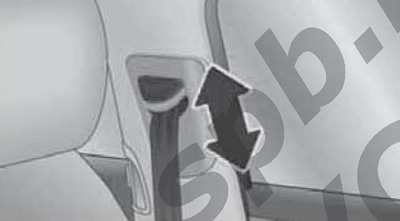
7.1 Adjusting the height of the front seat belt
Remember that the seat belt is most effective when the seat back is upright. Excessive seat back tilt increases the likelihood of the occupant sliding under the belt during an impact.
Seat belt reminders
Caution: Do not fool the electronics by fastening the seat belt behind your back or inserting a plug into the seat belt buckle, as this may result in additional injury caused by the electronics operating the air bags as if the driver and front passenger were wearing seat belts.
A buzzer and a corresponding indicator lamp in the instrument cluster serve as reminders that the front seat belts have not been fastened (see Section 13).
When the ignition is turned on, the seat belt warning light comes on for a few seconds to confirm that the system is working. If the seat belt warning light does not come on when the seat belts are fastened, remains on continuously, or comes on intermittently while driving, there is a fault in the seat belt warning system.
When the ignition is on, the K/L goes out only when the driver and front passenger (if available) fasten the seat belt. If the driver/front passenger does not fasten the seat belt at a speed of more than 20 km/h, the K/L starts to flash and a beep sounds. If the seat belt is not fastened within 90 seconds, the beep turns off and the K/L continues to light. If the seat belt is fastened and then unfastened again, the reminder will be repeated.
Note: If there is cargo on the front passenger seat, false warnings may be given, since the electronics determine whether the seat is occupied by the pressure on its cushion.
Rules for using seat belts
Warning: Do not attach any pads or other objects to the seat belt straps.
Slowly pull the belt out of the return device, place it over your shoulder and insert the belt buckle clip into the lock until it clicks. Pull the shoulder section strap upwards, checking that the clip is securely fixed in the lock. Make sure that the belt strap is not twisted; a twisted belt is dangerous in itself.
Lower the lap section of the belt as far as possible, placing it as low on the hips as possible. Pull the shoulder section of the belt to take up the slack and try to achieve a tight fit, tightening the belt as necessary. The strap should pass diagonally across the occupant's chest so that the impact load falls mainly on the strongest part of the upper torso.
The seat belt for the center rear seat is located in the back of the center rear seat. To fasten this belt, pull it out, insert the buckle at the end of the belt into the right buckle, and then fasten it like a normal belt, inserting the sliding buckle into the left buckle.
[Article reprinted from the website: www.SkodaBook.ru]
The driver, having fastened his seat belt, must ensure that all passengers are also properly fastened. One unfastened person in an accident can cause injuries not only to himself, but also to others, even if they are fastened.
To unfasten the belt, hold it by pressing the red button located on the lock body. When winding the belt with the retractor drum, hold it by the buckle. After leaving the car, make sure that the belt is not pinched by the door.
Recommendations for pregnant women
Ensuring the safety of a pregnant woman is the best way to preserve the fetus in the event of an accident, so when driving a car (as a driver or passenger) a pregnant woman must wear a seat belt, paying particular attention to the correct placement of the belt sections relative to her body.
When using diagonal waist belts, remember that the waist section of the belt should be positioned as low as possible on the hips and should never be on the stomach. The shoulder section should pass through the center of the chest and cover the stomach from above and from the side.
A pregnant woman should also take an upright position on the seat. In this case, the front seat should be moved as far away from the dashboard as possible, which will reduce the risk of injury and mutilation not only for the pregnant woman but also for the fetus in the event of an accident or deployment of the front airbag.
At each visit to your supervising physician, consult whether it is advisable for you to drive a car.