



Contents: Seats and headrests - general…⬇ Adjustment and heating of front seats ⬇ Memory for driver's seat and outside…⬇ Armrests ⬇ Rear seats ⬇
Note: Do not adjust the seats or steering column while the vehicle is moving. After adjusting the seat, rock it slightly to ensure that it is securely fastened.
Seats and headrests - general information
The design of the car seats guarantees maximum comfort for the person sitting in them, while simultaneously providing conditions for the most effective functioning of the belts and airbags. The choice of seat position also affects the safety of the person sitting in it. For example, if the front seat is moved too far forward, the risk of injury to the occupant when the airbag is deployed increases, as does the risk of being thrown through the windshield in a frontal collision. Increasing the angle of the seat back will worsen the fixation of the body by the seat belt - the more the back is tilted back, the higher the probability of the occupant's body slipping under the lap section of the belt in a strong frontal impact, and the more severe the injuries may be.
Secure the front seat in a position that is as far away from the steering wheel/dashboard as possible while still being comfortable for driving. The recommended distance from the chest to the front airbag cover is at least 25 cm. If there is a knee airbag, the distance from it to the driver's feet should be at least 10 cm. Bring the backrest to a position close to vertical; the slope should not be more than 30°.
Raised front edges of seat cushions prevent the occupant from slipping out from under the belt in a frontal collision.
Head restraints prevent injury to the cervical spine and head in the event of a rear impact. The head restraint should be adjusted in height so that its top point is level with the top edge of the occupant's head. The top point should not be lower than the occupant's eye level.
To raise the headrest, simply pull it up. To lower the headrest, press the lock (arrow in illustration 9.1) towards the headrest pillar and press the headrest into the backrest.
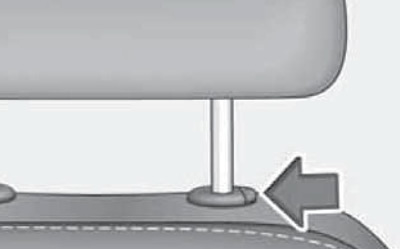
9.1 Headrest release button
To remove the headrest, first lift it to its maximum height, then press the lock (arrow in illustration 9.1) and pull the headrest out of the backrest. To install the headrest, press it into the backrest until it clicks.
The central rear head restraint has only two adjustment positions. To remove the central rear head restraint, pull it up as high as possible, press the lock (by analogy with illustration 9.1) towards the headrest pillar and at the same time (using a flat-head screwdriver no more than 5 mm wide) in the forward direction.
Adjustment and heating of front seats
Note: After changing the position of the seat, push it in the appropriate direction to ensure that it is securely locked.
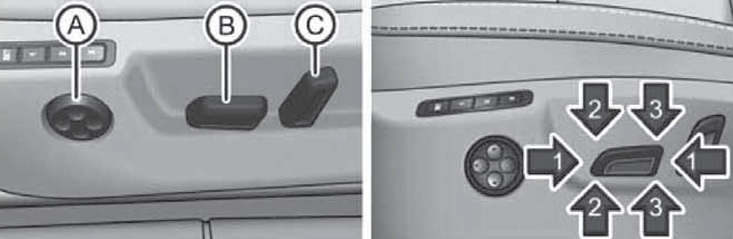
The front seats are equipped with a manual adjustment mechanism as standard (see illustration 9.2a). Some models are equipped with partially or fully electric seat adjustment (see illustration 9.2). The seat adjustment by means of the electric drive works both with the ignition on and off. If the battery charge is low, the electric drive may not work.
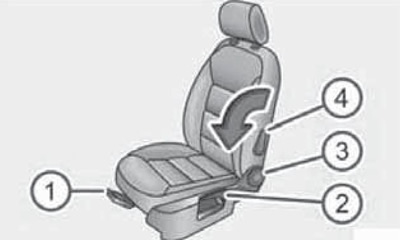
9.2a Driver's seat manual adjustment controls
1 Lever for releasing the seat adjustment lock in the forward-backward direction (pull up)
2 Seat height adjustment lever (pull up or down a few times)
3 Rotary handle for adjusting the backrest tilt (when adjusting, do not lean on the backrest)
4 Lumbar support adjustment handle (if available)
Note: If the seat accidentally stops moving while adjusting the seat position using the electric drive, press the switch again in the appropriate direction and perform the full travel of the adjustment.
To ensure the comfort of the driver and passengers, some trim levels feature heated front seats, and sometimes heated rear seats. The front seat heating is controlled using the buttons (9 and 11 in Illustration 12.1) in the climate control panel: the left one is for the left seat, and the right one is for the right seat. The rear seat heating is controlled by the corresponding buttons on the rear panel of the console between the front seats. The front seat heating has three intensity levels and only works when the ignition is on. If the maximum seat heating power is set, it automatically decreases to the 2nd level after 10 minutes. If the voltage in the vehicle's electrical system drops, the seat heating is automatically switched off to ensure sufficient electrical energy to control the engine. The heating power level can be judged by the number of indicators lit in the regulator.
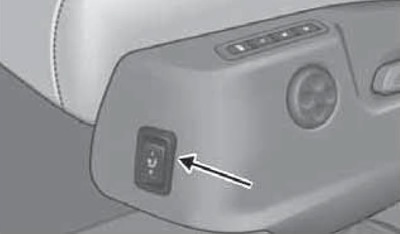
Some trim levels include front seat ventilation. Ventilation is switched on/off using a button on the front of the seat cushion (see illustration 9.2c). In position "1" the ventilation operates at low intensity, and in position "2" - at high intensity. To turn off the ventilation, move the key to the horizontal position.
9.2b Driver's seat adjustment controls with electric drive
A Adjusting the protrusion (front and back recesses) and heights (upper and lower recesses) lumbar support (if available)
In Seat Height Adjustment (move the whole switch up/down)
B1 Moving the seat forward and backward
B2/B3 Front/rear seat height adjustment
With Backrest Tilt Adjustment
To avoid discharging the battery, it is recommended to turn on the heating/ventilation when the engine is running. To save energy, the heating/ventilation should be turned off when not needed. It is not recommended to turn on the ventilation and seat heating at the same time.
Caution: Heated/ventilated seats should not be used by people with a low threshold for pain or heat.
Note: To avoid damaging the heating elements or the fan, do not kneel on the seats or apply other point loads to them, and do not allow the seats to get wet. Do not wet clean the seat. Do not turn on the heating when the air temperature in the passenger compartment exceeds 25°C.
[Data Copied from the portal: skodabook.ru]
Memory for driver's seat and outside mirrors
On models with electric seat adjustment, up to three seat/mirror positions can be stored in memory and then recalled using the buttons on the driver's seat or used automatically when unlocking the vehicle using a specific key fob (via the unlock button or via the "KESSY" system).
To memorize the current position of the driver's seat and outside mirrors, with the ignition on, press the "SET" button (And in illustration 9.3), and then within 10 seconds press the key of the corresponding memory cell (B), - successful entry into memory will be confirmed by a sound signal. If the selected memory cell is already occupied, it is replaced by the new settings.
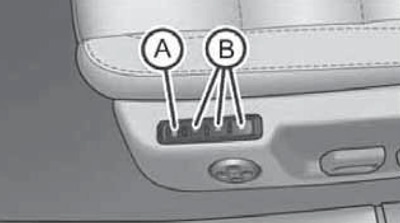
9.3 "SET" key (A) and memory cell keys (B)
Note: For safety reasons, it is not possible to store a position when the angle between the seat cushion and the seat back is more than 102°.
You can also memorize the position of the right outside rearview mirror, which will be automatically selected when reverse gear is engaged if the mirror control is in the "R" position (see relevant subsection below). To do this, switch on the ignition, set the outside mirror adjuster to the "R" position, engage reverse gear, adjust the right mirror and disengage the gear. The position of the mirror for reversing should be stored in memory each time new settings are made for the seat/mirror position. The right mirror, automatically set to the reversing position, returns to the normal position after disengaging reverse gear or at a speed of more than 15 km/h.
To apply the stored seat/mirror positions, briefly press the corresponding button (In Illustration 9.3) at a speed of no more than 5 km/h. To interrupt the movement of the seat/mirrors, press any button on the seat. To gradually move the seat/mirrors to a given position, hold down the corresponding button (B).
To assign the settings specified for the current memory cell to the remote control, remove the key from the ignition within 10 seconds after saving the settings and press the unlock button on the remote control. Successful assignment of the settings to this remote control is accompanied by a sound signal. To assign the settings specified for the current memory cell to the KESSY key fob, turn off the ignition within 10 seconds after saving the settings, open the driver's door and press the unlock button on the remote control within the next 10 seconds. Successful assignment of the settings to this remote control is accompanied by a sound signal and flashing direction indicators.
Note: If a memory cell has already been assigned to the remote control, it is replaced by the newly assigned cell. Also, if you assign a memory cell to the remote control that is already assigned to another remote control, the new assignment replaces the previous one.
To set the seat and mirrors to a desired position using the remote control, unlock the car with the remote control and open the driver's door.
Armrests
Note: It is not permitted to carry passengers on the center armrests.
The armrests are molded into the interior door trim. Additionally, there are central front (with appropriate equipment) and rear armrests.
The front central armrest with storage compartment can be adjusted in height and longitudinally (forward and backward). To open the storage compartment, simply pull the lid in the direction of the arrow (see illustration 9.4a). To close the storage compartment, fold the lid up as far as it will go, then lower it. To adjust the height of the armrest, slam the lid shut, then lift it to one of four positions. To adjust the length of the armrest, simply slide the storage compartment lid forward or backward.
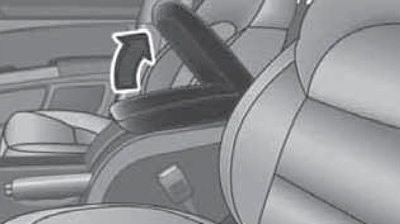
9.4a Front centre armrest with storage compartment
Note: To use the parking brake, the cover must be in the rearmost position.
In some trim levels, the glove compartment may be equipped with MDI and AUX-IN connectors (see Section 15).
The central rear armrest is formed by folding down the backrest of the central rear seat (see illustration 9.4b). There is a storage compartment in the armrest, to open it you need to press the upper button in the front part of the armrest and lift the lid. When you press the lower button in the front part of the armrest, two cup holders appear (see illustration 9.4c). To remove the cup holders, press them in the center and push them into the armrest until they stop. If the center rear seatback is left reclined for a long time, make sure that no seat belt buckles remain underneath it (to avoid deforming the back padding). When the armrest is lowered, a hatch is created for transporting long loads, such as skis (see Section 12).
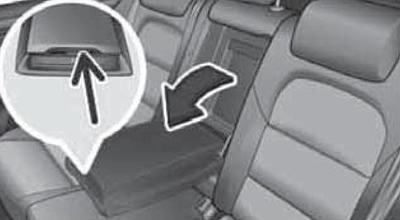
9.4b Rear centre armrest with storage compartment
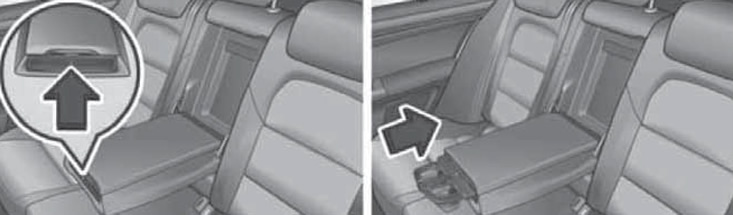
9.4c Cup holders in the rear center armrest
Rear seats
the 3-seater rear seat is divided into two parts in a 40:60 ratio. The backrest and/or cushion of each part can be folded separately to increase the volume of the luggage compartment.
Before folding the rear seat backrest, position the front seats so that they are not damaged. If the front seats are moved too far back, it is recommended to remove the rear head restraints first to obtain the flattest possible load surface. On Superb Combi models, the seat cushions should also be folded down first (see below). To fold the backrest, press the handle (And in illustration 9.5a) and fold the backrest forward. To return the backrest to its original position, place the outer rear seat belt (C) behind the edge of the side trim, and then pull the backrest up until the locking button clicks into place. Finally, make sure that the red mark (B) is completely hidden and also tug the backrest to make sure it is securely locked.
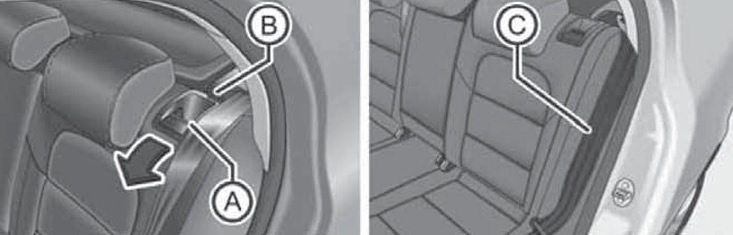
9.5a Folding the rear seat back
To fold the rear seat cushions forward (on Superb Combi models) lift it in the direction of the arrow (1 in illustration 9.5b) and pull forward (2).
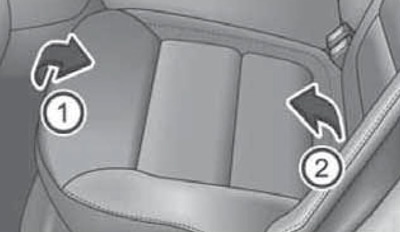
9.5b Folding the rear seat cushion (combi models only)
16.03.2025 01:03