



Placement of the vehicle identification number, placed on the cross wall in the engine compartment
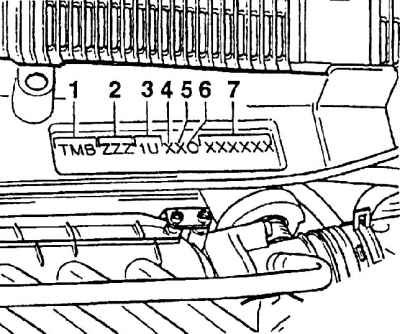
In Skoda cars, this designation began to be used by the manufacturer (today "SKODA - JSC Automobile Plant") since 1984.
The VIN number is placed on the cross wall of the body and, according to the unified international system, consists of seventeen characters (numbered from 1 to 7).
- the first part (3 characters) is the international manufacturer code (WMI): TMB = T - Europe, M
- Czech Republic, B – "ŠKODA - A.S. Automobile Plant";
- the second part (3 characters) - letters ZZZ (unoccupied designation);
- the third part (2 characters) - vehicle class: 1U = Skoda Octavia type;
- the fourth part (1 character) is the manufacturer's internal code;
- the fifth part (1 character) is the letter designation of the model year: T = 1996, V = 1997, W = 1998, X = 1999, Y = 2000;
- sixth part 1 character - digital designation of the manufacturer: Mlada Boleslav - from 0 to 4, Kvasiny - 5, Verkholabie - 7, Poznan - x;
- the seventh part (6 characters) is the serial production number of the vehicle.
The Skoda Octavia car, in addition to the VIN identification number, is also supplied with other identification numbers and information plates. The engine number and code are indicated on the engine block, and the gearbox number is indicated in a similar way (more detailed information is provided in the relevant chapters on engines and gearboxes).
There are two types of information plates. One is for familiarizing the driver of the vehicle with various important details related to operation. The other type of plates provides the exact specification of individual sub-assemblies and is necessary for the manufacture and installation of the vehicle; there is no need to be interested in this type of signs.
The content, meaning and placement of individual signs intended for drivers:
1. Homologation plate - contains a list of instructions (according to UNECC and EXO), which the car satisfies. (Cars intended for domestic use do not have it, those sent abroad are optional).
2. Sign "Ventilator" (fan) - warns that the radiator fan may start at any time and cause injury!
3. Sign "Pozor vysoke napeti" (Warning! High voltage!) - warns that the engine must be turned off before touching.
4. Sign "serizeni svetel" (headlight adjustments) - represents the headlight tilt in percent (%).
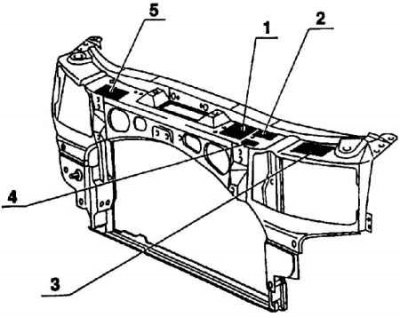
Plates 1–4 are located on the upper surface of the front wall of the body.
Plate 5 is placed on the plane of the front wall of the body if the vehicle is equipped with air conditioning.
5. Sign "klimatizace" (air conditioner) – informs about the refrigerant filler of the air conditioner.
6. Standard plate – contains data:
- manufacturer's name;
- approval number;
- vehicle identification number (VIN);
- maximum permissible mass of a loaded vehicle/technically permissible mass;
- maximum permissible mass of a loaded trailer, if the vehicle is adapted for this/technically permissible mass;
- maximum permissible front axle load mass/technically permissible mass;
- maximum permissible rear axle load mass/technically permissible mass.
Additional information may be provided outside the designated rectangle.
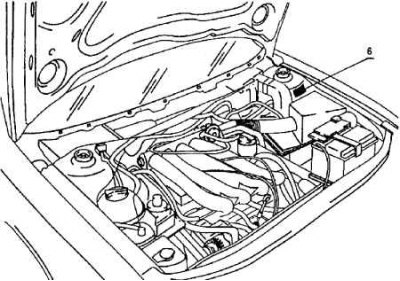
Plate 6 (standard) attached to the left casing of the front elastic unit.
7. Data plate – contains all the data necessary for identification, as well as information for vehicle repair, allowing the customer to accurately determine what the manufacturer equipped the vehicle with, and, consequently, what spare parts and what technology to use during repair. This data is the same as that provided on the inside of the SERVICE BOOK envelope.
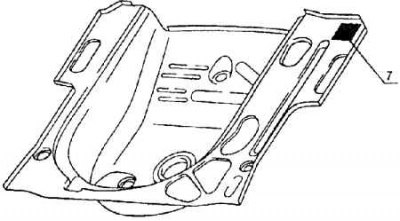
Plate 7 (with data) is located on the floor of the luggage compartment.
8. VIN plate – represents the VIN number.
9. Airbag sign (airbag) – means that the car is equipped with airbags.
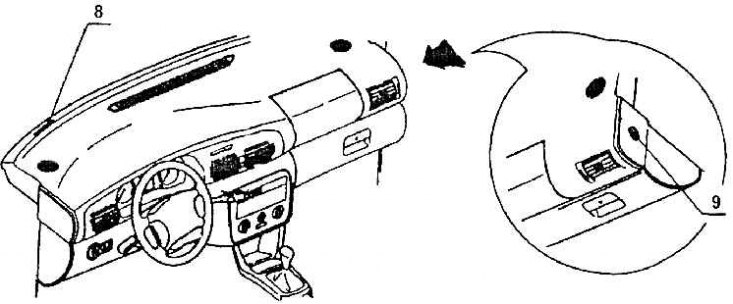
Plates 8 and 9 are pasted on the dashboard.
Image of individual plates
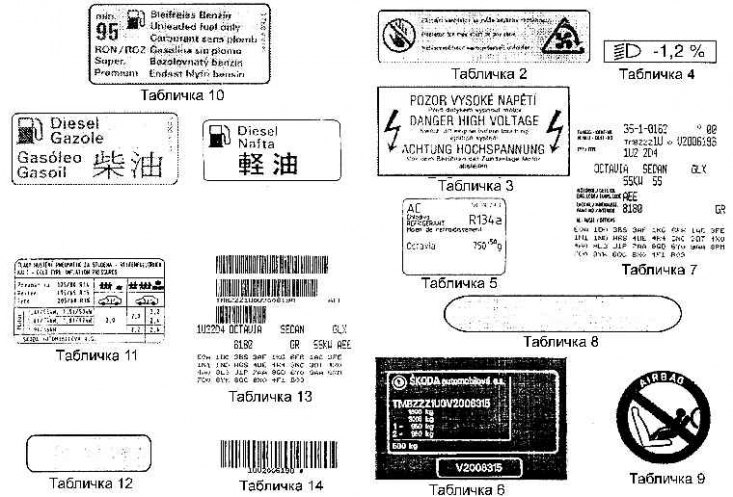
10. Fuel plate – contains information about the type of fuel that can be used (choice of three, see fig. Image of individual plates).
11. Recommended tire pressure plate – contains information on the internal pressure for different types of tires, different vehicle loads when using different engines in the vehicle.
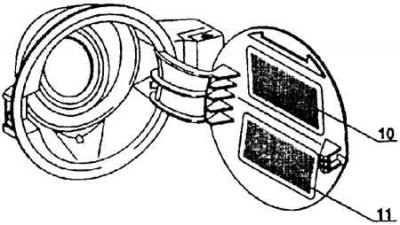
Plates 10 and 11 are glued to the inner surface of the fuel tank cap.
12. Immobilizer code plate – affixed to the keys by the vehicle manufacturer.
13. A plate pasted into the CAR SERVICE BOOK.
14. A plate attached to the middle pillar of the body to identify the body.