



Caution: Use of the tempostat during heavy traffic (for example, in the city), on slippery and winding roads, as well as in other road situations that may require changing speed, may lead to loss of control over the vehicle. The use of cruise control does not relieve the driver of the responsibility to maintain the speed and distance appropriate to each specific road situation.
The cruise control is an additional equipment and is designed to maintain a constant vehicle speed (not less than 30 km/h) without having to keep your foot on the accelerator pedal, unless the powertrain can provide it. The cruise control is controlled by the switches on the left steering column stalk (see illustration 16.1). The operation of the cruise control is indicated by the corresponding green K/L in the instrument cluster (see section 13).
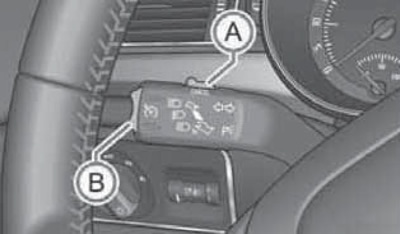
16.1 Temperature control switches on the left steering column switch
A Toggle switch "ON/CANCEL/OFF"
B End switch with "RES/+" and "SET/-" positions
To turn the temperature control on/off, move the toggle switch (And in illustration 16.1) to the "ON" or "OFF" position, respectively. After the cruise control is switched on, the supported speed value can be entered into its memory, the cruise control can be deactivated and reactivated. On models with DSG, the cruise control cannot be switched on when the selector lever is in the "P", "N" or "R" positions. When the cruise control is switched off, the K/L indicator in the instrument cluster goes out and the set speed is deleted from its memory.
To set the maintained driving speed, accelerate the vehicle to the desired speed (not less than 30 km/h) and press the lower side of the end key ("SET/-") - the corresponding K/L will light up in the instrument cluster. Now you can take your foot off the gas pedal.
Note: The cruise control automatically maintains engine torque at a level that ensures movement at a set speed. When driving downhill, the vehicle speed may exceed the set speed, since the cruise control is not connected to the braking system. In this case, press the brake pedal and, if necessary, shift to a lower gear. On models with manual transmission, when the cruise control is engaged, be sure to depress the clutch pedal before moving the gearshift lever to the neutral position. Otherwise, the maximum permissible engine speed may be exceeded.
With each subsequent short press on the top or bottom side of the end key (In Illustration 16.1) the vehicle speed, and with it the supported speed value, will increase or decrease by 1 km/h accordingly. To continuously change the set speed and vehicle speed, hold the key in the upper or lower position. If you release the end key at a speed of less than 30 km/h, the current speed is not stored in memory, and the memory is cleared.
To temporarily increase speed (for example, when overtaking) press the gas pedal; after releasing the gas pedal, the previously selected constant speed will be automatically set. If the current speed exceeded the set speed by more than 10 km/h for more than 5 minutes, the set speed will be erased from the memory.
To cancel maintaining the set speed, set the toggle switch (And in illustration 16.1) to the "CANCEL" position. - The K/L in the instrument cluster will go out, but the set speed will not be deleted from the memory. In addition, maintaining the set speed is automatically cancelled when the brake or clutch pedal is pressed, as well as at a speed of less than 20 km/h.
To return to the previously set maintained speed after canceling it, return the toggle switch (A) to the "ON" position or press the upper edge of the end switch (B). Returning to the maintained speed also occurs after releasing the brake or clutch pedal and then pressing the upper edge of the end switch.
View the original on the website skodabook