



The climate system is a system of heating and ventilation of air with the function of air cooling. The system "Climatronic" allows you to regulate the temperature separately for the driver and front passenger.
The climate control system is controlled by buttons and handles located on the panel in the central console (see illustrations 14.1a-b). If the car has a system "Climatronic" factory-fitted 4 audio/navigation system with graphic display, climate control system operation messages are briefly displayed on the audio/navigation system display. Temperature units and displayed information can be changed via the "Settings" menu of the display in the instrument cluster (see Section 13).
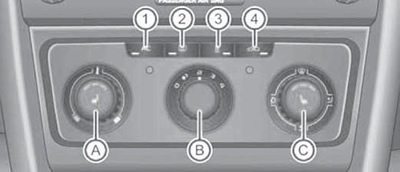
14.1a Climate control system "Climatic" (with manual control)
1 Switch "AC" of the refrigeration unit, with a built-in power indicator
2 Rear window heating switch, with built-in power indicator
3 Direct on/off button for additional heater, with built-in on indicator
4 Switch for recirculation/fresh air supply mode, with recirculation mode indicator
A Rotary temperature control with integrated driver's seat heating button (see Section 12)
B Rotary switch-fan speed controller
C Rotary switch for air supply modes, with integrated button for front passenger seat heating (see Section 12)
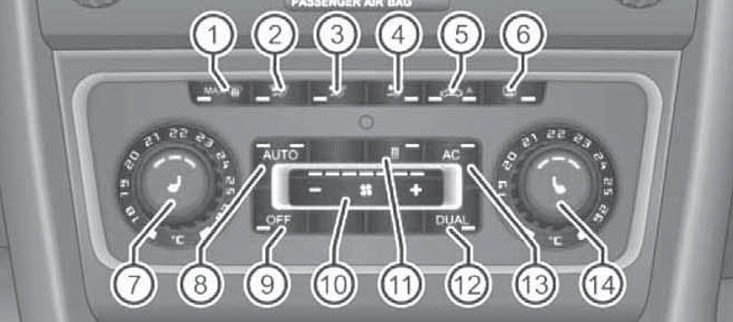
14.1b Controls for the Chmatronic climate control system
1 Switch for intensive removal of frost/moisture from the windshield, with built-in indicator light
2 Switch for air supply to the glass, with built-in indicator light
3 Chest-level air supply switch with built-in power indicator
4 Switch for air supply to the feet, with built-in power indicator
5 Manual selection switch for continuous/automatic circulation/fresh air supply mode, with circulation mode indicators
6 Rear window heating switch, with built-in power indicator
7 Rotary temperature control for the left side, with integrated driver's seat heating button (see Section 12)
8 Switch "AUTO" automatic mode, with intensity indicators
9 "OFF" key to turn off the system "Climatronic", with power-off indicators
10 Manual fan speed control key (7 steps), with step indicators
11 Button for electric windscreen heating or direct switching on/off of additional heater, with built-in switch indicator
12 Switch "DUAL" 2-zone system operation mode "Climatronic", with built-in power indicator
13 Forced on/off key "AC" of the refrigeration unit, with a built-in on indicator
14 Rotary temperature control for the right side, with integrated button for front passenger seat heating (see Section 12)
Air is sucked in by the fan through the windshield fairing grille and enters the cabin, passing through the cabin filter and, if the cooling function is on, through the evaporator (air cooling and dehumidification), and if the heater is on, through its radiator (air heating). Keep the windshield grille clear of snow, leaves and other debris, and replace the cabin filter periodically (see Chapter 1) to achieve maximum ventilation efficiency from the air conditioning system.
(View the original on the website SKODABOOK)
Note: The cabin filter prevents potentially harmful airborne particles from entering the passenger compartment (for example, pollen, road dust, industrial emissions). An activated carbon cabin filter additionally removes unpleasant odours. Air passing through the entire cabin exits through gaps in the luggage compartment trim and outlets behind the rear bumper trim.
To adjust the air flow intensity, use the fan speed controller (2 in Illustration 14.1a or 10 in Illustration 14.1b). The fan should not be turned off for a long time, because the climate control system will not work: fresh air will not enter the cabin, which will lead to rapid fatigue. To turn off the system "Climatronic" the "OFF" key is intended, and the "AUTO" key is used to turn on the automatic mode. The first time you press the "AUTO" key, the "AUTO High" mode is turned on (high fan speed, right indicator on key is on), and when pressed again, the "AUTO Low" mode is turned on (low fan speed, left indicator on key is on).
On models with a sunroof with built-in solar panels, when the light level is high enough after the ignition is turned off with the sunroof closed, the supply ventilation automatically switches to solar power mode.
On models with the system "Climatronic" in automatic control mode (left or right indicator in the "AUTO" key is lit), it is enough to set the required temperature, and the climate control system will set it and maintain it, automatically adjusting the intensity and direction of air supply, as well as turning on/off the refrigeration unit. The most comfortable temperature is considered to be 22°C. When manually adjusting the direction of air supply or fan speed, the corresponding function stops being adjusted automatically until the automatic mode is turned on again.
The main air supply directions are selected using a rotary switch (In illustration 14.1a) or keys (1-4 in Illustration 14.1b):
 or
or  - air is directed to the windshield (to remove frost or condensation). In this mode, on models with the "Climatic" system, the refrigeration unit automatically turns on, no air is supplied to the feet, and the air circulation is automatically turned off (if it was turned on; after automatic shutdown, you can turn on circulation manually).
 - function for intensive removal of frost/condensation from the windshield, available only on models with the system "Climatronic". The air is directed towards the windshield.
 - air is directed to the windshield and to the feet, on models with the system "Climatronic" absent.
 - air is directed at chest level (through adjustable deflectors).
 - the air is directed to the feet.
The rotary switch can be set to intermediate positions, and the keys can be pressed in various combinations.
Deflectors are designed to create a certain direction of air flows. In the upper part of the instrument panel there are non-adjustable deflectors for blowing the windshield and side windows (1 in illustration 14.2a). From under the lower part of the instrument panel, air is supplied to the foot wells (4). In the front part of the instrument panel there are adjustable deflectors for air supply at the chest level of the driver and front passenger: two central (3) and two side (2). To adjust the direction of air supply from these deflectors, use the handle on the grille of the corresponding deflector (it can be rotated up/down and left/right), and to adjust the intensity of air flow from these deflectors, use the regulator next to the corresponding deflector. The side adjustable deflectors can be used to blow air onto the front side windows. Air is supplied to the rear footwells through deflectors located under the front seats (6in illustration 14.2b). At the rear of the B-pillar trim there are deflectors for rear passengers (5), adjustable in the same way as the front adjustable deflectors.
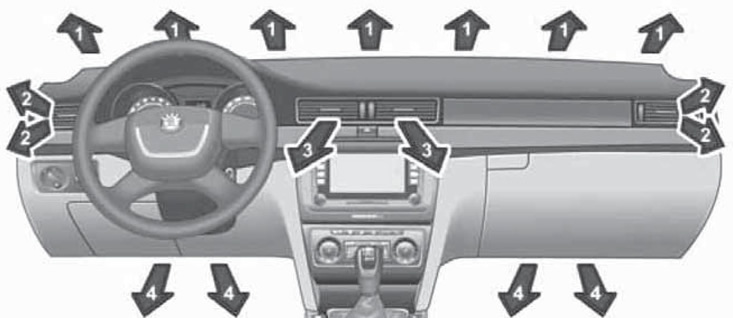
14.2a Direction of air flow from instrument panel vents
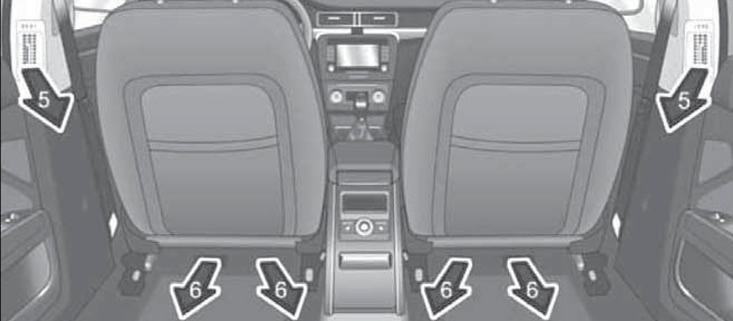
14.2b Direction of air flow from the vents in the rear of the passenger compartment
A rotary knob is used to adjust the temperature (And in illustrations 14.1a, or 7 and 14 in illustration 14.1b). On models with the "Climatic" system, the temperature values are not indicated on the regulator scale, and the set temperature is not maintained. On all models, the extreme left position (blue indicator) corresponds to the maximum cooling capacity, and the extreme right position (red indicator) corresponds to the maximum heating power; in both cases, a certain temperature value is not maintained. On models with the system "Climatronic" it is possible to set a specific temperature value from 18°C to 26°C separately for the driver and front passenger. If the indicator in the "DUAL" button is not lit, the temperature set for the driver's zone (left regulator), automatic devices are also installed for the front passenger area. For separate temperature control, press the "DUAL" button and turn the right temperature control to the desired position.
Note: The cabin air temperature sensor is located under the top row of climate control buttons. In the system "Climatronic" in addition, a sun sensor is used, located on the top of the instrument panel, in front of the windshield. When setting the cabin temperature to a temperature significantly different from the outside air temperature, sensitive people may catch a cold.
The intensity of heating depends on the temperature of the engine coolant, so the first minutes after starting the engine, the heating may not provide the necessary heating of the cabin. If necessary, to increase the heating power, you can turn on the independent heater with the key
 (if available, see subsection below).
For maximum efficiency in heating the interior, direct warm air to foot level (in wet weather, it is also necessary to provide additional air supply to the glass), and for maximum cooling, set the cold air supply at face level; in both cases, it is recommended to use the maximum air flow rate. It is recommended to keep the windows and doors closed so that the air heated or cooled by the climate system does not mix with the outside air. It is recommended to open all the windows for a while only during the first minutes of using a car that has been parked in the sun for a long time, in order to vent the hot air from the interior.
The electric heating of the rear and windshield is switched on and off using the buttons "
 " and "
 " only when the engine is running. During the heating operation (the indicator in the key is on) consumes significant power, so to save fuel it should be switched off as soon as the desired result is achieved. 10 minutes after switching on, the heating switches off automatically. In the event of a voltage drop in the vehicle's electrical system, the heating automatically switches off in order to ensure sufficient electricity to control the engine.
All versions have the ability to switch between circulation mode (outside air is not supplied to the cabin) and supply ventilation mode (outside air enters the cabin). To switch between the specified modes, use the key
 The illuminated indicator in the key indicates operation in circulation mode. On models with the system "Climatronic" additionally, there is an automatic circulation control mode that operates based on the air quality sensor: when the " key is pressed
 A" when the left indicator is on, the constant circulation mode is in operation, and when the right indicator is on, the automatic circulation control mode is in operation. The automatic mode only works when the outside air temperature is at least 2°C. You can also use the "AUTO" button to turn off the circulation mode.
The recirculation mode should be used when driving on dusty roads or in heavy traffic to prevent dust, unpleasant odors, and exhaust gases from entering the passenger compartment. In addition, the recirculation mode allows you to significantly speed up the reduction of the temperature in the passenger compartment when using the air cooling function. However, you should not turn on the air recirculation mode for a long time, since this will make the air in the car stale and condensation will appear on the windows. Under normal conditions, it is recommended to always turn on the fan and select the supply ventilation mode. For safety reasons, when some air distribution modes are turned on, the supply ventilation mode is automatically turned on.
The air cooling function only operates when the engine is running and the fan is on, when the outside air temperature is above +2°C. The "AC" button with a built-in indicator is used to turn on the refrigeration unit. The indicator in the "AC" button of the "Climatic" system lights up even if not all the conditions for turning on the refrigeration unit are met, indicating readiness to turn on. In automatic mode, the system "Climatronic", the refrigeration unit switches on/off automatically, cooling the air to the set temperature. In addition, it can automatically switch off when the coolant temperature is too high to reduce the load on the engine. When the air cooling function is on, the air entering the passenger compartment is cooled and dehumidified. This speeds up the removal of condensation from the glass when the air humidity is high. To get the maximum efficiency from the air cooling function, close the windows and doors when using it.
Note: The moisture taken from the air during its cooling condenses and drains out through the drain hose, so it is normal for a puddle to form under the car after it is parked with the air cooling function turned on. The operating compressor of the air conditioning system consumes engine energy, which leads to an increase in fuel consumption - turn off the air cooling function if it is not needed.
Note: Do not smoke in a car with a refrigeration unit when the circulation mode is on, as the tobacco smoke particles that settle on the evaporator of the refrigeration unit and on the cabin filter will spread their smell for a very long time. In addition, to prevent the appearance of an unpleasant smell from deposits on the evaporator, the refrigeration unit should be turned on monthly for at least 5 minutes.