



Depending on the engine model and manual transmission, either a Sachs or a LuK clutch is installed. The model of the installed clutch can be determined through the holes in the lower part of the engine-transmission connection. A smooth, rounded surface of the clutch basket edge indicates a Sachs clutch, and the presence of a seam on it or a straight surface of the clutch basket edge indicates a LuK clutch.
The clutch consists of a pressure plate and a driven plate (see illustration 7.1), as well as a hydraulic drive with the main and slave cylinders (see illustrations 7.2ad). Models with the "LuK" clutch are equipped with a self-adjusting clutch pressure plate. Replacing the pressure and driven disks separately is not permitted.
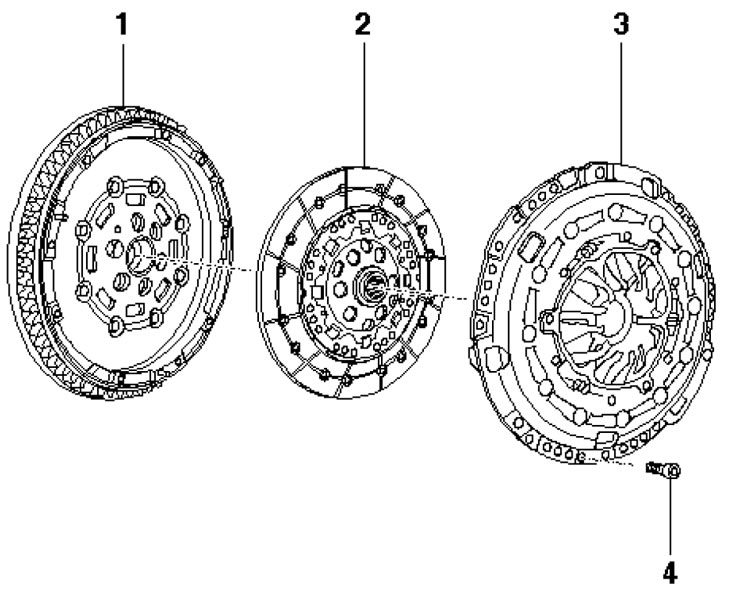
7.1 Clutch basket components "LuK" ("Sachs" - similarly) 1. 2-mass flywheel, the contact surface with the clutch must be free of grooves and grease; 2. Slave disk; 3. Pressure disc; 4. Bolt, M6 - 13 Nm, M7 - 20 Nm
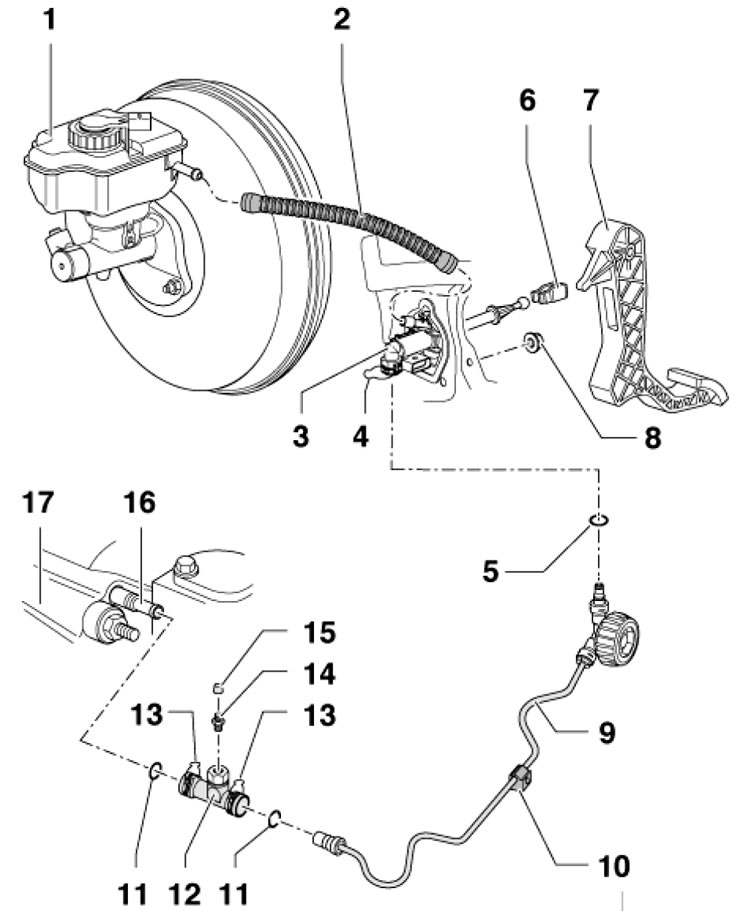
7.2a. External parts of the hydraulic clutch drive of the manual transmission "02Q" 1. Brake fluid reservoir; 2. Plastic tube; 3. Master cylinder; 4. Tube retainer 2; 5, 11. Sealing ring; 6. Support; 7. Clutch pedal; 8. Nuts for fastening the bracket to the bulkhead, 3 pcs., 20 Nm; 9. Plastic tube; 10. Tube support 9; 12. Connection for nipple 14; 13. Tube/connection retainer 12; 14. Bleed nipple; 15. Cap; 16. Slave cylinder; 17. Manual transmission
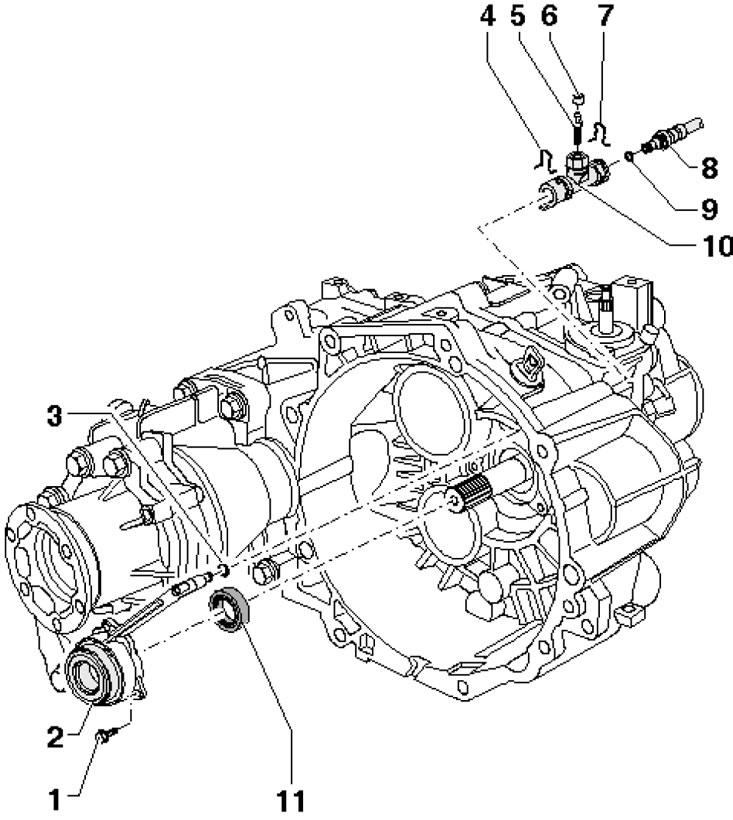
7.2b. Clutch hydraulic drive parts inside the gearbox housing "02Q" 1. Cylinder mounting bolts 2, 3 pcs., subject to replacement, 12 Nm (for metal cylinder, without fixing sealant) or 15 Nm (for plastic cylinder, with fixing sealant); 2. Slave cylinder with release bearing, cannot be replaced separately; do not wash the bearing, just wipe it; 3, 9. Sealing ring; 4. Connection retainer 10; 5. Bleed nipple; 6. Cap; 7. Tube retainer 8; 8. Plastic tube; 10. Connection for nipple 5; 11. Input shaft seal of the manual transmission
Data taken from an online portal: skodabook.ru
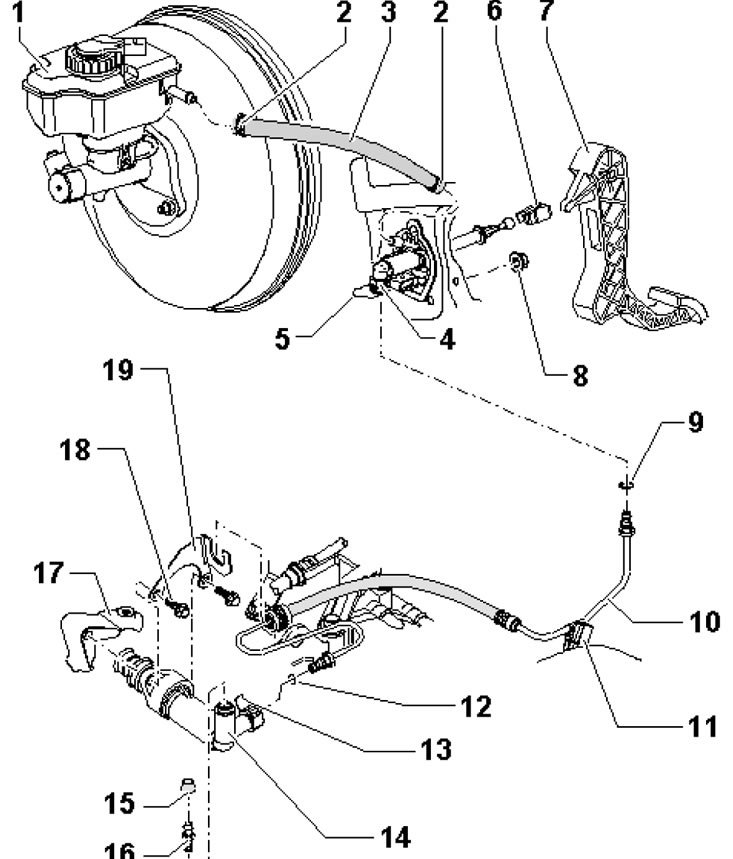
7.2 p. External parts of the hydraulic clutch drive of the RKPP "OAJ" 1. Brake fluid reservoir; 2. Clamp, not on all models; 3. Plastic tube or rubber hose, to tank 1; 4. Master cylinder; 5, 13. Tube retainer 10; 6. Support; 7. Clutch pedal; 8. Self-locking nuts for fastening the bracket to the bulkhead, 3 pcs., 20 Nm; 9, 12. Sealing ring; 10. Tube; 11. Tube support 10; 14. Slave cylinder; 15. Cap; 16. Bleed nipple; 17. Manual transmission; 18. Bolt, 20 Nm; 19. Support
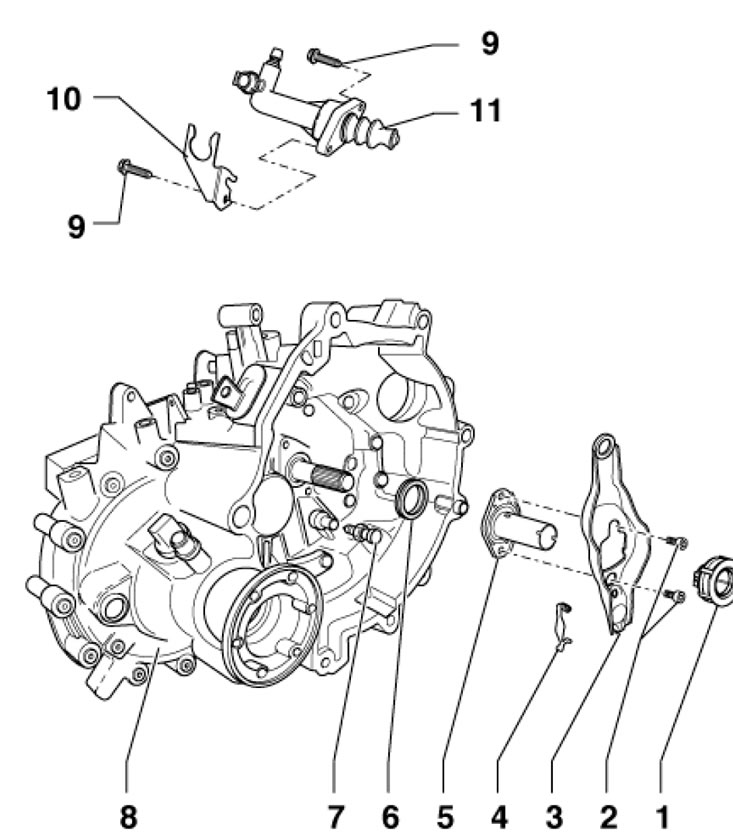
7.2 d. Details of the hydraulic clutch drive inside the crankcase of the RKPP "OAJ" 1. Release bearing, replaced together with parts 3 and 5, do not rinse, only wipe; 2. Bolt, subject to replacement, 5 Nm, then tighten to an angle of 90°; 3. Release lever, replaced together with parts 1 and 5; 4. Retaining spring; 5. Bearing guide sleeve 1, replaced together with parts 1 and 3; 6. Input shaft seal of the manual transmission; 7. Hinge pin, 20 Nm; 8. Manual transmission; 9. Bolt, 20 Nm; 10. Support; 11. Slave cylinder
The pressure plate is bolted to the flywheel, which is connected to the engine crankshaft. Between the pressure plate and the flywheel there is a driven disk, which is pressed against the flywheel by the release bearing of the slave cylinder. The driven disk is connected to the primary shaft of the manual transmission via a splined connection.
When the clutch pedal is depressed, brake fluid from the common reservoir is transferred under pressure through the clutch master cylinder to the slave cylinder. The slave cylinder acts on the pressure plate via the clutch release lever and release bearing. In this case, the driven disk is moved away from the flywheel and the power connection between the engine and the manual transmission is interrupted. When released, the pressure spring presses the bearing against the diaphragm spring of the pressure plate. This reduces wear on the clutch release bearing, since it does not accelerate to the engine speed when engaged. No clutch drive adjustment is required.
Each time the clutch is engaged and disengaged, the friction linings of the driven disk wear out as a result of the force applied. The driven disk is a wearing part, but its average service life is quite long and depends mainly on the engine load and driving style.