



Note: If components with rubber bushings have been replaced or the bolts/nuts of these components have been loosened, the suspension must be in the unloaded position before tightening the fasteners.
1. Rubber bushings can only be rotated to a limited extent. Therefore, before tightening the fasteners, the suspension parts with rubber bushings must be brought to a position corresponding to the normal position of an unloaded vehicle when driving. Otherwise, the bushings are subject to twisting and their service life is reduced. The unloaded position with the vehicle raised is achieved by lifting the corresponding suspension with a transmission jack.
2. Before starting work with the vehicle unloaded, measure and record the distance (and in the illustration) from the center of the wheel to the top edge of the wheel arch.
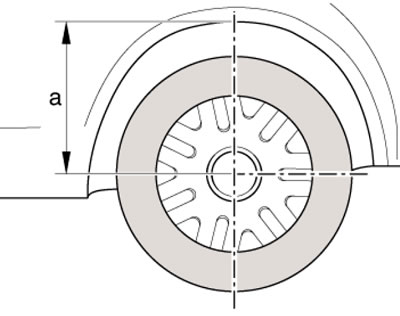
2.2. Distance from the wheel center to the upper edge of the wheel arch
Note: An unloaded vehicle is a vehicle with a full volume of working fluids and on-board tools and a spare wheel in place, without a driver, passengers or cargo.
3. Before lifting the suspension parts, secure the car to the lift legs with straps to prevent the car from slipping (see illustration).
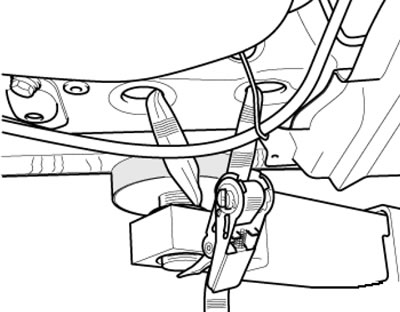
2.3. Fastening the rear suspension to the lift paw
4. Remove the wheel, turn the wheel hub so that one of the holes for the wheel bolts is at the top, and use the wheel bolt to connect the T10149 transmission jack support to the hub (see illustration).
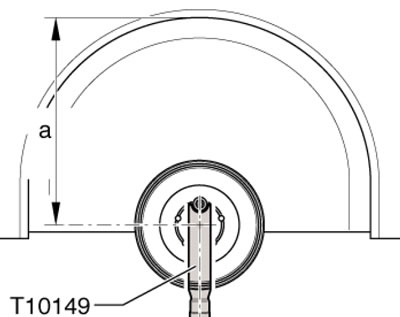
2.4. Unloaded position with the vehicle raised
5. Lift the hub holder (front suspension knuckle or rear suspension arm) on the transmission jack so that the distance (and in illustration 2.4) corresponded to the distance (and in illustration 2.2).
Note: The distance (a) corresponding to different suspension options is also indicated in Specifications. In this way, an unloaded position of the suspension is achieved. Tighten the necessary fasteners, lower the hub holder, remove the T10149 support and remove the jack.