
Company vehicles Hyundai Company vehicles Kia Company vehicles Lada Company vehicles Mazda Company vehicles Mercedes-Benz Company vehicles Opel Company vehicles Mitsubishi
English Русский
Български
Беларускі
Український
Српски
Hrvatski
Română
Polski
Slovenský
Magyar
Articles   
Bookmark Contacts Sitemap
SkodaBook.ru


Fabia Rapid Octavia Superb Kodiaq Yeti Others
Yeti (2009-2017)

Checking the engine with a vacuum gauge (Skoda Yeti 5L)

  • Main
  • Yeti
  • 5L (2009-2017)
  • Power unit
  • Petrol engine 1.2 l
  • Checking the engine with a vacuum gauge
0
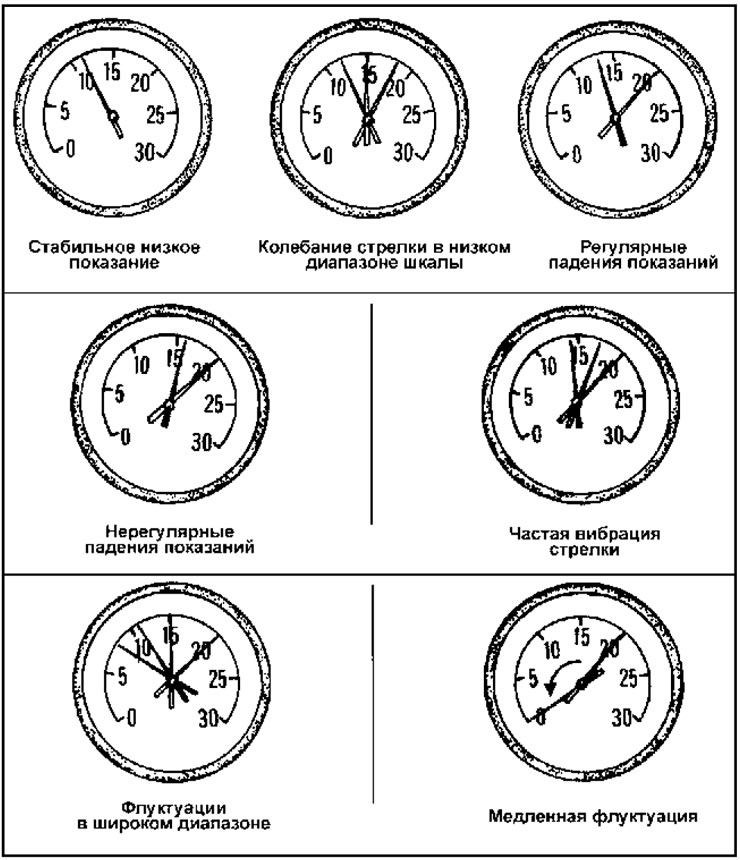
1. Using a vacuum gauge, you can get information about the condition of the engine and determine if the cylinder head gasket is blown, the fuel system, piston rings or valves are damaged, the fuel injection system is incorrectly adjusted, etc. Unfortunately, vacuum gauge readings can be misinterpreted, so these measurements should be used in combination with other engine testing methods. For correct determination, both the absolute value of the vacuum gauge readings and the rate of their change are important (see illustration).

1. Using a vacuum gauge, you can get information…

3.1. Vacuum gauge readings options for engine fault diagnostics

2. Connect a vacuum gauge to the intake manifold. Start and warm up the engine to normal operating temperature.

3. Read the vacuum gauge readings.

If the engine is in normal condition, the vacuum gauge readings should be constant and be 430÷560 mm Hg.

Low constant vacuum readings indicate a damaged gasket between the intake manifold and the throttle body, a damaged vacuum hose, incorrectly set ignition timing, or incorrectly set valve timing.

If the vacuum gauge readings are 80÷200 mm Hg below the norm and fluctuate, then the intake manifold gasket near the inlet may be damaged or the injector may be faulty.


If the readings constantly drop by 50÷100 mmHg relative to the stable value, then the valves may be damaged. In this case, you should measure the compression in the engine cylinders (see Section 2).

(Information published on the website: Skodabook.ru)

If the readings drop, but not regularly, then the valve may be stuck or there is an ignition failure.

If the readings fluctuate rapidly with an amplitude of about 100 mmHg at constant idle speed and smoke comes out of the exhaust pipe, the valve guides may be damaged.

If the reading fluctuates rapidly as the idle speed increases, the intake manifold gasket or cylinder head gasket may be damaged, the valve springs may be weak, the valves may be burnt, or the ignition may be malfunctioning.

Small fluctuations of about 25 mm Hg are usually associated with problems in the ignition system.

If the readings fluctuate greatly, the cylinder head gasket or cylinder may be damaged.

If the needle moves slowly over a wide range of values, the crankcase ventilation system may be clogged, the intake manifold gasket or the gasket between the throttle body and the manifold may be damaged.

4. Check how quickly the vacuum gauge readings are restored after a sharp and full opening of the throttle valve and its return to its original position. If the engine is in normal condition, the readings drop to almost zero, then rise to about 130 mmHg above normal and drop again to the previous values at constant idle speed. If the readings recover slowly and go through the maximum after the throttle valve is closed, then the piston rings may be damaged. If there is a long delay, the exhaust system may be clogged.
This article is available at russian, bulgarian, belarusian, ukrainian, serbian, croatian, romanian, polish, slovak, hungarian
Article verified: Timur Komissarov
Share with friends:
◀ Previous
Skoda Yeti: Petrol engine 1.2 l
Next ►

Checking the compression pressure
General information and preparatory operations
Engine — Specifications
Checking engine oil pressure and the corresponding sensor
Removal and installation of the engine and its supports
Removal and installation the accessory drive belt and auxiliary brackets
Removal and installation timing belt covers
Replacing crankshaft seals, removing and installing flywheel and…
Read similar articles on other Skoda models

➧ Checking the glow plugs of a 1.9L, 47 kW diesel engine Skoda Fabia 1 (1999-2007)
➧ Checking the engine oil level Skoda Rapid 1 (2012-2022)
➧ Vacuum System — Checking the Check Valve Skoda Octavia 3 (2013-2019)
➧ Checking the engine with a vacuum gauge Skoda Superb 2 (2008-2015)
➧ Checking the causes of diesel engine malfunctions Skoda Kodiaq 1 (2016-2024)
➧ Checking the engine oil level Skoda Favorit (1987-1994)
Link to this article in various formats
Reviews and comments of visitors
No comments yet


Add two numbers: 25 + 37


Yeti (2009-2017) 
  • General information
  • Introduction to manual
  • Controls and instruments
  • Maintenance
  • Power unit
  • Petrol engine 1.2 l
  • Petrol engine 1.4 l
  • Petrol engine 1.8 l
  • Diesel engine 2.0 l
  • Cooling system
  • Power and control system
  • Exhaust system
  • Ignition and preheating systems
  • Starting and charging system
  • Transmission
  • Clutch
  • Manual gearbox
  • 7-speed gearbox DSG «0AM»
  • 6-speed gearbox DSG «02E»
  • Drive shafts
  • Chassis (running gear)
  • Brake system
  • Front suspension
  • Rear suspension
  • Steering
  • Body and interior
  • Heating and air conditioning
  • Exterior (external elements)
  • Interior (internal elements)
  • Electrical equipment
  • Equipment and devices
  • Lighting and signaling
  • Electrical diagrams
SkodaBook.ru © 2018–2026 | Mobile version | Articles on Skoda | Sitemap EN BG BY UA RS HR RO PL SK HU | Feedback | Site search | Bookmark
Fabia 1 (1999-2007) | Fabia 2 (2007-2014) | Rapid 1 (2012-2022) | Octavia 1 (1996-2004) | Octavia 3 (2013-2019) | Superb 2 (2008-2015) | Kodiaq 1 (2016-2024) | Yeti (2009-2017) | Favorit (1987-1994) | Felicia (1994-2001) |
By continuing to use the site, you agree to the use of cookies.