



Installing the master cylinder on a vehicle
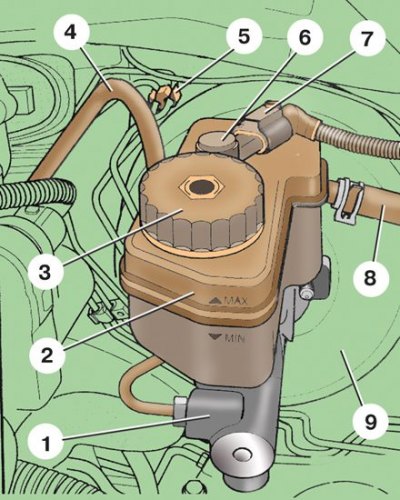
1 – master cylinder; 2 – tank; 3 – tank cap; 4 – vacuum hose; 5 – holder; 6 – brake fluid level sensor; 7 – connecting block; 8 – clutch hydraulic master cylinder hose; 9 – vacuum booster
Attention! The master brake cylinder cannot be repaired; if it malfunctions, it must be replaced as a complete unit.
Caution! After removing the master cylinder, the O-ring and self-locking nuts securing the master cylinder must be replaced with new ones.
Examination
A faulty master cylinder can be identified by traces of brake fluid leaking from it. A more thorough check can be carried out at a service station using special devices and instruments.
Removal
1. Remove the upper engine cover (see subsection 2.1).
2. Remove the air filter (see subsection 4.1).
3. Disconnect the wire from the "-" terminal of the battery. On some cars (large battery) remove the battery and bracket to gain easy access to the master cylinder.
4. Disconnect connector 7 (see the figure Installing the master cylinder on a vehicle) from brake fluid level sensor 6.
5. Open cap 3 of reservoir 2 and remove as much brake fluid as possible using a rubber bulb. Place 1 rag under the master cylinder to prevent brake fluid from getting on the car parts.
[Text taken from this website www.SkodaBook.ru]
6. Remove vacuum hose 4 from the holder on reservoir 2 of the master cylinder.
7. Loosen the spring clamp and disconnect the hose 8 of the clutch master cylinder from the nipple of the brake master cylinder reservoir.
8. Remove the brake pipes coming from the master cylinder from the holder 5.
9. Loosen the mounting nuts and disconnect both brake pipes from the master cylinder. Plug the tube openings.
10. Unscrew two nuts 3 (see figure Vacuum booster with master cylinder) fastening the master cylinder 1 to the vacuum booster 10.
11. Remove master cylinder 1 from the studs.
12. Turn the master cylinder upside down, place it on a container with the reservoir neck down and allow the remaining brake fluid to drain.
13. To remove the reservoir from the master cylinder, remove pin 2 and then carefully pull reservoir 11 upwards to remove the reservoir pipes from the sealing bushings 13. Replace bushings 13 that are torn or have lost elasticity.
Installation
1. Install the master cylinder in reverse order, replacing the sealing ring 4 (see figure Vacuum booster with master cylinder) regardless of its condition.
2. It is also necessary to replace the self-locking nuts 3 with new ones.
3. Before installing the reservoir, lubricate the sealing bushings 13 with brake fluid.
4. After installing the master cylinder, add fluid to the reservoir and bleed the brake system (see subsection 9.9.6).
Tightening torques, Nm
| Brake master cylinder mounting nuts | 20 |
| Brake pipe mounting nuts | 14 |