



Disconnecting the parking brake cable
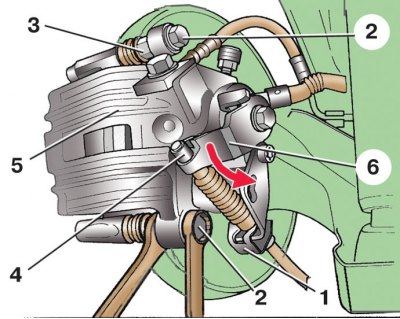
1 – spring clip; 2 – bolt; 3 – guide pin; 4 – parking brake cable; 5 – support; 6 – manual drive lever
Rear wheel disc brake mechanism parts
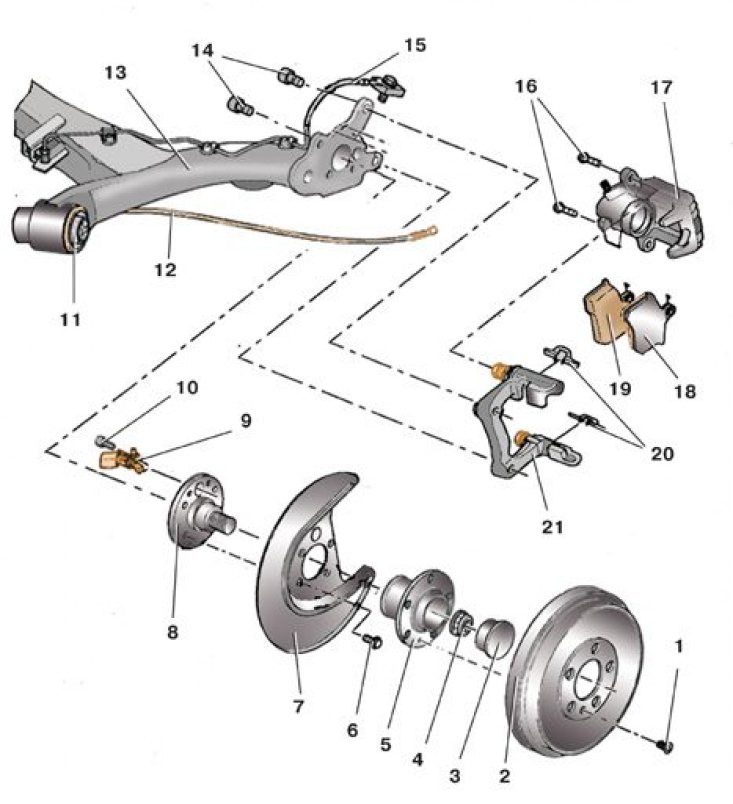
1 – screw; 2 – brake disc; 3 – protective cap; 4 – hub nut; 5 – hub; 6 – brake shield mounting bolt; 7 – brake shield; 8 – axle journal; 9 – wheel speed sensor; 10 – sensor mounting bolt; 11 – rubber-metal support; 12 – parking brake cable; 13 – rear suspension beam; 14 – brake shoe guide mounting bolts; 15 – brake hose; 16 – caliper mounting bolts; 17 – support; 18 – outer brake shoe; 19 – inner brake shoe; 20 – spring retainer; 21 – brake shoe guide
Installing brake pads
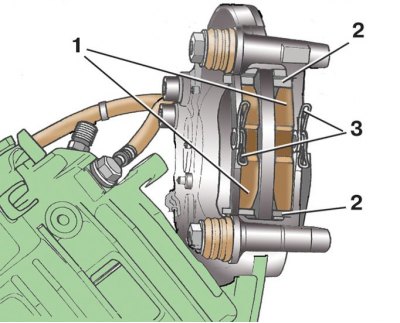
1 – brake pads; 2 – spring retainer; 3 – pressure springs
Replace brake pads in the following cases:
- the thickness of the friction lining is less than the permissible value;
- the surface of the linings is oily;
- the pads are not firmly connected to the base;
- there are deep grooves and chips on the overlays.
Caution! Brake pad sets must be replaced on both sides of the front suspension at the same time.
Caution: Do not use gasoline, diesel fuel, or any other mineral solvents to clean brakes.
1. Remove the wheel, having first loosened its mounting bolts, with the vehicle standing on the ground.
2. Using a screwdriver, remove the spring clip 1 (see figure Disconnecting the parking brake cable).
3. By pressing the lever 6 of the hand drive in the direction indicated by the arrow, disconnect the cable 4 of the parking brake drive from it.
4. Unscrew the two bolts 2 securing the caliper, holding the guide pins 3 by the hexagons with the second key.
5. Remove caliper 17 (see the figure Rear wheel disc brake mechanism parts) with the guide 21 of the pads, without disconnecting the brake hose 15 from it. Hang the caliper on the wire to the suspension spring, making sure that the brake hose is not stretched, twisted or strongly bent.
6. Remove brake pads 18 and 19 from caliper 17.
7. Remove some of the brake fluid from the master cylinder reservoir using a rubber bulb.
8. Clean the caliper. Using a wire brush, carefully clean away any rust from the areas where the brake pads are installed, and check that the pads move freely in the caliper.
9. Screw the piston into the cylinder using a special tool. If you don't have a tool, you can do this using, for example, snap ring pliers.
10. Install new brake pads 1 (see figure Installing brake pads) with new spring clamps 2. Pressure springs 3 must be parallel to the upper edge of the shoe.
11. Remove the protective film from the back surface of the brake pads.
12. Install caliper 17 (see the figure Rear wheel disc brake mechanism parts) into place and secure it with new bolts 16 (bolts are included with new pads).
13. Connect to lever 6 (see figure Disconnecting the parking brake cable) hand drive cable 4 parking brake drive.
14. Install spring clip 1.
15. Adjust the parking brake and install the wheel. Only fully tighten the wheel bolts with the vehicle on the ground.
| Nominal thickness of friction lining (with a base), mm | 16,9 |
| Minimum permissible friction lining thickness (with base/without base), mm | 7,6/2,0 |