



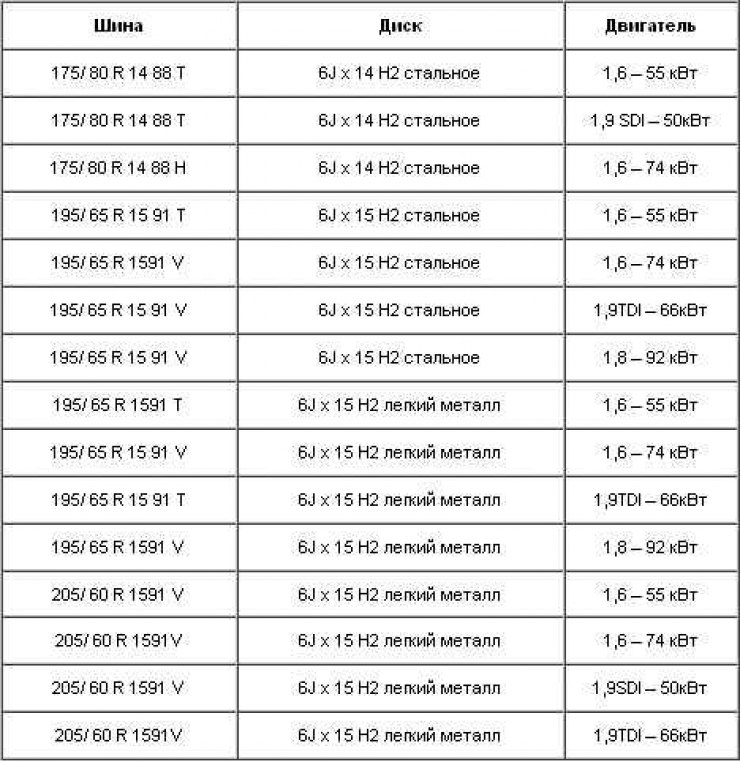
Tire applicability up to speed, km/h

Meaning of tire designation
175/ 80 R 14 88 H, where 175 = tyre width, the number 80 under the line represents the ratio of the tyre height to its width in percent. R = radial tyre construction; 14 = rim diameter in inches; 88 = symbol for load capacity (560 kg), and H = tyre suitability up to speed (210 km/h).
Each manufacturer designates the type of relief with its own symbols. TWI tire designation (Treadwear indicator) indicates the permissible amount of relief wear (1.6 mm).
Load index

The tire inflation pressure is indicated on the sticker on the inside of the fuel filler cap.
To extend the life of your tires, here are some recommendations:
- tyres older than six years may only be used when necessary and with appropriate careful driving;
- protect from exposure to chemical reagents aggressive to rubber (gasoline, oil, grease, brake fluid, coolant, solvent, etc.);
- protect from solar ultraviolet radiation (for example, during prolonged parking);
- protect against mechanical damage that may occur as a result of hitting a curb, driving over sharp stones, overloading the vehicle, sudden acceleration or heavy braking, or driving too fast on turns;
- tires are damaged due to incorrect wheel alignment (geometry), under-inflation or, conversely, over-inflation;
- wheels that are not dynamically balanced should not be used.
RADIAL STEEL Tires (radial construction with steel cushion layer) are particularly sensitive to incorrect inflation and geometry. When driving on flat tires, the carcass and the edge of the cushion layer belt often separate. When there are cuts and cracks in the tread layer, water penetrates to the steel cushion layer located under the tread.
The steel corrodes as a result, which is especially evident in local wear. The above-mentioned shortcomings are most dangerous in winter, when the roads are covered with salt.
Tires that are well maintained and used properly will wear evenly. If the tread of one tire shows uneven or excessive wear compared to others, a tire professional can determine the most likely cause by examining the wear pattern (for example, a flat tire, an over-inflated tire, incorrect wheel alignment, poor suspension, unbalanced wheels, etc.).
In order to ensure uniform wear, the manufacturer recommends replacing the front wheels with the rear ones and vice versa, provided, of course, that their direction of rotation is maintained, therefore, on one side, never crosswise.
There is no product number on the tire, but in case of a claim they are marked with their production date, coded according to the international DOT standard. The number in an oval frame consists of three digits. The first two digits indicate the week the tire was manufactured, and the third is the last digit of the year (e.g. 486 = week 48 of 1996).