



Note: The tires and rims suitable for use on your vehicle, as well as the tire inflation pressure, are indicated on the sticker located on the driver's side B-pillar.
1. For sporty driving, it is recommended to increase the tire pressure by 0.3 atm, based on the base value for different load conditions.
2. Winter tires usually have a pressure 0.2 atm higher than summer tires. It is important to follow the recommendations of winter tire manufacturers and remember that such tires have a speed limit.
3. Regularly checking the condition of your tires will help you avoid the hassle of stopping on the road due to a flat tire. Additionally, these checks provide valuable information about potential steering and suspension problems before serious damage occurs.
4. The tires used on the vehicles in question are equipped with built-in tread wear indicator stripes "TWI" (see illustration), which are exposed when the tread depth decreases to 1.6 mm. When the indicator appears, the tires are considered worn out. In most cases, it is recommended to replace tires with a tread depth of less than 2 mm.
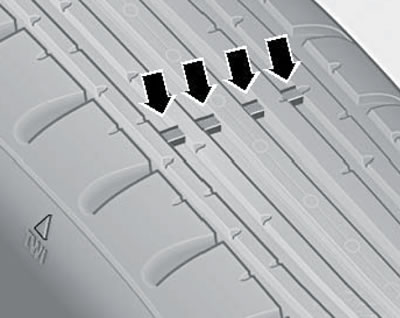
12.4. Tire wear indicators
5. Watch for any unusual wear on the treads. Tread defects such as cavities, bulges, flattening and more severe wear on one side indicate a violation of wheel alignment angles and/or wheel balancing (see illustration). If any of the listed defects are detected, you should contact a tire repair shop to have them eliminated.
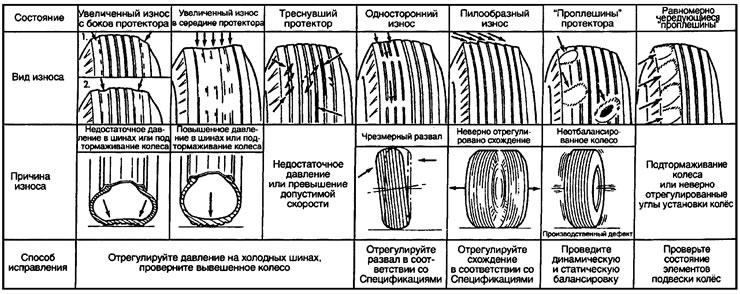
12.5. Examples and possible causes of tire wear
6. Check your tires carefully for cuts, punctures, stuck nails, etc. Sometimes after a tire is punctured by a nail, it still holds pressure for some time or deflates very slowly. If you suspect that you have such a "slow puncture", first check the serviceability of the tire inflation valve. Then inspect the tread for any foreign objects stuck in it or previously repaired punctures that have started to let air through again. You can verify the presence of a puncture by wetting the suspected area with soapy water. If there is a puncture, the solution will begin to bubble. If the puncture is not too big, the tire can be repaired at any tire shop.
7. Carefully inspect the inside sidewalls of the tires for signs of brake fluid leakage. If any are present, have the brake system checked immediately.
8. Maintaining correct tire pressure increases tire life, helps save fuel and improves overall driving comfort. A pressure gauge is required to check the pressure.
9. Always check tire pressure when tires are cold (i.e. before traveling by car). Checking the pressure on warm or hot tires will result in an overestimation of the pressure gauge reading due to thermal expansion of the tires. In this case, you should not release the pressure, because after the tire cools down it will be below normal.
10. To check the tire inflation pressure, remove the protective cap from the valve, then press the pressure gauge nozzle tightly to the inflation valve and read the reading - it should meet the requirements Specifications. Remember to replace the protective cap to prevent dirt and moisture from entering the nipple. Check the pressure in all tires, not forgetting the spare tire, and inflate them if necessary.
11. If the front wheels are very worn, it is recommended to swap them with the rear wheels. In addition, to ensure even wear, the front wheels should be swapped with the rear wheels (without changing between left and right sides) every 5-10 thousand km.
12. When checking your tires, you should also check the expiration date of the sealant included in the tire repair kit (if available, see Introduction) and, if necessary, replace it.