



Fuel Delivery Module and Fuel Supply Sensor "G"
1. Make sure the tank is no more than 1/4 full. If necessary, pump out the fuel (see Section 3).
2. Turn off the ignition and electrical appliances, remove the key from the ignition switch.
3. Remove the rear seat (see Chapter 11).
4. Unhook the lid (4 in illustration 3.18) with the fuel pump control unit "J538" (1). On models with additional heating, additionally disconnect the 2-pin connector of the metering pump "V54".
5. Disconnect the 5-pin connector (1 in illustration 3.19), disconnect the black supply line (2) and the blue return line (3) by pressing on their retaining rings. On models with additional heating, additionally pull out the suction line of the metering pump "V54" by loosening the lower clamp.
6. Loosen the fuel supply module retaining ring with the T30101 wrench (see accompanying illustration).
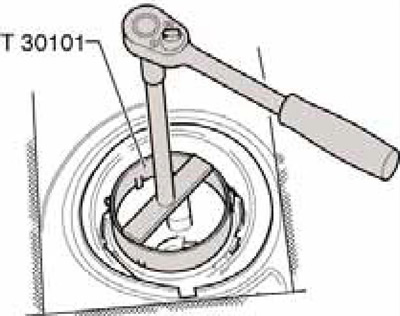
12.6 Loosening the retaining ring
7. Lift the closing flange slightly and make sure that its spring (2 in illustration 12.7a) still secured to the flange (1). If the spring (2) is loose on the guide tube (3), hold it with your fingers when removing the flange. Remove the flange and the sealing ring of the fuel delivery module from the fuel tank and place the delivery module to the side together with the connected lines. Remove the jet pump, separate the fuel line through the opening in the tank (1 in illustration 12.7b), going to the jet pump, and disconnect the fuel supply line (2) from the fuel delivery module.
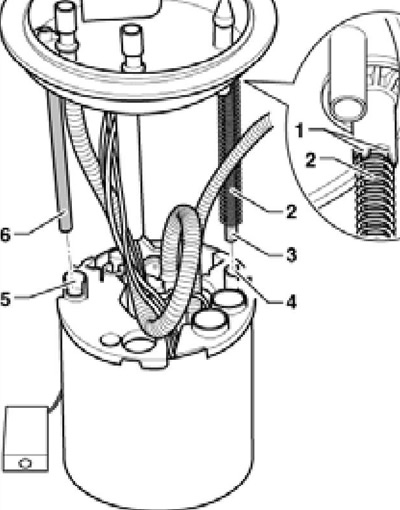
12.7a Fuel Delivery Module Parts
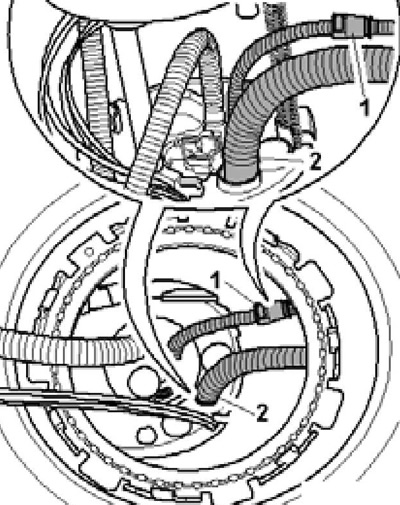
12.7b Removing the fuel delivery module
8. Remove the fuel supply module from the tank without damaging the wiring or bending the float of the fuel level sensor "G". Pour the fuel out of the module. If necessary, press the fasteners with a screwdriver (see illustration 12.8a), pull the "G" sensor up and disconnect its connectors (see illustration 12.8b): (1) - brown, (2) - blue, (3) - black.
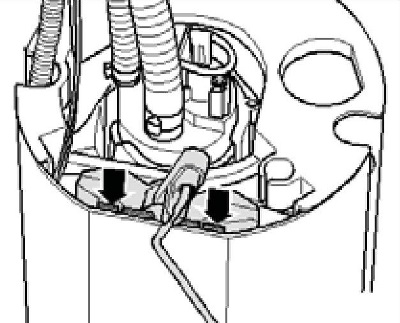
12.8a Sensor G-clamps
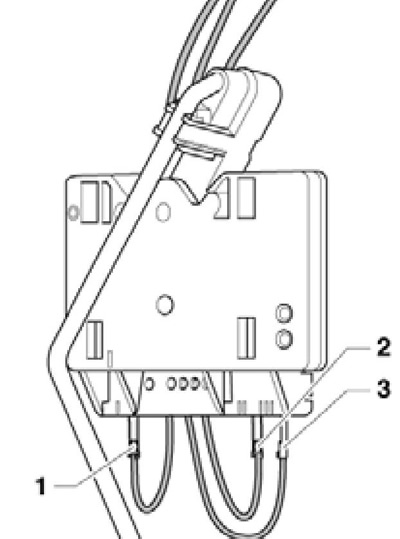
12.8b Sensor connectors
9. Install a new dry sealing ring into the tank opening and lubricate it with fuel only from the inside to install the closing flange. If removed, connect and install the "G" sensor. Insert the fuel delivery module into the tank so as not to bend the float of the "G" sensor.
[Article source: this website: skodabook]
10. Install the jet pump and connect the fuel lines. Make sure the spring (2 in illustration 12.7a) is held by the tabs (1) of the flange. First insert the guide tube (3) into the hole (4), then lower the flange until the guide tube (6) is fixed in the hole (5). Make sure that the wires (1 on the accompanying illustration) and the fuel supply line (3) are routed as shown in the illustration, and the float lever (2) is not locked.
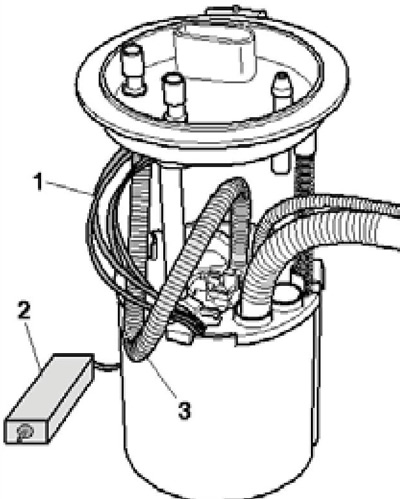
12.10 Wiring and hose layout diagram (until 06.2010.)
11. The mark on the flange should be opposite the mark on the tank (see accompanying illustration).
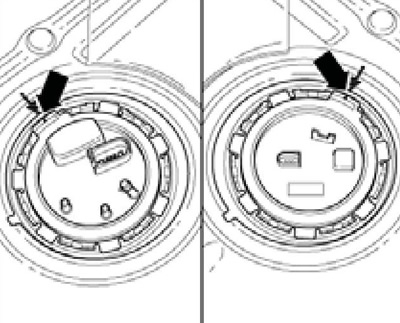
12.11 Installation position of the fuel delivery module (left) and sensor G169 (right)
Note: The mark on the tank may not be visible due to the floor covering.
Press the closing flange, tighten the locking ring to 110 Nm and connect the fuel lines. Connect the electrical wiring connector.
12. Close the cover with the "J538" block so that the arrow on it faces forward.
Jet pump and sensor No.2 "G169" fuel supply
Note: The suction pump should only be checked if the engine stalls due to lack of fuel and the fuel gauge needle is at the ¼ mark.
13. Make sure the tank is no more than ½ full. If necessary, pump out the fuel (see Section 3).
14. Turn off the ignition and electrical appliances, remove the key from the ignition switch.
15. Remove the rear seat (see Chapter 11).
16. Loosen the retaining ring with the T30101 key, as shown in Illustration 12.6.
17. Carefully pull the sensor "G169" out of the tank, press the clamps (see accompanying illustration) and disconnect the jet pump. Remove the sealing ring.
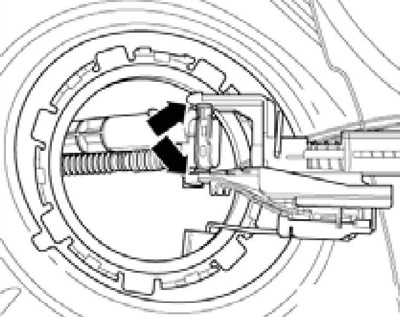
12.17 Separating the G169 sensor from the jet pump
18. To remove the suction pump, additionally remove the fuel supply module (see subsection above) and pull the suction pump out through the opening for the sensor "G169". Make sure that the fuel lines are securely connected to the suction pump, as well as their integrity and the pump is clean. Install the suction pump.
19. Install a new dry sealing ring into the tank opening and only now lubricate it with fuel from the inside.
20. Install the G169 sensor as shown in Illustration 12.11 and tighten the retaining ring to 110 Nm.
21. Further installation is carried out in reverse order.