



Contents: Petrol models 1.4 l ⬇ Petrol models 1.8 and 2.0 l: removal…⬇ Petrol engines 1.8 and 2.0 l:…⬇ Petrol engines 1.8 and 2.0 l:…⬇ Diesel engines 2.0 l (CFFB, CFGB and…⬇
Note: If a mechanical fault is detected in the turbocharger (for example, damage to compressor blades), in addition to replacing the turbocharger assembly itself, to prevent further damage, you should make sure that the air supply tract is clean and free of foreign objects. If foreign objects are found in the boost system, you should clean the boost air lines and replace the intercooler.
Note: The turbocharger can only be removed and replaced as a complete unit with the exhaust manifold. A description of how to remove the exhaust manifold of a 3.6L engine is given in Section 16.
Petrol models 1.4 l
Note: The vacuum block is checked in the same way as the check described for 1.8 and 2.0 l petrol engines. The end of the adjustment stroke of the rod should be reached at 800 mbar.
1. Turbocharger installation details are shown in the accompanying illustrations.
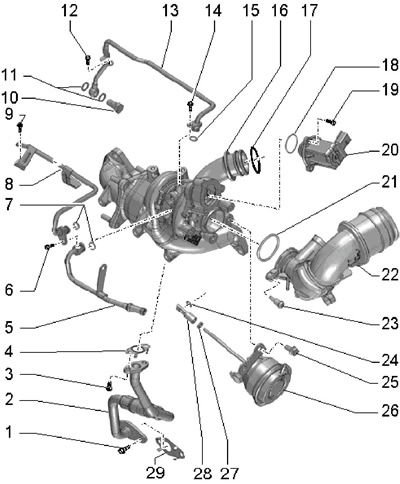
5.1a Turbocharger connections (petrol models 1.4 l)
1, 3, 9 Bolt, 8 Nm
2 Return oil pipe
4, 29 Gasket, subject to replacement
5, 8 Coolant pipe
6, 19 Bolt, 11 Nm
7, 11, 15 Sealing ring, subject to replacement
10 Hollow bolt, subject to replacement, 20 Nm
12, 14 Bolt, 8 Nm
13 Oil supply pipe
16 Turbocharger with exhaust manifold
17, 18, 21 Sealing ring, subject to replacement
20 Turbocharger air bleed valve "N₂49"
22 Inlet pipe
23 Bolt, 10 Nm
24 Lock washer, replaceable
25 Bolt, 20 Nm
26 Vacuum block
27 Lock nut, 10 Nm
28 Release handle
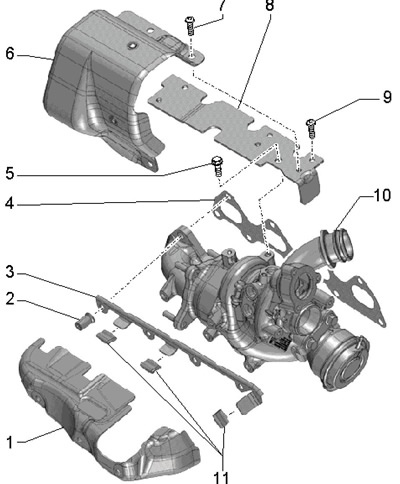
5.1b Turbocharger connections and installation details (petrol models 1.4 l)
1 Heat shield
2 Nut, subject to replacement, 16 Nm
3 Screen bracket 1
4 Gasket, subject to replacement
5 Bolt, 23 Nm
6 Heat Protective
7, 9 screen Bolt, 10 Nm
8 Support plate
10 Turbocharger with exhaust manifold
11 Fixators
2. Remove the inlet connection cover (see illustration 4.3) and it from the air intake. Loosen the clamp and disconnect the air cleaner outlet hose from the turbocharger.
3. Remove the catalytic converter (see Part B).
4. Disconnect the connector (1 on the accompanying illustration) sensor "N75" of the boost pressure regulation and connector (2) of the valve "N₂49" of the turbocharger air bleed.
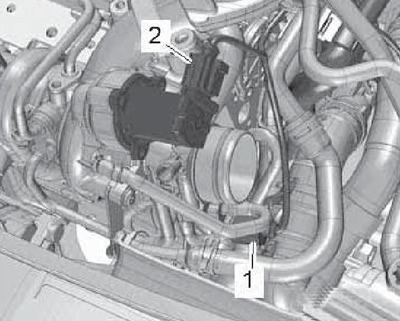
5.4 Connectors of sensors N75 (1) and N₂49 (2)
5. Disconnect the connector (2 in illustration 19.2 Chapter 2) boost pressure sensor "G31" with IAT sensor No.2 "G299", unscrew the bolts (2) and remove the support bracket (1). Unhook the hoses on the pressure pipe and open the cable channel. Release the clamps (arrows), pull the pressure pipe upward and pull it out of the turbocharger.
6. Unscrew the bolt (4 on the accompanying illustration) and remove the PCV hose from the turbocharger (arrow).
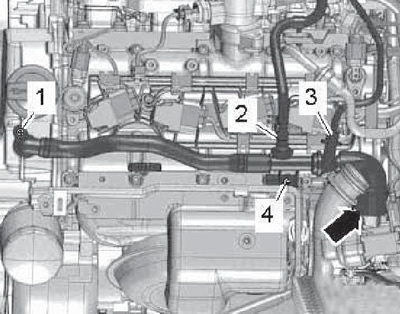
5.6 PCV Hose Connections
7. Clamp the coolant hoses with tools #3094 as shown in the accompanying illustration, unscrew the bolts (1, 3-5), remove the coolant lines from the turbocharger and put them aside.
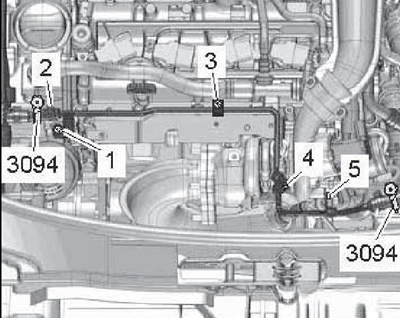
5.7 Removing coolant hoses
8. Remove the exhaust manifold heat shield (see accompanying illustration).
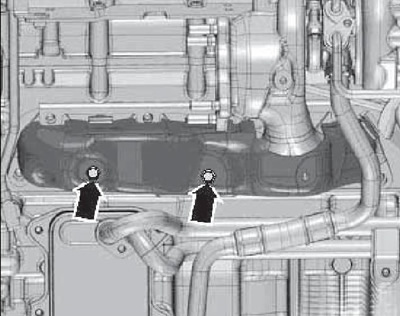
5.8 Fastening the heat shield
9. Remove the bolts (2 and 4 in the accompanying illustration) supply oil line, unscrew the hollow bolt (1) and remove the coolant pipe. Unscrew the bolt (3) and remove the mounting plate.
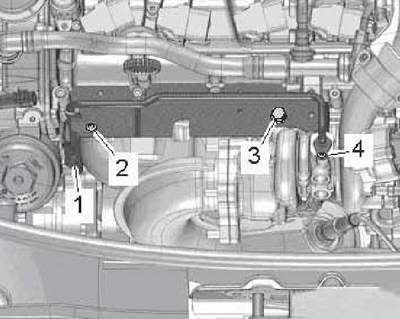
5.9 Removing the mounting plate
10. Remove the bolts (1 and 2 in the accompanying illustration) and remove the return oil pipe.
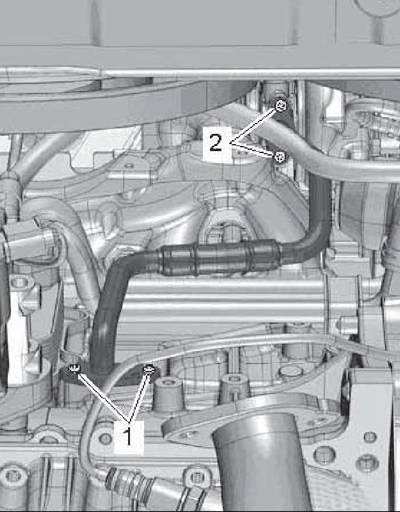
5.10 Fastening the return oil pipe
11. Give all the nuts (arrows in the accompanying illustration) and remove the bracket from the studs. Remove the exhaust manifold with the turbocharger from the cylinder head.
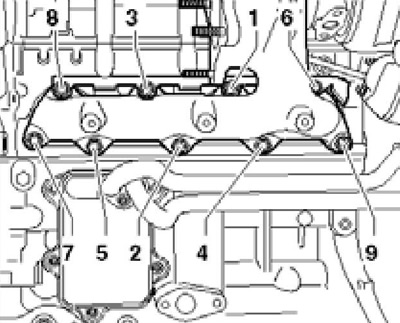
5.11 Fastening the turbocharger and exhaust manifold assembly
12. Installation is carried out in the reverse order. Use new seals. Before screwing on the exhaust manifold nuts, apply G052 112A3 grease to the studs. Tighten the nuts in the sequence shown in Illustration 5.11 to 16 Nm. Before installing the turbocharger, fill it with oil through the connection for the oil supply line. After installation, let the engine run at idle speed for about a minute.
Petrol models 1.8 and 2.0 l: removal and installation of turbocharger
13. Turbocharger installation details are shown in the accompanying illustrations.
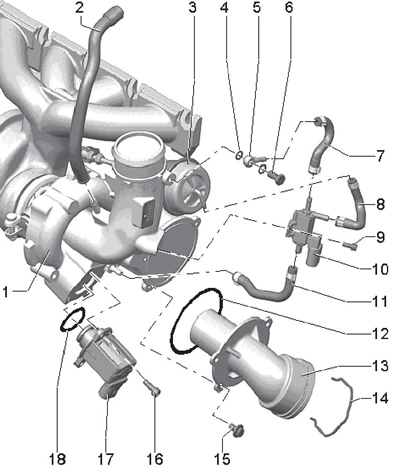
5.13a Turbocharger hoses and solenoid valves (petrol models 1.8 l)
1 Turbocharger
2 To the intake manifold
3 Turbocharger vacuum block
4, 12, 18 Sealing ring, subject to replacement
5 Connection
6 Hollow bolt, 8 Nm
7, 8, 11 Hose
9 Bolt, 3 Nm
10 Solenoid valve "N75" boost pressure control
13 Connection
14 Retainer
15 Bolt, 9 Nm
16 Bolt, 7 Nm
17 Turbocharger air bleed valve "N₂49"
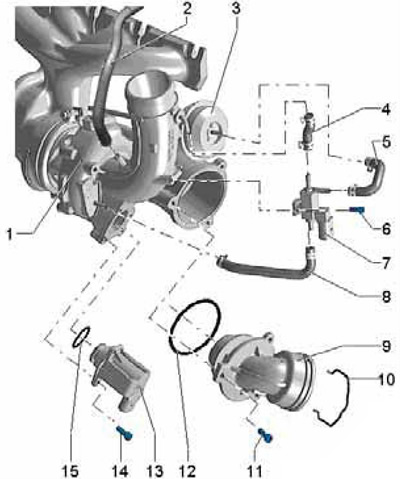
5.13b Turbocharger hoses and solenoid valves (2.0L petrol models)
1 Turbocharger
2 To the intake manifold
3 Turbocharger vacuum block
4, 5, 8 Hose
6 Bolt, 3 Nm
7 Solenoid valve "N75" boost pressure control
9 Connection
10 Fixator
11 Bolt, 9 Nm
12, 15 Sealing ring, subject to replacement
13 Turbocharger air bleed valve "N₂49"
14 Bolt, 7 Nm
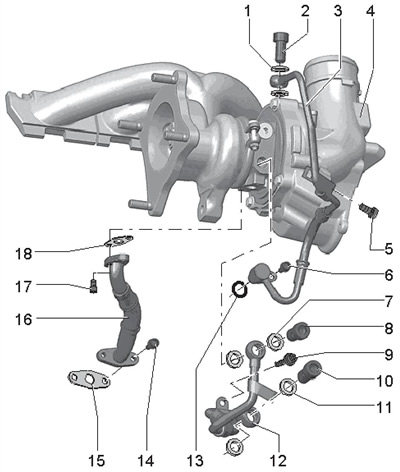
5.13 from the Turbocharger Tube (petrol models 1.8 and 2.0 l)
1, 7, 11 Sealing ring, subject to replacement
2, 8, 10 Hollow bolt, 20 Nm, then tighten to an angle of 45°
3 Oil supply pipe
4 Turbocharger
5, 6, 9 Bolt, 9 Nm
12 Coolant supply pipe
13 Sealing ring, subject to replacement
14, 17 Bolt, 9 Nm
15, 18 Gasket, subject to replacement
16 Return oil pipe
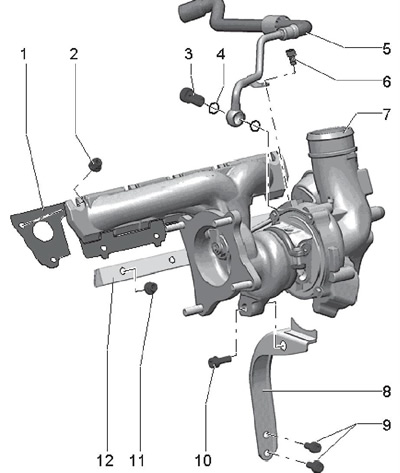
5.13d Turbocharger coolant return pipe and fasteners (petrol models 1.8 and 2.0 l)
1 Gasket, subject to replacement
2 Nut, must be replaced, before tightening, lubricate the studs with high-temperature grease G052 112A3
3 Hollow bolt, 20 Nm, then tighten to an angle of 45°
4 Sealing ring, subject to replacement
5 Coolant return pipe
6 Bolt, 9 Nm
7 Turbocharger
8 Bracket
9, 10 Bolt, 30 Nm, lubricate the threads with high-temperature grease G052 112A3 before tightening
11 Nut, do not loosen when removing the turbocharger, must be replaced, 30 Nm, before tightening, lubricate the studs with high-temperature grease G052 112A3
12 Fastening strip
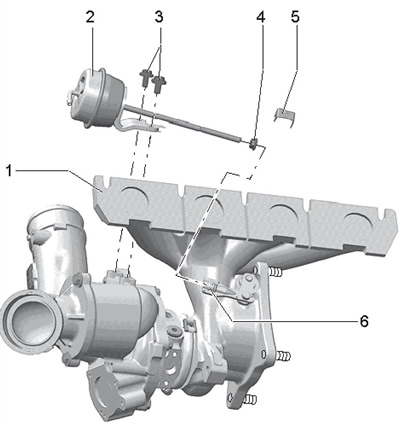
5.13e Turbocharger vacuum block (petrol models 1.8 and 2.0 l)
1 Turbocharger
2 Vacuum block
3 Bolt, 10 Nm
4 Nut, 9 Nm, sealed
5 Locking plate
6 Knurled Nut
14. Drain the coolant (see Chapter 3).
15. Remove the right front wheel arch liner (See Chapter 11).
16. On AWD models, remove the right drive shaft heat shield.
17. Remove the exhaust pipe (see Part B).
18. Remove the bolts (arrows in illustration 25.4 Chapter 2), lift the clamps (1 and 2) and remove the air pressure tube.
19. Disconnect the connectors (1 and 2 in Illustration 30.9 Chapter 2) and release the electrical wiring from the holders (arrows).
20. On models with additional heating, unscrew the bolts (1 and 2 in illustration 30.10 Gpava 2) and turn the coolant pipes to the left.
21. Remove the bolts (1 and 2 in Illustration 30.12 Chapter 2) and remove the turbocharger bracket.
22. Unscrew the hollow bolt (2 in illustration 30.13 Chapter 2) and set the coolant line aside. Remove the return oil line bolts on the cylinder block and the supply oil line bolt (3).
Note: For clarity, the illustration shows the engine removed.
23. Remove the PCV tube (1 in illustration 23.2 Chapter 2), unscrew the bolts (arrows) and remove the intake manifold by loosening the clamp (2). Seal the turbocharger connection to prevent dirt from getting into it.
24. Disconnect the ignition coil connectors (see Section 14 Chapter 1) and put the wiring aside.
25. Disconnect the coolant line going to the expansion tank (see illustration 30.16 Chapter 2).
26. Disconnect the vacuum line (1 in illustration 30.52 Chapter 2) at the connection point (2) and release it from the holders. Disconnect the coolant hoses (arrows) from the coolant pipe, disconnect the ground wire (3) and unscrew the bolt (4).
27. Remove the bolts (1-3 in illustration 30.19 Chapter 2) and remove the heat shield together with the coolant pipe.
28. Disconnect the coolant hose (see illustration 30.20 Chapter 2) and release it from the holder.
29. Give me the nuts (see accompanying illustration) and remove the turbocharger and exhaust manifold assembly upwards.
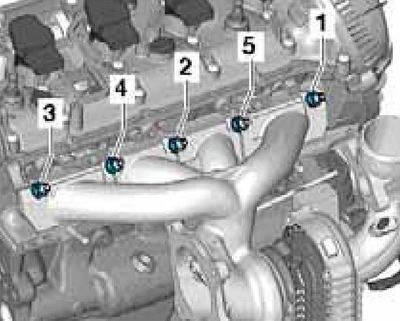
5.29 Turbocharger assembly mounting nuts
30. Installation is carried out in the reverse order. Use new sealing elements and self-locking nuts. Tighten the turbocharger assembly mounting nuts in the sequence (1-5 in illustration 5.29) in 4 stages: 5 Nm, 12 Nm, 16 Nm, 25 Nm. Before connecting the feed oil pipe, fill the turbocharger with engine oil through the connection port for this pipe. The coolant return line is installed together with the turbocharger. After the first start of the engine, let it run for about a minute at idle speed.
[Article source: this website SKODABOOK.RU]
Petrol engines 1.8 and 2.0 l: checking and replacing the vacuum block
31. Make sure that the turbocharger hoses and the N75 boost pressure control solenoid valve are not clogged or leaking, and that the N75 valve is in good working order. The engine must be warmed up to a temperature of at least 60°C.
32. Start the engine and monitor the thrust (And on the accompanying illustration) vacuum block, using a mirror for this. Ask an assistant to increase the engine speed by sharply pressing the gas pedal - the thrust should shift.
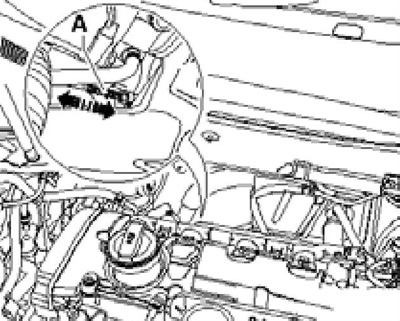
5.32 Vacuum block thrust
33. If the rod does not move when the speed increases, connect the VAS6213 hand vacuum pump to the vacuum block as shown in the accompanying illustration. Move the sliding ring at the vacuum pump connection towards the pressure gauge.
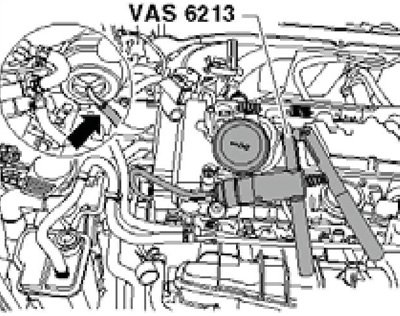
5.33 Vacuum block hose
34. When working with a vacuum pump, watch the draft (And in illustration 6.32) vacuum block: at a pressure of approximately 300 mbar the rod should start to move, and at approximately 700 mbar it should reach the end of the adjustment stroke (10 mm). Caution: Do not create a pressure greater than 750 mbar, so as not to damage the vacuum block. If the pressure is not achieved and suddenly drops, replace the vacuum block as described below. If the pressure is created, but the rod does not move, check the smoothness of the bypass valve lever: if blocking or sticking of the lever is detected, the vacuum block should also be replaced.
35. Remove the turbocharger (see subsection above).
36. Remove the lock washer above the rod on the turbocharger (1 on the accompanying illustration).
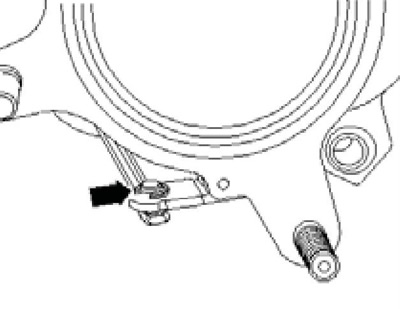
5.36 Thrust lock washer
37. Loosen the locknut (2 on the accompanying illustration), separate the rod from the turbocharger (3), unscrew the bolts (arrows) and remove the vacuum block (1).
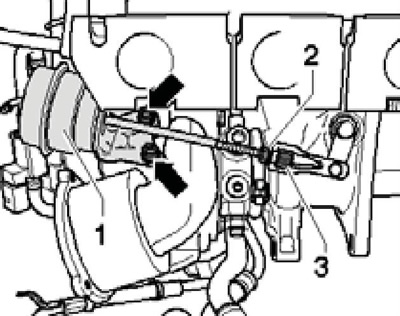
5.37 Fastening the vacuum block
38. Installation is carried out in the reverse order. After disconnecting the rod, the vacuum block should be adjusted.
Petrol engines 1.8 and 2.0 l: adjustment of the vacuum block
Note: Adjustment of the vacuum block is required only after disconnecting its rod and is performed with the turbocharger removed.
39. Remove the turbocharger (see subsection above).
40. Disconnect the hose from the vacuum unit (see accompanying illustration).
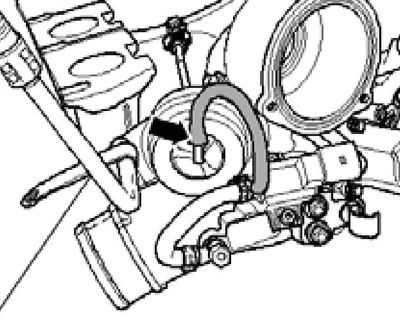
5.40 Connecting the hose to the vacuum block
41. Remove the lock washer above the rod on the turbocharger (1 in illustration 5.36) and loosen the lock nut (2 in illustration 5.37).
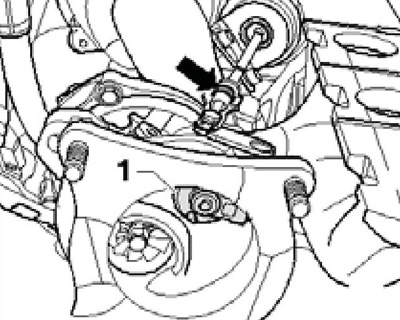
42. Pre-install the bypass valve (1 on the accompanying illustration) above the vacuum block rod (arrow) so that the valve can still be turned manually.
5.42 Pre-setting the bypass valve
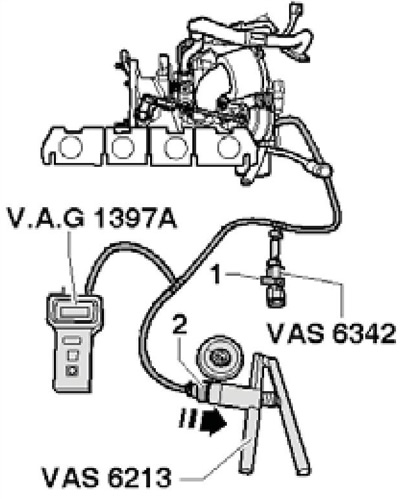
43. Assemble the vacuum pump VAS6213, tester VAG1397A and pressure test valve VAS6342 as shown in the accompanying illustration. Connect valve VAS6342 to the lever (1). Move the sliding ring at the vacuum pump connection towards the pressure gauge. Switch on tester VAG1397A and set its switch to position "II".
5.43 Control devices
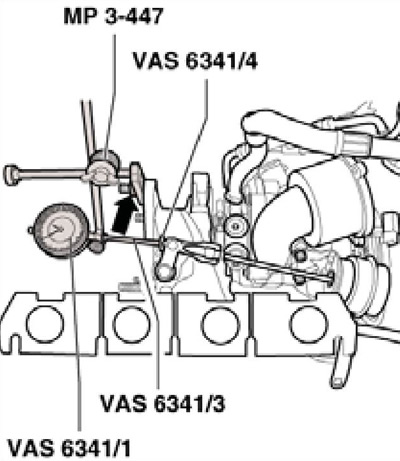
44. Secure the MPZ-447 holder to the turbocharger (arrow on the accompanying illustration). Attach the VAS6341/1 indicator with the 30 mm extension VAS6341 /3 and the flat nut AVS6341/4 to the holder. At zero pressure, set the preload on the indicator to 1 mm, then reset it to zero. Check that the indicator moves smoothly.
5.44 Installing the indicator
45. Using a vacuum pump, create a pressure of 460 ±5 mbar (according to VAG 1397 tester). The indicator should show 4.1-4.3 mm. Otherwise, turn the vacuum block rod until this size is reached.
46. Tighten the lock nut by hand and repeat the measurement. Release the pressure via the check valve to 0 bar and reset the indicator.
47. Using the vacuum pump, create a pressure of 460±5 mbar again (according to VAG 1397 tester) and record the indicator reading (this will be considered value #1). Then, increase the pressure to 650-700 mbar and drop it to 460±5 mbar. Record the indicator reading again (this will be considered value #2). Add values #1 and #2, then divide them by 2. The result should be 5±0.25 mm.
Otherwise, adjust the position of the rod, tighten the lock nut by hand and repeat the adjustment.
48. When the value specified in paragraph 47 is reached, tighten the lock nut to 9 Nm and secure with paint. Install the lock washer over the vacuum block rod.
Diesel engines 2.0 l (CFFB, CFGB and CLJA)
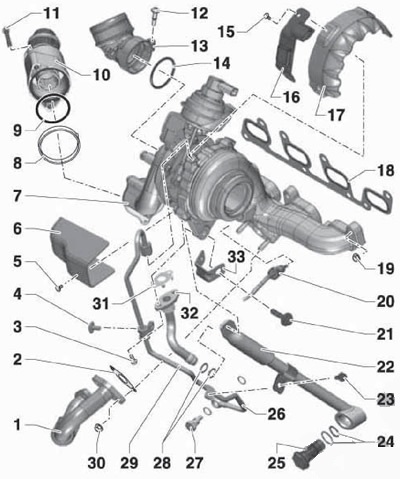
49. Turbocharger installation details are shown in the accompanying illustrations.
5.49 Turbocharger installation details (diesel engines 2.0 l CFFB, CFGB, CLJA)
1 Connecting pipe, to EGR radiator
2, 18, 31 Gasket, subject to replacement
3 Bolt, 20 Nm, subject to replacement
4 Bolt on bracket 33, 10 Nm
5, 15 Bolt, 15 Nm
6, 17 Heat shield
7 Turbocharger
8 Retaining ring
9, 14 Sealing ring, subject to replacement
10 Pulsation damper
11, 12 Bolt, 9 Nm
13 Inlet connection
16 Wiring bracket
19 Nut, subject to replacement, 24 Nm
20 Sensor No.1 "G235" exhaust gas temperature (upstream sensor "G507" turbocharger temperature), 45 Nm
21 Bolt, 20 Nm
22 Turbocharger support, for return oil line
23 Bolt, 10 Nm
24, 28 Sealing rings of different diameters, subject to replacement
25 Hollow bolt, 60 Nm, subject to replacement
26, 29 Oil supply line, tighten union nuts to 22 Nm
27 Hollow bolt, 30 Nm, subject to replacement
30 Nut, 24 Nm
32 Return oil line
33 Oil supply line bracket