



Contents: Engine 3.6 l ⬇ Engine 1.4 l ⬇ Petrol engines 1.8 and 2.0 l ⬇ Diesel engines 2.0 l (CFFB, CFGB and…⬇
Engine 3.6 l
Note: The following describes the removal of the upper portion of the intake manifold; its lower part is removed together with the fuel distribution line (see Section 9).
1. The installation details of the intake manifold are shown in the accompanying illustration.
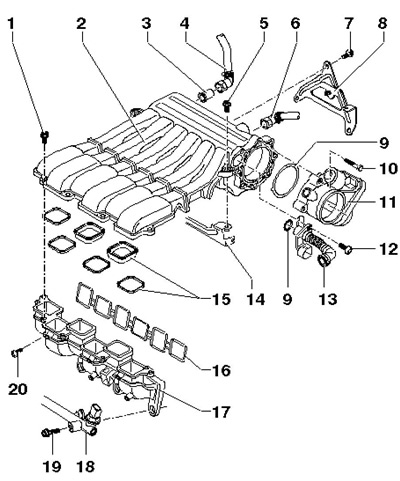
7.1 Intake manifold installation details (3.6L engine)
1 Captive bolt, 10 Nm
2 Upper part of the intake manifold
3 Sealing sleeve
4 To the brake booster
5 Bolt, 10 Nm
6 To EVAP canister solenoid valve No.1
7 Bolt, 20 Nm
8 Rear support of the intake manifold, on the protective screen
9 Sealing ring, subject to replacement
10 Bolt, 7 Nm
11 Throttle module
12 Bolt, 3.5 Nm
13 PCV connection, from cylinder head cover, with heating resistor "N79"
14 Front support of intake manifold, on cylinder head
15 Gasket, subject to replacement, installed dry in part 2, and then lightly lubricated with engine oil
16 Gasket, subject to replacement
17 Lower part of the intake manifold
18 Fuel distribution line for cylinders No.2, 4, 6
19 Bolt, to be replaced, 30 Nm, then tighten the angle 90°
20 Bolt, 8 Nm
2. Disconnect the ignition coil wiring connectors (see Chapter 5), press the cable channel with a screwdriver and put the connectors aside (see accompanying illustration).
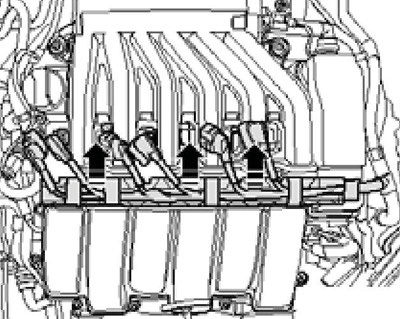
7.2 Separation of cable channel
3. Disconnect the connector (1 on the accompanying illustration), remove the inlet hose (2) and pull the PCV connecting hose (3) out of the cylinder head cover.
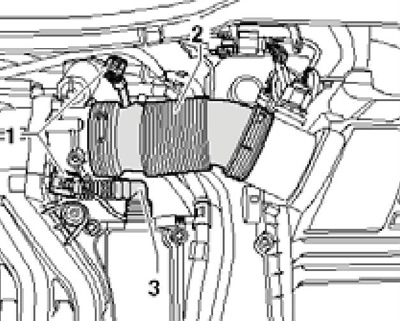
7.3 Removing the PCV Hose
4. Disconnect the hoses (arrows) from the upper part of the intake manifold, unscrew the bolt (1) of the rear support and the bolts (2) of the front support of the intake manifold.
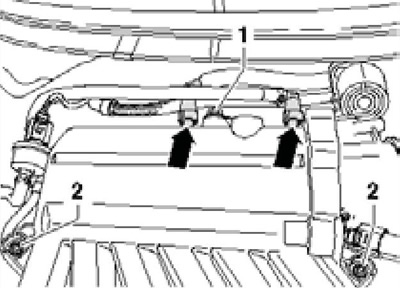
7.4 Connections and fastening of intake manifold supports
5. Remove the bolts securing the upper part of the intake manifold to its lower part and remove the upper part (see accompanying illustration). Plug the intake ports to prevent dirt from getting in.
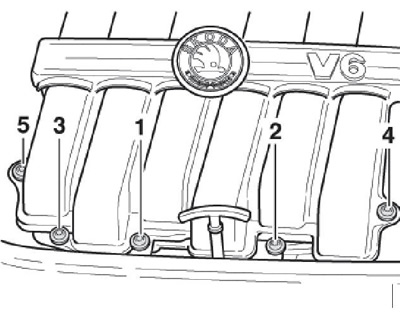
7.5 Fastening the upper part of the intake manifold
6. Insert new dry pads (15 in illustration 7.1) into the top of the intake manifold and then lightly lubricate them with engine oil.
7. Further installation is carried out in the reverse order. Tighten the bolts in the sequence shown in Illustration 7.5.
Engine 1.4 l
8. The installation details of the intake manifold and throttle module are shown in the accompanying illustrations. Removal of the upper part of the intake manifold is possible only after removal of the throttle module, and removal of the lower part of the intake manifold is possible only after removal of its upper part.
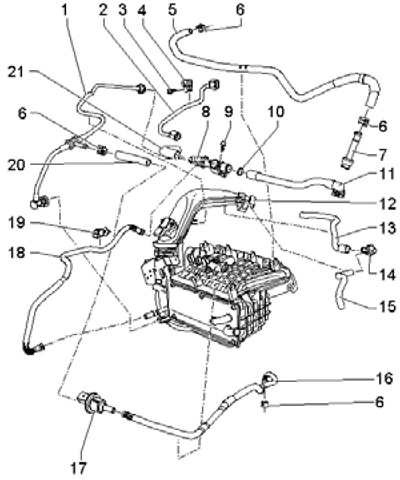
7.8a Intake manifold connections (1.4L engine, part 1)
1, 18 20 Connecting hose
2 High pressure fuel pipe, 18 Nm (on the high pressure fuel pump) and 20 Nm (on the bottom of the intake manifold)
3, 9 Bolt, 8 Nm
4, 19 Holder
5 Low pressure fuel hose to the injection pump
6 Spring clamp
7 Connection, for fuel supply line
8 PCV non-return valve
10 Sealing ring, subject to replacement
11 Connection, on the timing case
12 Pressure pipe, from turbocharger
13 Connecting hose, on timing case
14 Non-return valve
15 Connecting hose, on air cleaner
16 Connecting hose, on EVAP canister
17 Solenoid valve No.1 "N80" EVAP
21 Connecting hose, on turbocharger
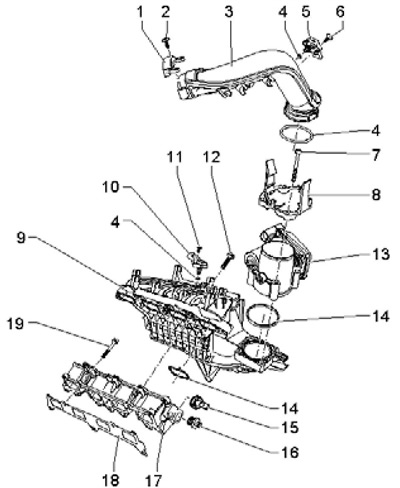
7.8b Intake manifold installation details (1.4L engine part 2)
1 Holder
2, 7 Bolt, 7 Nm
3 Pressure tube
4, 14 Sealing ring, subject to replacement
5 Boost pressure sensor "G31" with IAT sensor No.2 "G299"
6, 11 Bolt, 5 Nm
8 Adapter
9 Upper part of the intake manifold, with intercooler
10 Sensor "G71" of pressure in the intake manifold and IAT sensor "G42"
12, 19 Bolt, 20 Nm
13 Throttle module "J338", after replacement ECM adaptation is required
15 Sensor "G247" fuel pressure, 22 Nm
16 80 Nm
17 Lower part of the intake manifold
18 Gasket, subject to replacement
9. Remove the key from the ignition switch. Remove the top engine cover.
10. Disconnect the hoses (1 and 2) from the pressure pipe. Disconnect the connector of the boost pressure sensor "G31", combined with the sensor No.2 IAT "G299" (4) and unscrew the screws (3).
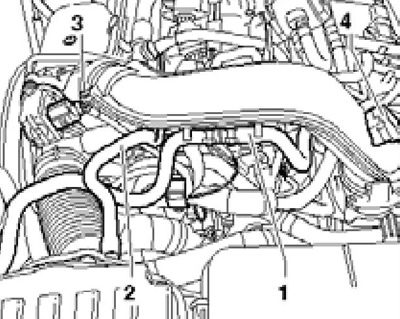
7.10 Hoses on pressure pipe, sensor connector and screws (3)
11. Release the clamps (1 on the accompanying illustration), pull the pressure pipe slightly upward and separate it from the turbocharger.
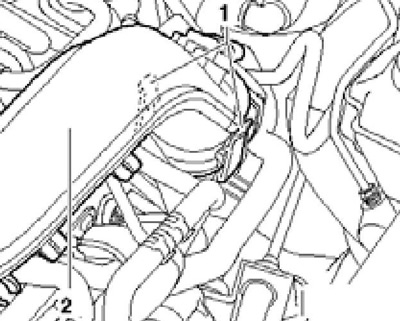
7.11 Removing the pressure tube
12. Disconnect the connector (1 on the accompanying illustration) throttle module (3), unscrew the bolts (2) and remove it from the intake manifold. If necessary, remove the intake manifold as described in paragraphs 13-15.
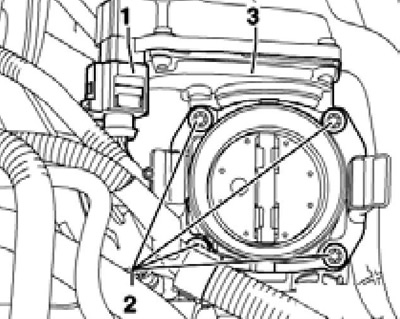
7.12 Removing the throttle module
13. Drain the coolant from the intercooler circuit (see Chapter 3).
14. Remove the fuel supply line (2 in illustration 23.20 Chapter 2), collecting the leaking fuel with a cloth.
15. Remove the coolant hoses (1 on the accompanying illustration), disconnect the connectors (2), remove the fuel supply line (3) and unscrew the bolts (4) securing the intake manifold.
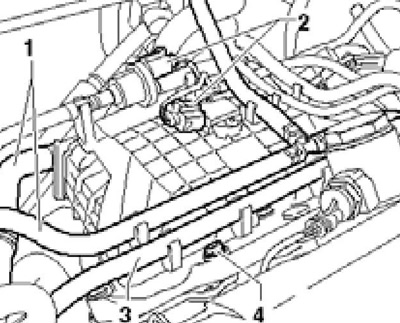
7.15 Removing the upper part of the intake manifold
16. Install the intake manifold in the reverse order. Tighten the intake manifold mounting bolts to 20 Nm. Finally, fill and bleed the engine cooling system (see Chapter 3). When installing the throttle module, pay attention to the following points.
17. If necessary, clean the throttle module as described in paragraphs 18-19. Install a new throttle module into the groove in the intake manifold.
18. Open the removed throttle valve by hand and fix it in the open position using a wooden or plastic wedge (see accompanying illustration), so as not to scratch it.
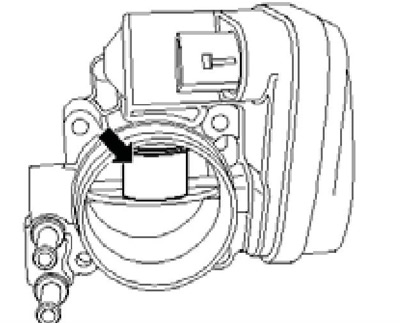
7.18 Fixing the damper in the open position
19. Clean the throttle module thoroughly with acetone (according to DIN 53247) and brushes, paying special attention to the cylindrical surface mating with the valve.
Caution: Acetone is extremely flammable. When cleaning, do not use compressed air, wear protective glasses and gloves.
Wipe the throttle body with a lint-free cloth and allow the acetone to evaporate completely.
20. If a new throttle module or a new ECM is installed, the adapted values must be cleared and the ECM must be adapted to the throttle module again using the scan tool (see Chapter 5). Adaptation can only be carried out with a new or cleaned throttle module, as deposits at the end of the throttle travel can lead to incorrect adaptation values.
Petrol engines 1.8 and 2.0 l
21. The details of the installation of the intake manifold are shown in the accompanying illustration. To remove only the throttle valve, follow the steps described in paragraphs 22-24. The intake manifold is removed together with the fuel distribution line (paragraphs 25-42), after which they can be separated from each other (paragraphs 43-44).
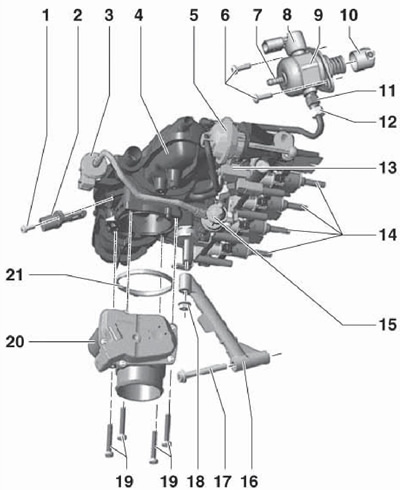
7.21 Intake manifold installation details (petrol engines 1.8 and 2.0 l)
1 Sensor bolt 2.5 Nm
2 IAT sensor "G42"
3 Solenoid valve #1 "N80" EVAP, with valve 15
4 Inlet manifold
5 Vacuum block (regulator) for intake manifold flap valve
6 Fuel injection pump bolts, subject to replacement, 10 Nm
7 Fuel line connector from fuel tank
8 Valve "N₂76" fuel pressure regulation
9 fuel injection pump, with valve 8
10 Roller pusher
11 High pressure fuel line connection, to be replaced, 22 Nm
12 Fuel pipe to fuel distribution line, 18 Nm
13 Control valve "N316" of the intake manifold flap
14 Injectors; o-rings and Teflon rings are subject to replacement
15 Double non-return valve, built into valve 3
16 Intake manifold support
17 Support bolt 16, 23 Nm
18 Support nut 16, 10 Nm
19 Module bolts 20, 4 pcs., 5 Nm
20 Throttle body module "J338", ECM adaptation required when replacing
21 Seal, subject to replacement
22. Loosen the clamp (2 in illustration 23.16 Chapter 2), unscrew the bolt (4) and disconnect the connector (arrow).
23. Remove the sound insulation under the engine compartment (see Chapter 11), loosen the clamps (1 and 2 in Illustration 7.23 Chapter 4) and remove the pressure air hose. Unscrew the bolt (1 in illustration 23.16 Chapter 2) and remove the air pressure tube downwards.
24. Disconnect the connector (1 in illustration 4.29 Chapter 3), unscrew the bolts (arrows) and remove the throttle module. Cleaning the throttle module is done in the same way as on the 1.4L engine (see above). For installation, go to paragraph 45.
25. Remove the air cleaner (see section 4).
26. Clean the connection between the intake manifold and the cylinder head.
27. Disconnect the vacuum line (arrow on the accompanying illustration), going to the EVAP canister, and also disconnect the connectors of the following parts: IAT sensor "G42" (1), throttle valve module "J338" (2), EVAP solenoid valve N₂1 "N80" and CMP sensor "G40".
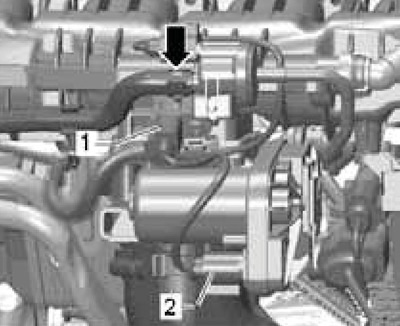
7.27 Connections
28. Disconnect the vacuum line (1 on the accompanying illustration) at the connection point (2) and remove the PCV hose (3).
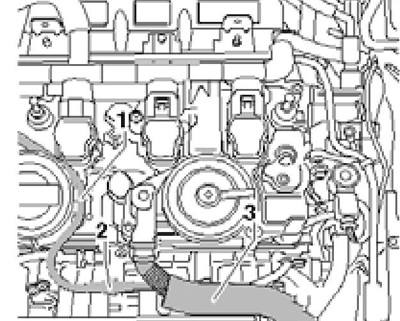
7.28 Vacuum line (1) and PCV hose (3)
29. Remove the bolts (see accompanying illustration) fuel supply pipe and set it aside.
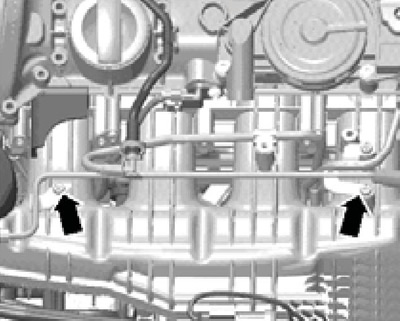
7.29 Fuel feed pipe bolts
30. Relieve the fuel pressure (see Section 3) and remove the union nut of the fuel line to the high-pressure fuel pump (lower arrow in the accompanying illustration).
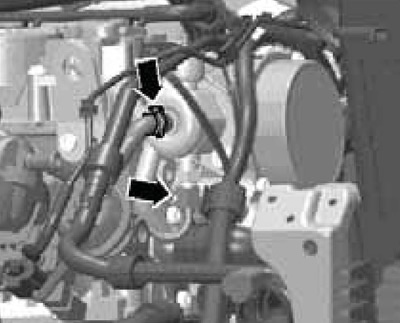
7.30 Fuel pipes
31. Disconnect the vacuum tube (see accompanying illustration) from the valve "N316" of the intake manifold flap.
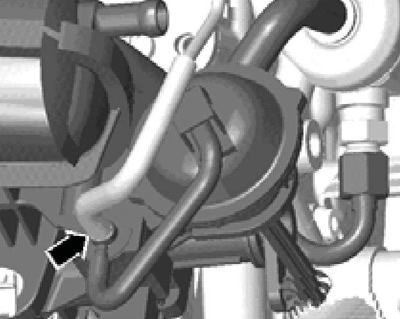
7.31 Vacuum tube on valve N316
32. Remove the coolant pipe mounting bolts from the intake manifold (see illustration 30.24 Chapter 2).
33. Disconnect the connector (1 in illustration 30.23 Chapter 2) fuel pressure sensor "G247".
34. Loosen the clamps (1 and 2 in Illustration 2.10 Chapter 3) and remove the boost air hose.
35. Loosen the clamp (2 in illustration 23.16 Chapter 2), disconnect the connector (arrow) of the boost pressure sensor "G31", loosen the clamp on the pressure air pipe, unscrew the bolts (1 and 4) and remove the pressure pipe together with the hose downwards.
36. Disconnect the connectors (1-3 on the accompanying illustration) and unscrew the holder from the intake manifold.
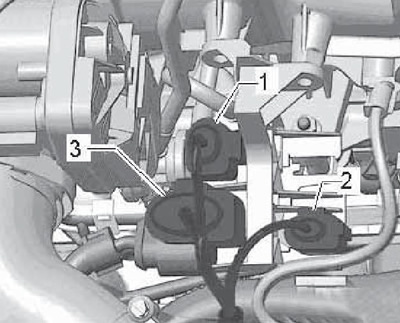
7.36 Electrical wiring connectors
37. Give the nut (1 in illustration 30.25 Chapter 2), unscrew the bolt (2) and remove the intake manifold support.
38. Unscrew the oil filter with wrench No.3417 and cover the oil filter holder to prevent dirt from getting into it.
39. Loosen the electrical wiring holders (see accompanying illustration).
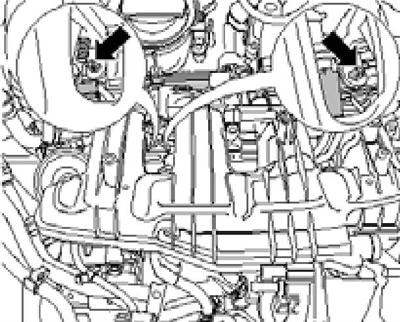
7.39 Wiring Holder
40. Release the cable from the intake manifold (see accompanying illustration).
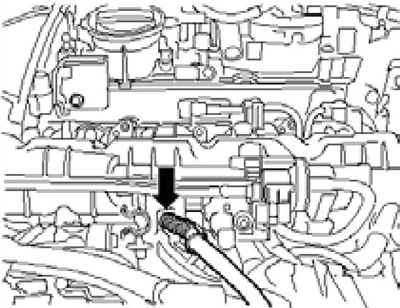
7.40 Cable on the intake manifold
41. Give me the nuts (And on the accompanying illustration) and loosen the bolts (arrows) of the intake manifold. Carefully pull the intake manifold together with the fuel distribution line slightly out of the cylinder head.
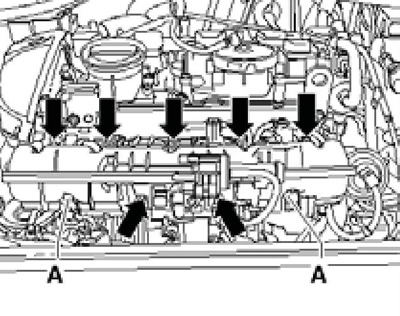
7.41 Fastening the intake manifold
42. Disconnect the connector (see accompanying illustration) "G336" intake manifold flap position sensor and remove the intake manifold. Plug the intake ports with a clean cloth.
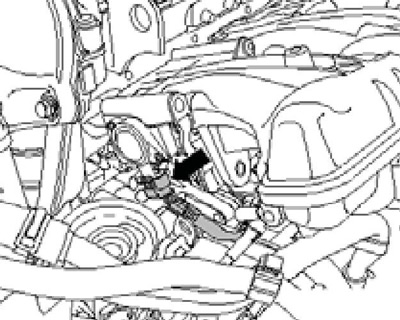
7.42 Connector for sensor G336
Note: Injectors may remain in the fuel rail.
43. Pull the No.1 "N80" EVAP solenoid valve out of the holder (arrow on the accompanying illustration). Remove the double non-return valve (1) and fuel pipe (2).
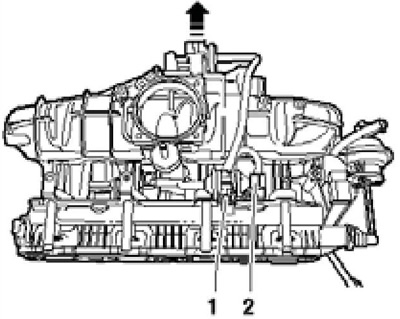
7.43 Solenoid valve N80 and double non-return valve
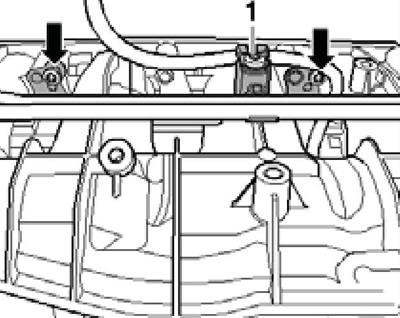
44. Loosen the clamp (1 on the accompanying illustration) hose, unscrew both lower bolts (arrows) and pull the fuel distribution line out of the intake manifold.
7.44 Fuel distribution line bolts
45. Installation is carried out in the reverse order. Please note the following features.
46. Before installing the intake manifold and fuel rail assembly, the injectors must be installed in the cylinder head. If the intake manifold was pulled out slightly again during installation and the injectors remain in the fuel rail, they must be reinstalled in the cylinder head.
47. If a new module "J338" is installed, delete the adapted values and re-adapt the ECM to this module using the diagnostic tool. After installing a new intake manifold, the throttle position sensor "G336" must be adapted to the ECM.
Diesel engines 2.0 l (CFFB, CFGB and CLJA)
48. Details of the installation of the intake manifold are shown in the accompanying illustration.
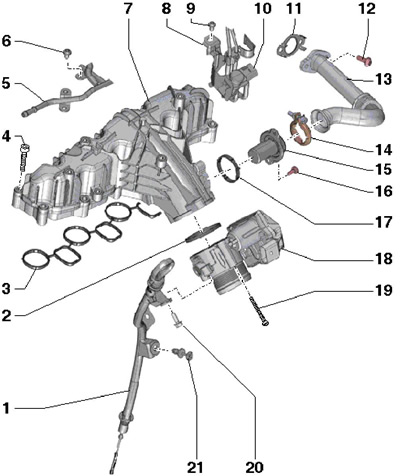
7.48 Installation details of the intake manifold of 2.0 L diesel engines (CFFBC, CFGB and CLJA)
1 Engine oil dipstick guide tube
2, 17 Sealing ring, subject to replacement
3, 11 Gasket, subject to replacement
4, 16, 19 Bolt, 8 Nm
5 Return fuel line
6, 9, 20 Bolt, 9 Nm
7 Inlet manifold
8 Valve bracket 10
10 Switching valve "N345" of the EGR cooler
12 Bolt, 20 Nm
13 EGR radiator connecting pipe
14 Clamp, 5 Nm, subject to replacement
15 EGR connection
18 Module "J338" throttle valve, with potentiometer "G69"
21 Tube retainer 1