



Caution: The assistance systems described below do not relieve the driver of the need to be attentive while driving, especially when reversing. Some thin objects located less than 30 cm away, as well as those located above or below the sensor range, may not be detected and may damage the vehicle. Ultrasonic waves at the operating frequency of the sensors, heavy precipitation and/or other conditions in which wave distortion occurs (for example, heavy rain), may interfere with the sensors' ability to detect obstacles. In addition, due to unfavorable surface characteristics, objects that absorb ultrasonic waves are not always detected. In some cases, water on the parking assistance system sensors may be mistaken for an obstruction. Uneven asphalt or cobblestone surfaces may cause false alarms.
Parking assistance system
Depending on the equipment, a parking assistance system may be installed (back, or front and back) with acoustic or visual indication. On models with a graphical instrument cluster display, the tone of the warning signals can be adjusted via the instrument cluster menu.
The rear parking assistance system uses ultrasonic sensors installed in the rear bumper (see illustration 17.1). If the front and rear parking assistance system is installed, sensors are additionally installed in the front bumper (see illustration 17.2). Each bumper can be equipped with 4 sensors; if there is a parking autopilot, two additional side sensors are installed in the front bumper. Ultrasonic waves emitted by the sensors are reflected from obstacles. When the waves subsequently hit the sensor, the distance to the obstacles is determined. The front sensors detect an obstacle no more than 120 cm in the forward direction, and the rear sensors detect an obstacle no more than 160 cm in the rear direction. To ensure proper system operation, keep the sensors clean. When washing, it is permissible to direct a jet of water under high pressure at the sensors from a distance of no more than 10 cm and only for a short time.
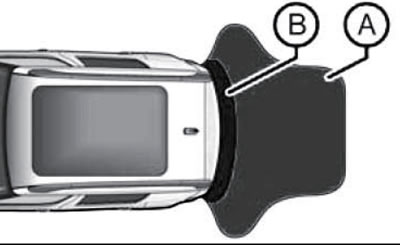
17.1. Detection zones of the parking assistance system sensors in the rear bumper
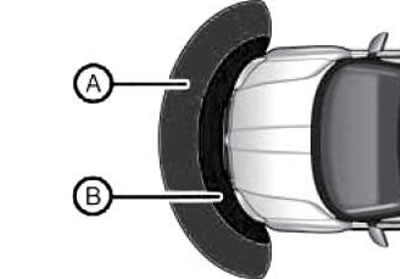
17.2. Detection zones of the parking assistance system sensors in the front bumper
The parking assistance system is switched on/off automatically when the reverse gear is engaged/disengaged if the ignition is on. On models with front sensors, there is an additional button on the center console to turn on the system "
 " (26 in illustration 12.1) with power indicator. Successful activation of the system is accompanied by a short beep. If the signal sounds 3 seconds after the reverse gear is engaged and there are no obstacles near the vehicle, the system is faulty. A system malfunction is additionally indicated by the flashing indicator in the key (if available). On models with front sensors, the system is automatically switched off when accelerating to a speed of more than 10 km/h. When connecting the trailer wiring to the standard towing hitch connector, the sensors in the rear bumper do not turn on; in some configurations, an image of the trailer appears on the audio/navigation system display.
When the parking assistance system is activated, no signals are given if the DSG mode selector lever is in the "P" position.
On models with an acoustic alarm, an intermittent sound signal is emitted when an obstacle is detected. As you approach the obstacle, the duration of the pauses in this signal decreases and, when critically close, a continuous signal sounds. On models without a standard towing hitch (TSU), the critical distance is 30 cm, and on models with a standard towing hitch, this distance is increased by 5 cm.
If a certain model has a standard audio/navigation unit, its display can show visual indication of data coming from the sensors, and the audio/navigation system can be used to adjust the volume when the parking assistance system is turned on. The closer the car is to the obstacle, the closer the corresponding segment is to the image of the car. The display of the penultimate segment means that the collision hazard zone has been reached. The red segment on the color display lights up when the distance to the obstacle is critical.
Parking autopilot "Park Assist"
The parking autopilot is designed to assist the driver in finding a suitable free parking space and entering this space. The parking space must be at least 0.8 m longer than the length of the car, i.e. it must be at least 5 m in length.
The original article can be found on the resource [SkodaBook.ru]
An integral part of the parking autopilot is the rear and front parking assistance system (see subsection above), providing support to the driver when entering a parking space.
In addition to the special features of using the parking assistance system, the following features should be kept in mind when using the parking assistant.
The parking autopilot is based on parked cars and does not take into account the position of curbs and other conditions, so be careful not to damage the wheels.
The accuracy of the parking space gap estimation may be affected by an erroneous signal from the outside air temperature (from the corresponding sensor), for example, due to the strong influence of thermal radiation from the engine.
Parking Assist cannot provide automatic parking on a sharp turn.
If the parking assistant starts to work worse after changing the wheels, it should be adapted to the new wheel circumference. Adaptation occurs automatically while driving.
When connecting the trailer wiring to the standard towing hitch connector, the parking autopilot does not turn on.
To prepare for parking, follow these steps.
Make sure the ESP system is on (ESP K/L is not lit).
Moving at a distance of 0.5-2 m along parked cars at a speed of no more than 30 km/h, press the "
 " parking autopilot (32 in illustration 12.1), - the autopilot indicator will appear on the display in the instrument cluster, and the indicator in the key will light up.
If you press the autopilot button at a speed of between 30 and 50 km/h, a message about exceeding the speed limit will be displayed on the instrument cluster display to register a free parking space. The autopilot indicator will appear when the speed drops below 30 km/h. When the speed exceeds 50 km/h, the indicator must be reactivated by pressing the autopilot button again.
After the autopilot is turned on, the search for a free parking space is performed on both sides of the car, but by default the indication is displayed only for the right side. If you plan to park on the left side of the road, turn on the left turn signals.
If a free parking space is found, its parameters are entered into memory and stored until another suitable gap is found or until the distance from the first place exceeds 10 m. Therefore, you can turn on the parking autopilot even after passing a free space, and the display will show information about whether this place is suitable for parking.
To park, follow these steps, which you have 3 minutes to complete.
As soon as the parking autopilot has determined a free parking space during the above steps, the display shows the following indication: (And in illustration 17.3). After this, you should continue driving until the indicator (B) appears.
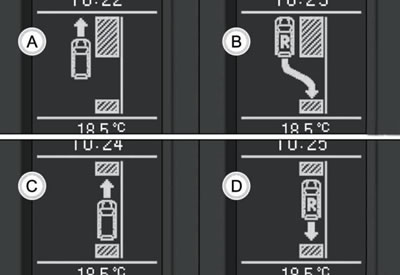
17.3. Parking autopilot indication
After the indicator (B) appears, stop the vehicle for about a second and then engage reverse gear.
As soon as the message "Automatic steering. Look around!" appears on the display, release the steering wheel - the system takes over steering control.
Carefully monitoring the surrounding area, start moving in reverse at a speed of no more than 7 km / h. If you cannot complete parking in one go, it continues with further actions.
If the display shows (C), engage the forward gear and, while paying close attention to your surroundings, begin moving forward at a speed of no more than 7 km/h. If parking is not completed after this, it continues with the following actions.
If the display shows (D), engage reverse gear and, while paying close attention to your surroundings, begin moving forward at a speed of no more than 7 km/h.
The actions described in the last two points can be repeated several times. Complete the parking maneuver according to the information from the parking assistance system. As soon as parking is complete, a beep sounds and the message "Automatic taxiing is completed. Take control!"
The parking autopilot is switched off if any of the following events occur:
- the parking assistant button is pressed;
- the speed during the search for a free space exceeded 30 km/h;
- the speed during parking exceeded 7 km/h;
- time (3 minutes) for parking has expired;
- the parking assistance system was activated;
- aSR function is disabled;
- the driver prevents the steering wheel from turning, or turns it himself;
- when reversing is required, the DSG selector lever is moved out of the "R" position.
The following describes the possible messages of the parking assistant that may be displayed on the instrument cluster display.
Park Assist finished. (The parking autopilot has completed its work.) - the parking process is complete, or the car was still moving at a speed of no more than 10 km/h after the ignition was turned on.
Park Assist: Speed too high! (Parking Assist: Speed too high!) - reduce speed to at least 30 km/h.
Driver steering intervention: Please take over steering! (Driver intervention: Take control!) - the parking process was terminated due to driver intervention.
Park Assist finished. TCS deactivated. (The parking assistant is switched off. Turn off ASR.) - the parking process is not possible due to the ASR system being turned off.
TCS deactivated. Please take over steering! (Parking Autopilot: Please take over steering!. ASR is off!) - the parking process is completed due to the ASR system being switched off during parking.
Trailer: Park Assist finished. (Trailer: Parking autopilot has completed its work.) - parking cannot be performed because the trailer's electrical wiring is connected. Time limit exceeded! Please take over steering! (Time limit exceeded. Take control!) - the parking process was terminated due to exceeding the time limit (180 sec).
Fault: Park Assist stopped. (System malfunction: Parking autopilot has stopped working.) - parking cannot be performed due to a malfunction in the vehicle. Have the fault corrected at a service station.
Park Assist defective. Workshop! (Parking autopilot malfunction. For repair!) - parking is impossible due to its malfunction. Have the fault corrected at a service station.
Steering interv. active. Monitor area around vehicle! (Automatic steering. Look around!) - Parking autopilot is active and takes over steering wheel control. While observing your surroundings, move backwards carefully.
Please take over steering! Finish parking proc, manually! (Take control! Finish parking manually!) - Take control. Complete parking without using Park Assist.
Speed to high! Please take over steering! (The speed is too fast. Take control!) - the parking process was stopped due to speeding.
Park Assist: TCS intervention. (Parking Assistant: ASR intervention.) - intervention of the ASR system during the search for a suitable parking space.
TCS intervention! Please take over steering! (ASR Intervention: Take Control!) - the parking process was stopped due to intervention from the ASR system.
Park Assist: Stationary time not sufficient. (ASR intervention. Take control!) - the stopping time before gear shifting was shorter than 1 s.
Park Assist: Speed to low. (Parking Assist: Speed too low.) - after turning on the ignition, the vehicle speed must exceed 10 km/h at least once.