



Contents: Checking and adjusting the front…⬇ Adjusting the front wheel camber ⬇ Checking the rear wheel alignment ⬇ Checking the rear wheel alignment ⬇ Adjusting the front wheel alignment ⬇ Checking and adjusting the front…⬇ Checking the deviation of the rear…⬇
Adjusting the front wheel camber
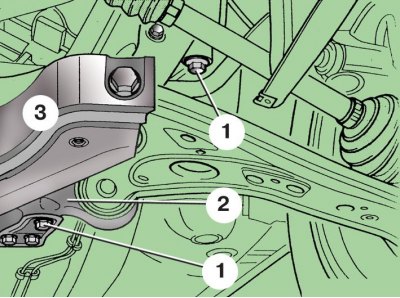
1 – beam bracket mounting bolt; 2 – front suspension beam bracket; 3 – front suspension beam
Adjusting the front wheel alignment
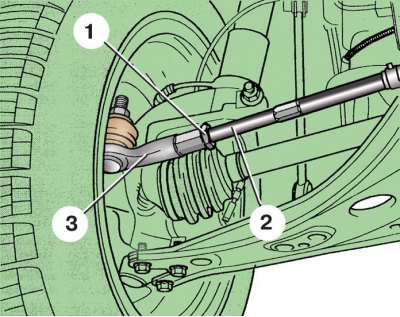
1 – lock nut; 2 – steering rod; 3 – tie rod end
Checking the front wheel steering angle
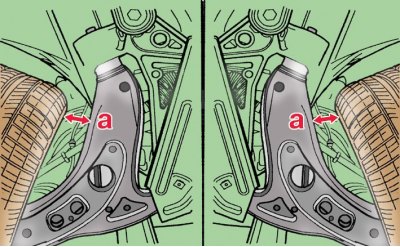
a – distance between the tire and the front suspension arm
It is recommended that wheel alignment be performed at a service station.
Wheel alignment angles need to be adjusted if the following parts have been removed:
- front suspension arm;
- steering knuckle;
- steering rod or steering rod end;
- steering gear;
- front suspension beam;
- front suspension strut;
- front suspension beam bracket;
- anti-roll bar;
- rear axle.
The adjustment is performed by:
- with proper steering and chassis;
- at normal tire pressure;
- if the difference in tread height on the left and right is no more than 2 mm;
- at the vehicle's curb weight.
Important! If the wheel alignment results differ from the specified values, first check the vehicle's lateral tilt.
Checking and adjusting the front wheel alignment
1. Check and, if necessary, adjust the front wheel alignment.
2. Check the rear wheel alignment.
3. Check the rear wheel alignment.
4. Check and, if necessary, adjust the front wheel alignment.
Adjusting the front wheel camber
Wheel alignment is adjusted by shifting the front suspension beam brackets (see table. Front wheel alignment angles).
1. Loosen bolts 1 (see the figure Adjusting the front wheel camber).
2. Move the 2 beam bracket so that the wheel camber on both sides is the same.
3. Check the wheel steering axis angle.
4. Replace bolts 1 and tighten them to a torque of 70 Nm, then turn them further by 90°.
Checking the rear wheel alignment
The camber angle of the rear wheels is not adjustable. If it differs from the nominal (see table. Rear wheel alignment angles), replace the rear axle beam.
[Article published on the website: Skodabook.ru]
Checking the rear wheel alignment
The rear wheel alignment is not adjusted. If it differs from the nominal (see table. Rear wheel alignment angles), replace the rear axle beam
Adjusting the front wheel alignment
The toe-in of the front wheels is adjusted by changing the length of the steering rods. When adjusting, the wheels must be set to the straight-ahead position (see table. Front wheel alignment angles).
1. Loosen the lock nuts 1 (see figure Adjusting the front wheel alignment) on both sides.
2. By turning the steering rods 2 with a hex key, achieve the required wheel alignment. In this case, the length of the right and left rods must be the same.
3. Tighten locknuts 1.
Caution! After turning the steering rods, the steering gear protective boots must not be twisted.
4. Check the wheel alignment again and readjust if necessary.
Checking and adjusting the front wheel steering angle
The turning angles of the front wheels are adjusted by changing the length of the steering rods.
Check and adjust in the following cases:
- the difference in the maximum turning angles of the right and left wheels exceeds 2°;
- at maximum turn the wheel touches the suspension or body parts;
- the radius of a car's left turn is different from the radius of its right turn.
1. Turn the steering wheel to the extreme position first in one direction and then in the other and measure the distance a (see figure Checking the front wheel steering angle) for right and left wheels. The obtained values should be the same.
2. Loosen the lock nut 1 (see figure Adjusting the front wheel alignment) and, by turning or unscrewing the steering rod, achieve the required wheel turning angle.
3. Loosen or tighten the steering rod on the other side by the same number of turns. Then tighten the lock nuts 1.
4. Check and adjust wheel alignment if necessary.
Checking the deviation of the rear axle from driving in a straight line
The rear axle deflection is not adjustable.
1. Measure the toe-in of the right and left rear wheels.
2. Calculate the deviation. If the toe-in values of the right and left wheels have the same signs (positive or negative), you need to subtract the smaller value from the larger value and divide it in half. For example: left wheel toe-in is +15`, right wheel toe-in is +5`, then (15 - 5)/2 = 5. This means the rear axle deviation is 5`. If the right and left wheel toe-in values have different signs, their absolute values must be added together and divided equally. For example: left wheel toe-in +15`, right wheel toe-in - 5`, then (15 + 5)/ 2 = 10. Rear axle toe-in is 10`.
Front wheel alignment angles
Parameter | Standard suspension | Suspension with increased ground clearance |
| Wheel alignment | 0° ±10` | 0° ±10` |
| The difference in the angles of rotation of the wheels when turning the wheel by 20° | -1°30` ±20`* 55` ±20`** | -1°28` ±20`* |
| Difference in wheel turning angles at maximum turning angle | 6°50`* 4°5`** | 6°50`* |
| Wheel camber angle | -30` ±30` | -15` ±30` |
| Maximum permissible difference in camber angles between the right and left wheels | 30` | 30` |
| Wheel steering axis inclination angle | 4°28` ±30`* 2°51` ±30`** | 4°14` ±30`* |
* Power steering.
** Steering without power assistance.
Rear wheel alignment angles
Parameter | Standard suspension | Suspension with increased ground clearance |
| Wheel alignment | 20` ±10` | 15` ±10` |
| Wheel camber angle | -1°25` ±10` | -1°25` ±10` |
| Maximum permissible difference in camber angles between the right and left wheels | 30` | 30` |
| Maximum permissible deviation of the rear axle from straight-line driving | 20` | 20` |