



Exhaust Assembly - 1.8-92 kW Engine
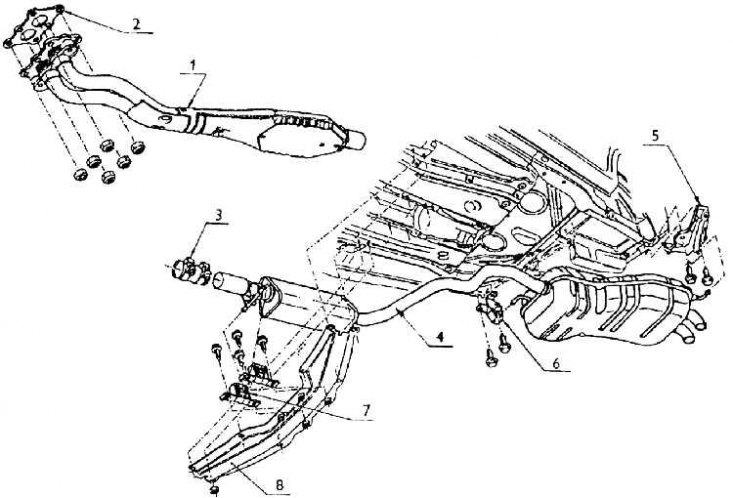
1 – front exhaust with catalytic converter; 2 – seal; 3 – clamp; 4 – rear exhaust; 5 – rear bracket; 6 – middle bracket; 7 – front bracket; 8 – exhaust supporting structure
In cars with 1.8–92 kW engines, the exhaust system consists of two parts. The front part of the exhaust is attached to the manifold flange with a 10 mm thick flange using six bolt connections.
Between the flanges a metal seal is inserted, made of three connected thin steel sheets with an extruded sealing profile around the round holes.
The seal must be replaced with a new one each time it is dismantled.
If the manifold flange has two outlets, the front part of the exhaust that is connected also has two pipes. They are then combined into one and a controlled catalyst, relatively large and long, is welded to it.
The engine vibrations relative to the exhaust pipe are damped by an elastic element under the flange. The gap between the flange outlets and the connected pipeline branches is covered by two bellows welded to both flanges. On the sides between the flanges are so-called vibration dampers.
The dampers consist of fingers with lenticular plates welded to the upper flange and inserted into cylindrical housings, which in turn are welded to the lower flange. The voids are filled with steel fibers. The design solution allows for oscillations, but protects the bellows from damage in the event of a breakaway of the entire lower part of the pipeline.
The cone for the incoming flow of the front part of the catalyst contains a holder for the oxygen probe. The catalyst itself is trimetallic (platinum, palladium and rhodium). A heat shield is welded to the bottom of the catalytic converter to protect it from heat radiation from the chassis. There is also a heat shield above the entire exhaust system under the floor.
The front pipe of the rear exhaust is connected to the pipe coming out of the catalytic converter by a two-piece clamp with fasteners and providing a good seal.
The position of the clamp is set by marks on both parts, and there is a certain gap between the ends of the tubes. There is an expansion chamber behind the clamp.
In front of the expansion chamber, a bracket with two pins inserted into a rubber-metal socket screwed to the crossbar and thus to the body is welded to the pipeline.
The exhaust ends with a powerful, volumetrically molded muffler, from which two end pipes emerge, bent with their outlet ends towards the chassis.
There is one elastic suspension in front of and behind the muffler, to which the muffler, or the rear part of the exhaust, is attached. Consequently, the entire exhaust in cars with 1.8–92 kW engines is suspended on three suspensions.
Neither the entire exhaust nor any individual part of it can be replaced with an exhaust of a different design. Individual parts can be replaced independently, but only with parts of the same order number.