



Exhaust Assembly - 1.6-55 kW Engine
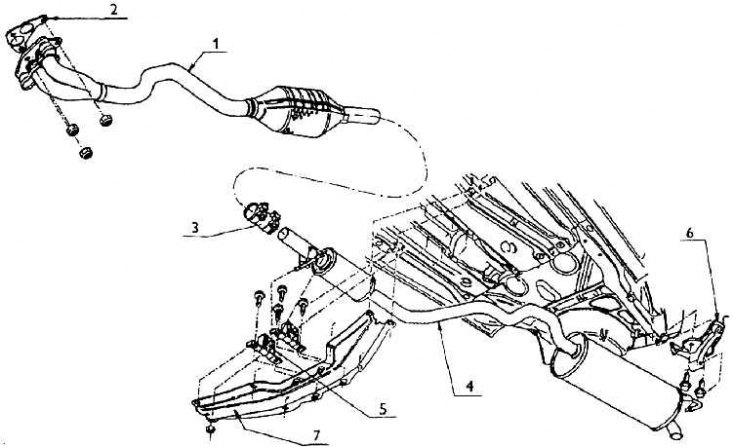
1 - Front exhaust; 2 – seal; 3 – clamp; 4 – rear exhaust; 5 – front bracket; 6 – rear bracket; 7 – exhaust supporting structure
The principle of the technical solution of the elastic element of the front part of the exhaust pipe
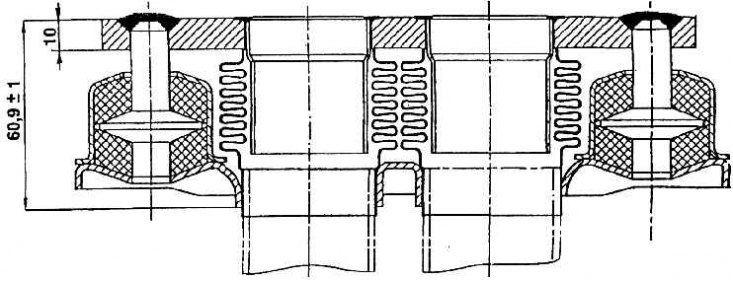
In cars with a 1.6–55 kW engine, the exhaust system consists of two parts. The front part is designed so that its route runs under the engine, since the exhaust manifold is located on the front side of the engine (in the direction of movement). The front part of the exhaust is attached to the manifold flange with a 10 mm thick flange using three bolted connections. A metal seal made of three combined thin steel sheets with a pre-pressed profile for sealing around round holes is inserted between the flanges. The seal must be replaced with a new one after each disassembly. If the manifold flange has two channels, then the front part of the connected exhaust pipeline consists of two tubes. Then they merge into one and a controlled catalyst is welded to it.
In order to ensure mutual vibrations of the engine and the exhaust pipe, an elastic element is installed under the flange (see fig. The principle of the technical solution of the elastic element of the front part of the exhaust pipe). Between the flange outlets and the connecting branches of the pipeline there is a gap, covered by two bellows welded to both flanges. On the sides between the flanges there are so-called vibration dampers. The vibration dampers consist of fingers with lenticular plates. The fingers are welded to the upper flange and inserted into cylindrical housings welded to the lower flange.
The voids are filled with steel fibers. This design solution allows for the necessary vibrations, but protects the bellows from damage by accidentally tearing off the entire lower part of the pipeline.
An oxygen probe (lambda) bracket is placed in front of the catalyst in the pipeline. The catalyst itself, as already mentioned, is a trimetal (platinum, palladium and rhodium). A heat shield is welded to the bottom of the catalyst to protect it from thermal radiation from the chassis.
There is also a heat shield attached above the entire exhaust system under the floor.
The front pipe of the rear exhaust is connected to the pipe coming out of the catalytic converter and is well sealed with a two-piece clamp with clips. The position of the clamp is determined by marks on both parts, and there is also a certain gap between the ends of the pipes. Behind the clamp is an expansion chamber.
In front of the expansion chamber, a bracket with two pins inserted into a rubber-metal socket screwed to the body is welded to the pipeline.
The exhaust ends with an oval-section muffler, from which a figured tube emerges, bent by the outlet opening to the chassis. On the rear side of the muffler there is a hook inserted into a rubber-metal block screwed to the body. This is the second fastening element, allowing the exhaust assembly to produce relative vibrations.
Neither the entire exhaust nor any part of it can be replaced with an exhaust of a different design. Individual parts can be replaced independently, but only with parts of the same order number.