



Warning: Do not allow antifreeze to come into contact with your skin or painted surfaces of the vehicle. If this does happen, wash off the antifreeze immediately with plenty of water. Antifreeze is extremely toxic, so do not leave it unattended in an open container or spilled on the floor: children or animals may be attracted to the sweet smell of antifreeze and may drink it.
Caution: Do not remove the filler cap of the expansion tank until the engine has cooled down!
Note: All engines (cast iron and aluminum) they are filled with coolant with purple G12-Plus-Plus antifreeze, which provides optimal protection against freezing, corrosion and sediment, and does not require replacement throughout the life of the engine.
14. The vehicles in question are equipped with a compensating cooling system with excess pressure. The expansion tank is located on the left side of the engine compartment (1 in the illustration Section 1). As the engine warms up during operation, the expanding coolant (coolant) fills the reservoir. When the engine cools down, the coolant automatically flows back into the cooling system, which ensures that the fluid level is maintained at a constant level.
15. The coolant level should be checked regularly, at least every month, and before each long trip.
16. At room temperature, the coolant level in the expansion tank is considered normal if the coolant reaches the area between the "MIN" and "MAX" marks on the tank wall. When the engine is warm, the coolant level may be slightly above the "MAX" mark. If necessary, add coolant to the expansion tank through the filler neck, then close it securely with the cap. When topping up, do not allow the coolant level to rise above the upper limit. To warn of a low brake fluid level, there is a corresponding indicator lamp in the instrument cluster (see Section 13 of the Chapter "Controls and Operating Techniques").
17. To fill the cooling system, always use the one specified in Specifications mixture.
Note: If there is a need to fill the cooling system on the road, then in the summer you can use clean water, but not another antifreeze (not specified in Specifications) type. The required type of antifreeze can be added later, but as quickly as possible.
18. If the coolant level drops rapidly, visually inspect the cooling system for leaks - these are usually detected by a white or rust-colored coating in the area surrounding the leak.
- Check the condition of the hoses and the reliability of their fastening to the pipes; replace damaged hoses and clamps (see also Section 5). Cracks are easier to detect if you pinch the hose.
- Check the expansion tank cap seal.
- Check the cooling system with pressure. To do this, warm up the engine to operating temperature, carefully remove the expansion tank cap and install the VAG1274 pressure injection device with the VAG1274/8 adapter on its neck (see illustration 4.18). Create a pressure of about 1.0 bar - it should not decrease; if the pressure drops, check the cooling system for leaks.
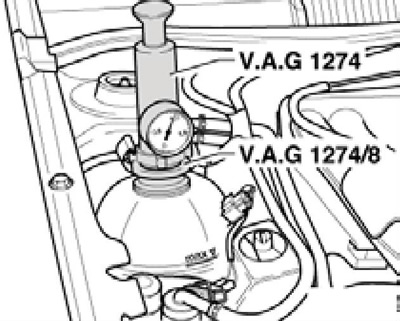
4.18 Checking the cooling system under pressure
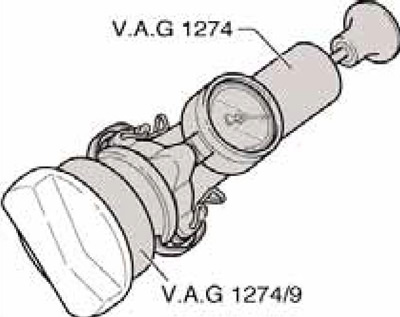
4.19 Checking the expansion tank cap
Note: If the VAG1274B tool is used to build up pressure, the VAG1274B/1 connecting hose must be installed between it and the adapter.
- You should also check the EGR radiator of diesel models and the oil cooler (there may be an internal leak).
19. If no leaks are found, check the expansion tank cap for leaks. To do this, first pull the cap valve and release it - it should return to its original position. Make sure that the valve seat is not contaminated or damaged. Then lubricate the cap seal with coolant and connect the VAG1274 pressure build-up device with the VAG1274/9 adapter to the cap (see accompanying illustration). When creating pressure, watch the bypass valve in the cap - it should open at a pressure of 1.4-1.6 bar. Otherwise (if the valve opens at a lower pressure or does not open at the specified pressure) replace the expansion tank cap. Note: If the VAG1274B tool is used to build up pressure, the VAG1274B/1 connecting hose must be installed between it and the adapter.
20. You should also check the condition of the coolant - it should be relatively clean. If the liquid is brown or rusty, it should be drained, the cooling system should be flushed, filled with a new mixture and bled (see Chapter 3).
21. To check the frost resistance of the coolant, use a hydrometer.
Text obtained from the website [SkodaBook.ru]