


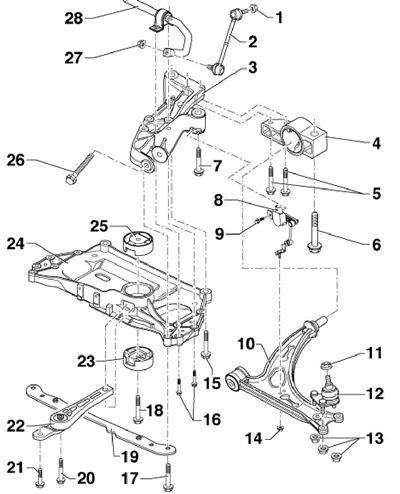
1.1a Front subframe, stabilizer and front suspension arm mounting parts (models with aluminum subframe)
1, 27 Self-locking nut, replaceable, 65 Nm, hold by the hinge hexagon when tightening
2 Stabilizer bar 28, between the stabilizer and the suspension bar
3 Console, when adjusting the front wheel alignment angles, must be replaced
4 Bracket with glued rubber bushing
5 Bolt M10x76, to be replaced, 50 Nm, then tighten to an angle of 90°
6, 7 Bolt M12x1.5x90, subject to replacement, 70 Nm, then tighten to an angle of 180°
8 Front left "G78" suspension height sensor, on models with automatic headlight leveling from 11.2009.
9 Bolt, 9 Nm, only on models from 11/2009.
10 Suspension arm, arms made of the same material must be installed on both sides, if damaged, the ball joint must be replaced along with the arm
11 Self-locking nut, replaceable, 60 Nm
12 Ball joint, if damaged, the lever must be replaced together with the support
13 Self-locking nut, subject to replacement, 60 Nm
14 Nut, 9 Nm, only on models from 11/2009.
15 Bolt M12x1.5x100, subject to replacement, 70 Nm, then tighten to an angle of 90°
16 Bolt M8x75, subject to replacement, 20 Nm, then tighten to an angle of 90°
17 Bolt M12x1.5x75, subject to replacement, 70 Nm, then tighten to an angle of 90°
18 Bolt M14x1.5x70, to be replaced, 100 Nm, then tighten to an angle of 90°, first tighten when the rocker support is bolted to the transmission
19 Soundproofing holder
20 Bolt M 10x75, subject to replacement
21 Bolt M 10x35, subject to replacement
22 Swing support, first attach to transmission, then to subframe
23 Lower rubber-metal bushing of the rocking support
24 Subframe
25 Upper rubber-metal bushing of the rocking support
26 Bolt M12x1.5x110, subject to replacement, 70 Nm, then tighten to an angle of 180°, tightened with the suspension unloaded
28 Anti-roll bar
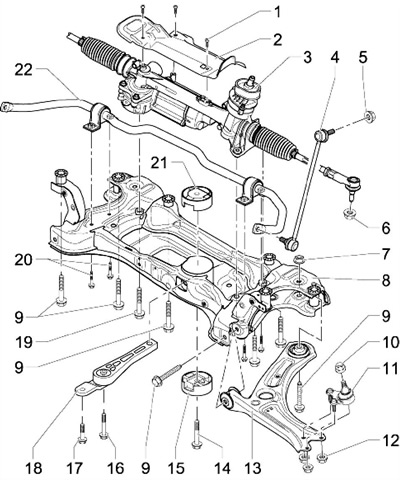
1.1b Front subframe, stabilizer and front suspension arm mounting parts (models with steel subframe)
1 Bolt, 6 Nm
2 Heat shield
3 Steering mechanism
4 Stabilizer bar 22, between the stabilizer and the suspension bar
5 Nut, 65 Nm
6 Nut, to be replaced, 20 Nm, then tighten to an angle of 90°
7 Nut, to be replaced, 70 Nm, then tighten to an angle of 180°, hold while tightening the bolt 9
8 Subframe, welded part made of steel
9 Bolt, to be replaced, 70 Nm, then tighten to an angle of 180°, while tightening hold the nut 7
10 Self-locking nut, replaceable, 60 Nm
11 Ball joint, if damaged, replace the lever together with the support
12 Self-locking nut, subject to replacement, 100 Nm
13 Suspension arm, arms made of the same material must be installed on both sides, if damaged, the ball joint must be replaced along with the arm
14 Bolt M14x1.5x70, subject to replacement, 100 Nm, then tighten to an angle of 90°, first tighten when the rocker support is bolted to the transmission
15 Lower rubber-metal bushing of the rocking support
16 Bolt M10x75, subject to replacement
17 Bolt M10x35, subject to replacement
18 Swinging support
19 Bolt M 10x76, to be replaced, 50 Nm, then tighten to an angle of 90°
20 Bolt M8x75, subject to replacement, 20 Nm, then tighten to an angle of 90°
21 Upper rubber-metal bushing of the rocking support
22 Anti-roll bar
Rear suspension - independent, multi-link, with separately mounted shock absorbers and springs (see illustrations 1.2a-c and 1.3). The hub assembly holder assembly is shown on illustrations 3.1a-b Chapter 8.
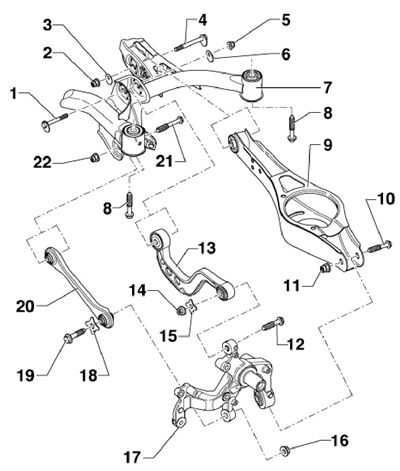
1.2a Subframe and rear suspension arms of FWD models
I Eccentric bolt for camber adjustment, do not turn more than 90° in each direction
2, 5 Self-locking nut, subject to replacement, 95 Nm, tightened with unloaded suspension
3, 6 Eccentric washer, inner hole with protrusion
4 Toe-in adjustment eccentric bolt, do not turn more than 90° in each direction
7 Subframe
8 Bolt, to be replaced, 90 Nm, then tighten to an angle of 90°
9 Lower wishbone
10 Bolt, subject to replacement
11 Self-locking nut, subject to replacement, 90 Nm, then tighten to an angle of 90°, tightened with the suspension unloaded
12 Bolt, subject to replacement, 130 Nm, then tighten to an angle of 90°, tightened with the suspension unloaded
13 Upper wishbone
14 Self-locking nut, replaceable, tightened by turning bolt 12
15, 18 Washer
16 Self-locking nut, subject to replacement, tightened with the suspension unloaded by turning bolt 19
17 Hub assembly holder
19 Bolt, subject to replacement, 130 Nm, then tighten to an angle of 90°, tightened with the suspension unloaded
20 Guide lever
21 Bolt, subject to replacement
22 Self-locking nut, subject to replacement, 90 Nm, then tighten to an angle of 90°, tightened with the suspension unloaded
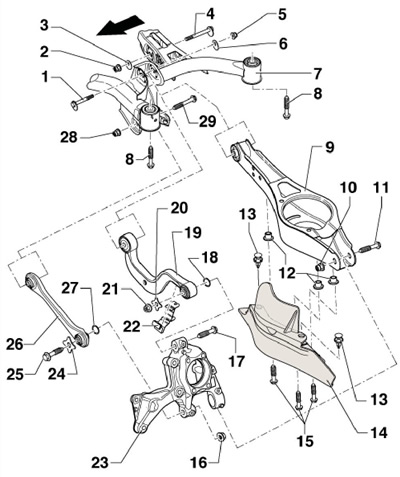
1.2b Subframe and rear suspension arms for AWD models
Arrow - Direction of movement
1 Eccentric bolt for camber adjustment, do not turn more than 90° in each direction
2, 5 Self-locking nut, subject to replacement, 95 Nm, tightened with unloaded suspension
3, 6 Eccentric washer, inner hole with protrusion
4 Toe-in adjustment eccentric bolt, do not turn more than 90° in each direction
7 Subframe
8 Bolt, to be replaced, 90 Nm, then tighten to an angle of 90°
9 Lower wishbone
10 Self-locking nut, subject to replacement, 90 Nm, then tighten to an angle of 90°, tightened with the suspension unloaded by turning the bolt 11
11 Bolt, subject to replacement
12 Threaded bushings M6
13 Spacer sleeve
14 Protection from stones
15 Bolts, 8 Nm
16 Self-locking nut, subject to replacement, 130 Nm, then tighten to an angle of 90°, tightened with the suspension unloaded
17 Bolt, subject to replacement, 130 Nm, then tighten to an angle of 90°, tightened with the suspension unloaded
18, 27 Round washer
19 Upper wishbone
20, 24 Figured washer
21 Self-locking nut, subject to replacement, tightened with the suspension unloaded by turning bolt 17
22 ABS sensor wiring holder, fixed to lever 19
23 Hub assembly holder
25 Bolt, subject to replacement, tightened with the suspension unloaded
26 Guide lever
28 Self-locking nut, replaceable, 90 Nm, then tighten to 90°
29 Bolt, subject to replacement, tightened with the suspension unloaded
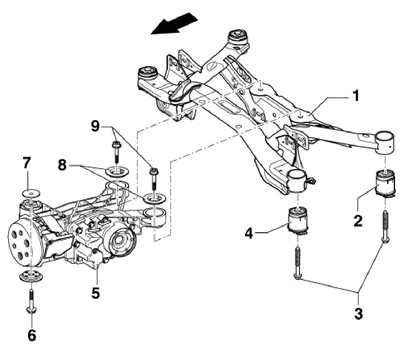
1.2c Subframe and final drive AWD models
Arrow - Direction of movement
1 Subframe
2/4 Rear/front glued rubber-metal bushing
3 Bolt, to be replaced, 90 Nm, then tighten to an angle of 90°
5 Rear final drive
6, 9 Bolt, to be replaced, 60 Nm, then tighten to an angle of 90°
7, 8 Washer
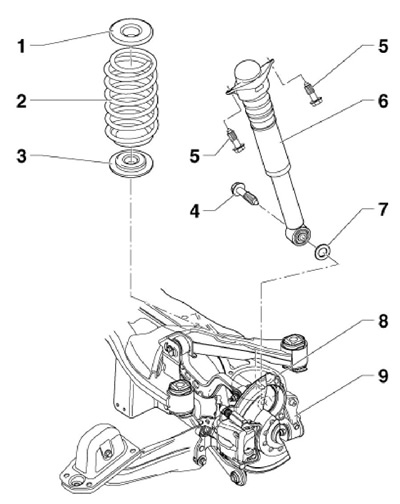
1.3a Rear suspension spring and shock absorber (using AWD models as an example)
1 Upper spring seat
2 Spring
3 Lower spring seat
4 Bolt: on AWD models - 180 Nm; on FWD models - tighten with unloaded suspension (130 Nm, then tighten to 90° angle)
5 Bolt, to be replaced, 50 Nm then tighten to an angle of 45°
6 Shock absorber
7 Washer (only on AWD models)
8 Lower wishbone
9 Hub assembly holder
The suspension modification can be identified by the PR number on the vehicle data sticker (see illustration 1.4), located on the floor of the luggage compartment and in the service book (see Introduction).
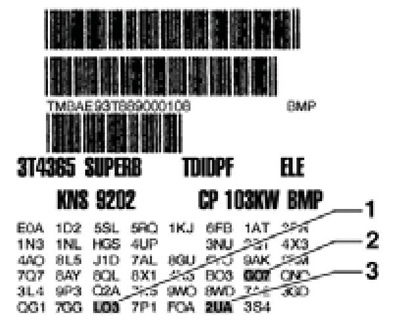
1.4 Identification of the suspension
1 Springs
2 Shock absorbers
3 Chassis
The steering system consists of a steering wheel, a steering shaft, a rack-and-pinion steering gear, and a steering drive. The steering wheel with an integrated driver's front airbag is mounted on a shaft that transmits steering movements to the steering gear. The steering column switch assembly is mounted behind the steering wheel. A coil spring, which can twist and untwist, is used to maintain contact between the airbag and the SRS control unit when the steering wheel is turned. The coil spring consists of a tape with internal conductive tracks. The steering column can be adjusted for both reach and tilt.
To facilitate the control of the car, a 3rd generation electromechanical power steering with two leading gears is installed as standard. A separate gear is added to the simple steering mechanism, acting on the steering rack and driven by an electric motor. The torque sensor on the steering shaft, acting on the steering wheel with the steering angle sensor, is located in the steering gearbox. Communication is carried out via the CAN data bus. The advantages of this design include:
- low energy consumption (the booster only uses energy when it is actually working, when the steering wheel is turned);
- hydraulic components fall off (pump, lines and power steering reservoir);
- minimal transmission of impacts to the steering wheel (for example, when driving on an uneven road);
- low noise transmission to the vehicle;
- the "active return" function helps return the wheels to a straight position.
When repairing or servicing suspension and steering components, problems often arise with loosening "stuck" bolts and nuts. The fasteners located under the bottom of the car are constantly exposed to external influences and over time they corrode and partially deteriorate. Using brute force to loosen such "stuck" fasteners is associated with the risk of damaging them. First, wet the element that cannot be loosened with a small amount of a special penetrating liquid (for example, WD-40), allowing it to soak into the rust layer well. Use a wire brush to remove external deposits from accessible areas of the threaded surfaces. Sometimes a sharp blow with a hammer on the nut through a drift helps to break up the rust filling the gaps between the turns of the threaded joint - try not to damage the threads as a result of the drift jumping off. Using a long handle when loosening "stuck" fasteners allows you to significantly increase the applied torque, but it should be remembered that the use of extensions in a set with ratchet-type drives is associated with the risk of failure of the return mechanism, as well as the possibility of injury. Self-locking nuts and fasteners damaged by corrosion or when removed during repairs must be replaced without fail. Welding and straightening are not allowed on bearings that carry the force load and on suspension components that guide the wheel.
Since most of the procedures described in this chapter are performed with the vehicle raised off the ground, you should take care in advance of options for securely fixing it in the raised position - prepare strong supports. To jack up the vehicle, use hydraulic trolley jacks - remember that the onboard jack included in the standard package is intended only for temporary jacking of the vehicle when replacing a broken wheel. The hydraulic jack can also be used to hang up some suspension components when performing a particular procedure. Before performing work, secure the vehicle to the lift legs using safety belts.
Attention: It is not permitted to carry out work under a vehicle that is held in a raised position only by means of jacks!