



- behind the left end panel of the instrument panel (fuses);
- on the left side of the engine compartment (fuses and relays);
- above and below block J519 (behind the driver's storage compartment).
2. The location of fuses and relays in the mounting blocks, as well as their purpose, is indicated in Chapter "Electrical equipment diagrams". The purpose of the fuses is additionally indicated on the back of the cover of each mounting block. The fuse or relay number is indicated directly on the mounting block, next to the corresponding relay or fuse.
3. To gain access to the fuse box on the left side of the instrument panel, remove its left end panel by prying it up from below with a key or screwdriver (see illustration 15.10 Chapter 11).
4. To gain access to the mounting block in the engine compartment, open the cover of this block by sliding the latches forward (arrows in the accompanying illustration) and pulling the cover up. When moving the latches, press the cover to avoid damaging them.
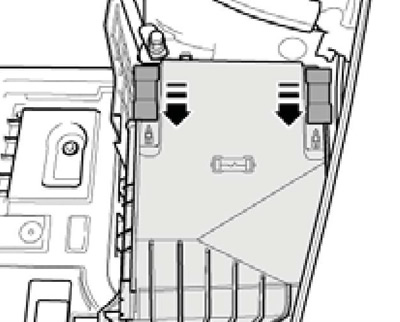
3.4 Removing the cover of the mounting block in the engine compartment
5. To access the mounting block above the J519 unit, remove the driver's glove compartment; to access the mounting block under the J519 unit, additionally remove the air duct to the driver's footwell and the knee airbag.
Fuses
6. Each individual fuse is used to protect a specific electrical circuit or several circuits at once, and one circuit may have one or more fuses. Fuses in the mounting blocks are mostly of a compact design, equipped with bayonet contacts, and, if necessary, are easily removed from their sockets with your fingers or with pliers stored in the cover of the mounting block. To remove the fuses, use their pliers, stored in the mounting block behind the left end cover. On small fuses, slide the tweezers from above, and on large ones - from the side.
7. If any of the power consumers fails, always check the condition of the corresponding fuse first. Turn on the ignition and use a test lamp to probe the open terminals of each fuse. If the lamp lights up when connected to each terminal, the fuse is OK. If voltage is present only on the power supply side, the fuse has blown. Note also that the fuse body is usually made of transparent plastic, through which it is easy to determine the condition of the working jumper.
8. When replacing a blown fuse, make sure that the replacement element you prepare matches the type of the one that failed. Fuses designed for different nominal current strengths may not physically differ from each other in any way, but they are not interchangeable. Each electrical circuit has different operating parameters and requires a different degree of protection, so replacing a fuse designed for a certain current strength with a fuse with parameters that do not match is fraught with the most serious consequences (until a fire breaks out). The operating parameters of the fuse are usually indicated on its plastic housing, and color identification is also used.
9. If the new fuse also fails immediately after installation, there is no point in replacing it further; the cause of the overload in the circuit should first be identified and eliminated. In most cases, this is a short circuit in the connecting wiring caused by damage to its insulation. Spare fuses are usually placed in free terminal blocks of the mounting block.
Relay
10. To supply power or control signal to some of the electrical consumers in the vehicle (such as fuel injection system components, horn, starter, cooling fan, fog lights and others) relays are used. In fact, a relay is an electric key that ensures the closure of the working circuit by a control signal. If the relay fails, the corresponding consumer will fail to function. A description of how to check the proper functioning of the relay is given below. Failed relays must be replaced.
11. If it is not possible to find out how to connect the relay to the corresponding electrical circuit using the electrical connection diagrams (diagrams are provided at the end of the Manual), it should be remembered that the approach to testing any relay is, in principle, the same in all cases (see below).
12. In most cases, the control circuit is always connected to two of the relay contact terminals. When control voltage is applied to these terminals, the current begins to circulate through the relay control winding, resulting in the closing of the contacts of the working circuit of the consumer of electrical energy. The remaining terminals are the terminals of the working circuit.
13. In order to facilitate the identification of the relay terminals, explanatory markings with an image of the key connection diagram are usually applied to its body.
14. Before removing the relay, make sure that the corresponding circuit is de-energized.
15. Connect a fused jumper wire between one of the relay control terminals and the positive battery terminal. Use a second jumper wire to ground the other control terminal - the relay should click. Some relays require that the polarity of the connection be observed - if there is no click, try reversing the polarity of the control terminals.
16. With the jumper wires connected, check for conductivity between the terminals of the working circuit.
17. If the test result is negative, replace the relay.
Original text is located on (skodabook.ru)