



Glass marking

All door glass has a greenish tint after tinting. For safety reasons, the glass is tempered, its thickness is 4±0.2 mm. The front door glass is lowered; the rear doors also have lowered windows in the front section, while the rear section has fixed windows. The windows bear the manufacturer's mark, homologation symbol and digital designation.
In the front doors, the glass is guided by two window regulator bars, since in the rubber profile of the door groove there is a glass guide for the entire stroke only on the rear side, at the B-pillar. In the rear doors, there can be only one window regulator guide bar, since the glass is guided in the rubber profile on both sides for the entire stroke. Considering that the rear doors are lowered in an arc at the top and the upper edge of the glass follows this curve, this leads to the fact that in the lower position of the stroke, the glass slightly protrudes at the B-pillar above the sealing line.
Sealing of the lowering glass of the front doors
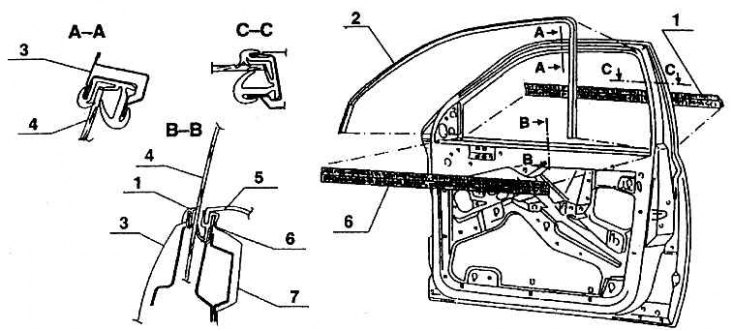
1 – external cleaning seal; 2 – glass guides; 3 – outer door leaf; 4 – glass that drops down; 5 – upholstered door panel; 6 – internal cleaning seal; 7 – inner door leaf
Sealing of the lowering and fixed glass of the rear doors
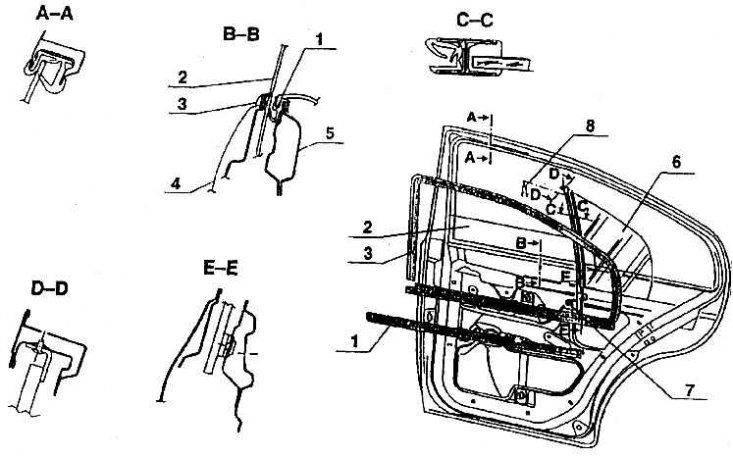
1 – glass cleaning seal internal; 2 – sliding glass; 3 – glass sealing; 4 – outer door sheet; 5 – inner door sheet; 6 – fixed glass; 7 – lower bar bolt; 8 – upper bar bolt
The rear edge of the rear door glass is guided by a rubber profile with polyamide pile. The profile is embedded in the front part of the strip (approximately H profile). This strip is secured at the top to the upper bracket with a bolt to the door frame (the bolt is inserted from below, see section O–O in Fig. Sealing of the lowering and fixed rear door glass). At the bottom, the strip is secured with a bolt to the stiffening rib of the inner door sheet. The strip passes through the slot of the inner seal along the contour. A rubber profile (U) is embedded in the rear part of the strip. It is inserted into (during pre-assembly) fixed glass of the rear doors and it, together with the mentioned strip, is inserted into the contour seal of the inner door frame.
The rubber edge formed by the inner contour seal of the door for glazing is in all side doors from several different profiles united by vulcanization. In the front doors, a seal is inserted into the door frame in the front, upper and rear parts, on the surfaces of the window lift guides of which there is a polyamide pile. But the seal is simultaneously adapted in shape so that its outer part cleans the connection of the frame with the outer sheet of the door. In the opposite direction, the seal again cleans the connection of the frame with the inner sheet of the door.
The front doors have a separate outer wiper seal and it is mounted on the door outer leaf pillar. In the rear doors, the outer wiper seal is vulcanized to the transition profile and the door upper profile.
The internal cleaning seal is seated on the pillar of the inner door leaf (connected to a stiffening rib) and simultaneously forms a groove for the seating and thus also the fastening of the upper edge, which forms the upholstered door panel. The rubber door seal profiles are shown in Fig. Sealing of the lowering and fixed rear door glass and Sealing of the lowering front door glass.