



Front window lift, manual/electric
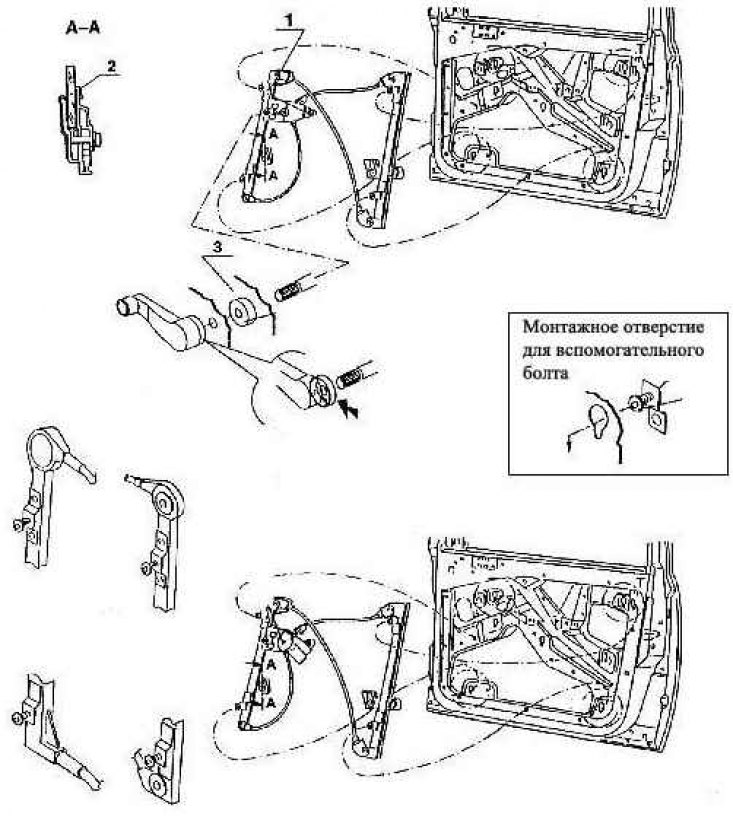
1 – Manually controlled window lifter; 2 – lowering glass; 3 – protective door film
Manual/electric rear side door window lift
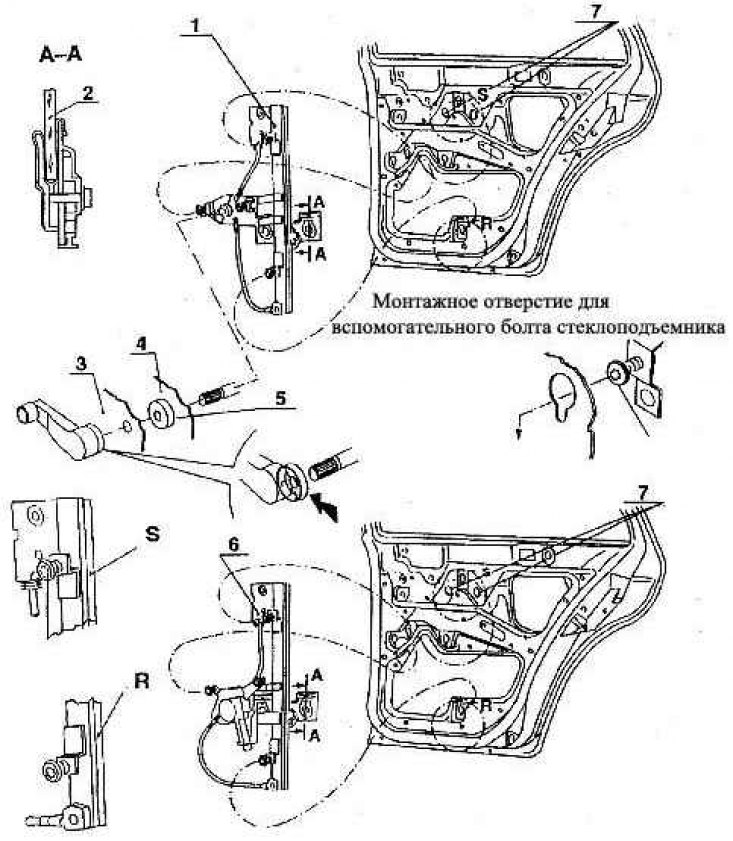
1 – Manually controlled window lifter; 2 – lowering glass; 3 – door packing; 4 – protective film; 5 – sealing pad; 6 – electrically controlled window lifter; 7 – holes for glass tightening
There are two types of window lifts for doors on Skoda Octavia cars. The standard window lift is controlled manually, using the handles on the doors. As special equipment, you can order electrically controlled door window lifts before purchasing the car.
The glass of the door windows is spatially profiled, and therefore their trajectory when lowering and raising must be curved, and the window lifters are adapted to this.
The design of the window lifters differs for the front and rear doors, as well as for the right and left sides. The glass is lowered and raised according to the parallelogram principle, with the glass secured in two places on the lower edge, guided both in a spatially profiled guide bar and in rubber profiles inserted into the door grooves.
The original article is located on skodabook.ru
The window lifters are relatively simple compact mounting units. The metal parts have a zinc-chromium surface protection. When installed in the doors, the window lifters are simply inserted into the profiled holes using auxiliary bolts, moved down and the bolts are tightened. The window lifters installed in the front doors have two running strips, each screwed at the top and bottom to the holes in the inner door sheet. Plastic covers are put on the profile racks of the strips, on which the glass holders are fixed. The glass holders are two steel brackets connected by a bolt, like a collet, which after inserting the glass (inserted into a rubber profile) are pressed against the glass by turning the screw. The movement of the sliders is provided by a steel cable attached to them and driven by the center of the bar. In the upper parts of the bars there are plastic rollers for the cable, in the lower parts the cable slides in plastic guides. The connection of the sliders of both bars is made in a cross so that when moving up and down they are parallel. Between the bars the cable is laid in a flexible sheath.
A bracket carrying a drum winch - a cable leash - is welded to one of the strips. On the outer perimeter of the drum there is a screw groove on which several turns of the cable are wound and which, when the drum is turned in one direction, are wound and twisted in the other direction. A spring brake is also inserted into the drum, limiting the sliding of the glass by pressure on its upper edge. The movement of the drum is carried out either manually by a handle or by an electric motor. Apart from the type of drive, the window lifters are generally the same for both versions.
The rear door window regulator is conceptually similar to the front window regulator. However, since the glass is smaller and lighter, and is guided on both sides along the entire length of the stroke by rubber profiles, the window regulator is designed with only one running strip. Their pads also have two collet holders for securing the glass. The cable winding mechanism, the brake and the cable routing in the roller, runners and in flexible cable guides are similar to those in the front door window regulator. In the manual version, there is a plastic handle with a freely rotating knob mounted on a multi-faceted roller. The handle is fastened by snapping a plastic ring into a groove under the multi-faceted roller. The plastic ring is a part of the handle and when installing or removing the handle, it only shifts along the axis of the handle arm. Electrically controlled window regulators are always installed together with a central lock and heated side mirrors. (For completeness, it should be added that both the central lock and the electric control and heating of the external mirrors on some vehicle modifications can be installed separately).
The electric drive of the front and rear door window lifts is carried out by independent electric motors, which are parts of the window lifts. The technical solution has a high level, documented also by the fact that the equipment has fuses against clamping, unplanned shutdown and other functions.
The control panel for all four windows is located on the driver's door pull handle. In addition, there is electric control for the rear and front window lifters on the passenger side of each of the said doors.
The movement of the glass from the lower position or vice versa continues (at a steady temperature of the car of about 20°C) from three to four seconds. At lower temperatures the time is somewhat longer. Even if the power button is pressed for a very short time (no more than 0.3 seconds), the lowering or movement of the glass will continue until the end of the stroke, even if the switch is not pressed. The stroke is interrupted by another momentary press of the button. In the electric control there is, as already mentioned, a safety device against clamping. This means that if the speed sensor of the electric window lifter motor registers an increase in resistance by 100 N, the device automatically stops the movement of the glass, and greater pressure will turn on the reverse stroke and the glass will lower part of the stroke length or even to the lower position. The safety device does not operate in the last 4 mm before the end of the upward movement and this is so that the glass fits properly into the upper part of the rubber seal. The clamping safety device also does not operate when the upper edge of the glass is below 200 mm (from the top position). The mentioned solution of electric control prevents the window lifter from causing, for example, an injury by trapping a hand or head in the glass. The force moving the glass is comparatively high. When disconnecting the battery and then connecting it, it is necessary to set the upper position of the glass again in the command unit. This is done by holding the control button until the glass reaches the upper position and the mechanism is switched off under the influence of resistance. This position of the glass is fixed by the command unit. Only after this so-called initiation are the above-described functions of the window lifter possible. It is possible to initiate either each window lifter independently or for all windows together, namely with the help of the key of the outer locks. The key is inserted into the lock of the right or left front doors and held in the closed position. The design solution allows both the extension of the windows at any time when closing the doors and the opening of all windows simultaneously if the key is held in the lock in the open position. Version of the design of cars equipped with electric functions of some door elements (electric windows, electric mirrors, heated mirrors, speakers, central locking) provides for the connection of these electrical elements to a common command unit installed in the doors.