



Installation of external handle - side door lock
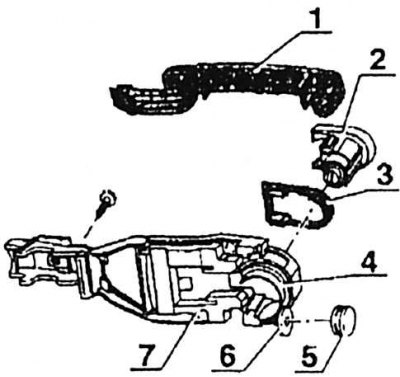
1 – door handle; 2 – patented cylinder lock; 3 – locking pad; 4 – lock cartridge; 5 – lid; 6 - hexagon socket head bolt; 7 – door handle housing
Front door lock
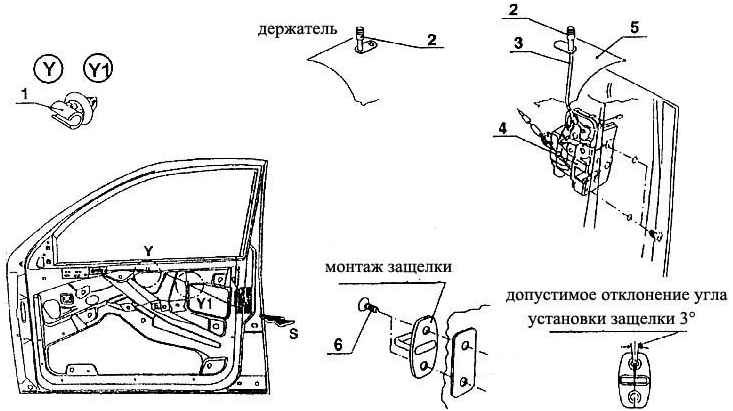
1 – bracket; 2 – traction rod end; 3 – traction; 4 – door lock; 5 – door panel; 6 – screw
Rear door lock
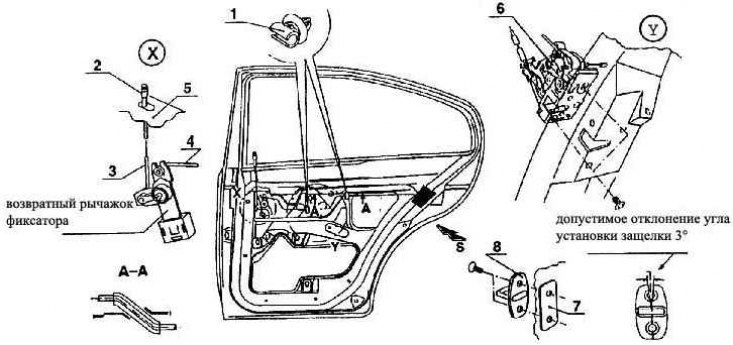
1 – bracket; 2 – end of the locking rod; 3 – locking rod; 4 – traction; 5 – return button of the lock; 6 – door lock; 7 – holder; 8 – latch
Door locks form a complete system, which is understood as the entire complex of the mechanism that allows you to close and open doors from the outside and inside, fix the doors from the inside and lock the front doors from the outside with a key. Patented cylinder locks (so-called larvae) both front doors are combined with a common key for the ignition, the trunk lid lock and the fuel filler cap lock - if installed. It should be emphasized here that the patented locks are NEVER lubricated with oil. Their long-term flawless operation is guaranteed if dirt is removed from it by rinsing in technical gasoline, and after drying, flaked graphite is applied to the cams of the lock mechanism with a key. The internal lock is different for the front and rear doors, as well as for the left and right sides. The lock is installed in the door cavity with two screws accessible from the outside of the door. There is a profiled hole in the door sheet, through which the lock latch installed on the door pillar will pass when the door is closed and slam into the lock. The contact surfaces of the lock (ratchet) with the latch to improve sliding and reduce noise when locking the doors have a plastic coating that increases resistance to abrasion.
The latch of the lock can move when mounted on the pillar of the door frame of the body, which allows the door to be adjusted to the body. The lock can be controlled using an external or internal handle. The external handle is folding with a plastic handrail moderately raised on the surface of the door, in the sheet of which there is a recess for the hand. The mechanism of the handle is directly connected to the lock, namely, a steel cable with a plastic tip. In the external handles of the front door locks there are inserts of patented locks. These locks put the handle on the safety lock when turned with a key. The lock is connected to the internal handle by a steel cable passed through a flexible sheath.
The rear door locks have a so-called child safety device, which, when activated, prevents the doors from being opened from the inside.
All door locks have two slam positions and can be set to safety by a push-button safety switch from the car cabin. The safety switch is connected to the lock by a wire rod. Rear door and front passenger door safety switches (but not the driver) can be activated before the doors are closed. The design of the locks complies with the safety instructions of the UN EHC. The locks prevent the doors from opening spontaneously in an accident, as they are secured in the longitudinal and transverse directions.