



Note.
- Relatively large leaks can be found, for example, by introducing purified and dried compressed air or nitrogen into the refrigerant circuit at a pressure of no more than 15 bar. If the leak is large enough, the leak can be found by the noise emitted by the air or gas escaping at that location.
- Compressed air or nitrogen must be supplied through the service port.
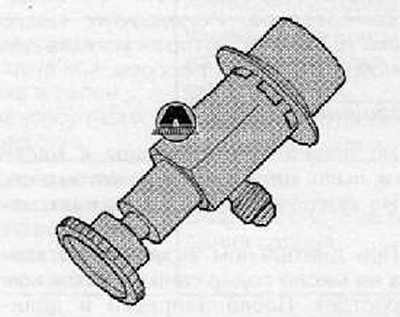
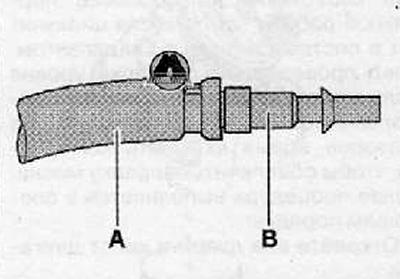
1. You can connect the quick-release adapter for service fittings to the workshop compressor unit using, for example, a modified charging hose -A- (e.g. with 5/8 thread"-18 UNF, depending on adapter thread) and a suitable adapter -B-. In order to prevent moisture, oil and dirt from the workshop compressor unit from entering the refrigerant circuit of the air conditioning unit, in addition to the oil-dirt-water separator of the compressor unit, usually used in painting, use, for example, a combination fine filter by installing it between compressor unit and filling hose -A-.
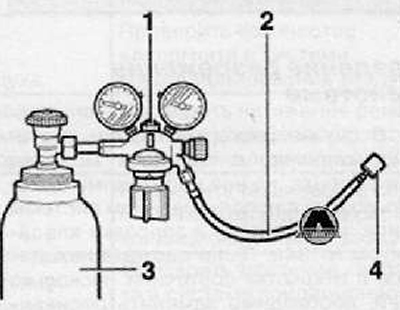
2. Through the block of pressure gauges with a reducer for nitrogen (rated for maximum pressure: 15 bar) -1- and filling hose -2- (e.g. with 5/8 thread"-18 UNF) to the service port (to which the quick connector for service fittings was connected) closed refrigerant circuit, you can connect a gas cylinder -3- with nitrogen.
3. Slowly raise the pressure in the refrigerant circuit to a maximum of 15 bar.
Attention.
- Maximum allowable working pressure: 15 bar.
- Therefore, when searching for a leak using nitrogen, only work with a nitrogen bottle reducer.
4. Locate the leak using the noise emitted by the gas escaping at this point or using the ultrasonic detector -VAG 1842-.
5. Displace the nitrogen with clean and dry compressed air from the refrigerant circuit. Nitrogen must not enter the service bottle. Cause: This causes the service bottle to fill with non-condensable gases.
6. Repair leaks.
7. Evacuate and recheck with a vacuum gauge for several hours. Only if the vacuum is maintained, you can start refueling.
8. If there is a leak through which air does not penetrate or almost does not penetrate, and the air conditioner service station manages to create a sufficient vacuum: The vacuum gauge readings do not increase after the stand is switched off or increase very slowly, indicating that air is penetrating and the vacuum is only lost through a very small leak.
9. Fill the circulation circuit with 100 grams of refrigerant, use an electronic leak detector to find the place of a possible leak and eliminate the leak; or charge the circuit with refrigerant with UV contrast agent, locate the leak in the circuit with the leak detection kit VAS 6201 and repair the leak.
10. If necessary, empty the refrigerant circuit.
11. Evacuate the refrigerant circuit and repeat the vacuum test within a few hours Only if the vacuum is maintained, you can start charging.