



Vehicle owner's manual Skoda Rapid 1

Overview of the front panel of the car
1. Electric windows. 2. Switch for adjusting the position of the exterior mirrors. 3. Deflectors. 4. Multifunction switch lever (turn signals, high beam and parking lights, horn, cruise control). 5. Steering wheel (with...
1. Electric windows. 2. Switch for adjusting the position of the exterior mirrors. 3. Deflectors. 4. Multifunction switch lever (turn signals, high beam and parking lights, horn, cruise control). 5. Steering wheel (with...

Dashboard
1. Tachometer. 2. Display. with odometer, with maintenance indicator, with electronic clock, with multifunctional display, with information display. 3. Speedometer. 4. Coolant temperature gauge. 5. Display modes key:...
1. Tachometer. 2. Display. with odometer, with maintenance indicator, with electronic clock, with multifunctional display, with information display. 3. Speedometer. 4. Coolant temperature gauge. 5. Display modes key:...

On-board computer
Controls Button A and button B are located on the wiper arm. Switching and return on the multifunction steering wheel is carried out using knob D. Memory selection Briefly press button B on the wiper switches or button...
Controls Button A and button B are located on the wiper arm. Switching and return on the multifunction steering wheel is carried out using knob D. Memory selection Briefly press button B on the wiper switches or button...

MAXI DOT (information display)
Attention. On contact with the display (for example, when wiping) remove the ignition key from the lock to prevent damage. Operation via buttons on the wiper lever Main menu (Main menu) called by pressing the A key for...
Attention. On contact with the display (for example, when wiping) remove the ignition key from the lock to prevent damage. Operation via buttons on the wiper lever Main menu (Main menu) called by pressing the A key for...

Vehicle self-diagnosis (Auto-Check-Control)
Vehicle condition The self-diagnosis function is designed to check the status of certain functions and components of the vehicle. The test is continuously carried out with the ignition on, both while driving and when...
Vehicle condition The self-diagnosis function is designed to check the status of certain functions and components of the vehicle. The test is continuously carried out with the ignition on, both while driving and when...
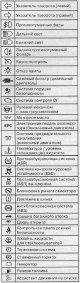
Pilot lamps
Review Warning lamps inform the driver about the inclusion of certain functions or malfunctions in the vehicle's systems and can also be duplicated by sound signals. Attention. If you do not heed the indicator lamps...
Review Warning lamps inform the driver about the inclusion of certain functions or malfunctions in the vehicle's systems and can also be duplicated by sound signals. Attention. If you do not heed the indicator lamps...

Car keys
A. A set of keys without remote control. B. Key with remote control. The car is always supplied with two keys. Depending on the equipment, your car may have keys without a remote control or keys with a remote control....
A. A set of keys without remote control. B. Key with remote control. The car is always supplied with two keys. Depending on the equipment, your car may have keys without a remote control or keys with a remote control....
Central locking system
If a central locking system is used for locking or unlocking, all doors and the fuel filler cap are locked or unlocked at the same time. The trunk lid unlocks when unlocked. The trunk lid can then be opened by pressing...
If a central locking system is used for locking or unlocking, all doors and the fuel filler cap are locked or unlocked at the same time. The trunk lid unlocks when unlocked. The trunk lid can then be opened by pressing...

Device for passive safety of children
Child-proof door lock mounted on the rear side door The rear side doors are equipped with a door protection device against opening by children. Turn the device on and off with the car key. To turn on: Turn the tool slot...
Child-proof door lock mounted on the rear side door The rear side doors are equipped with a door protection device against opening by children. Turn the device on and off with the car key. To turn on: Turn the tool slot...
Safety locking device
The central locking system is equipped with a safety locking device. As a result of locking the car from the outside, the door locks are automatically blocked. None of the doors can be opened with a handle, either from...
The central locking system is equipped with a safety locking device. As a result of locking the car from the outside, the door locks are automatically blocked. None of the doors can be opened with a handle, either from...

Remote control
A transmitter with a battery is installed inside the radio key case (battery). The receiver is located inside the vehicle. The range of the remote control is about 10 m. With weakly charged batteries, the range will be...
A transmitter with a battery is installed inside the radio key case (battery). The receiver is located inside the vehicle. The range of the remote control is about 10 m. With weakly charged batteries, the range will be...

Luggage compartment door
Attention. Make sure the lock clicks into place after closing. Otherwise, the tailgate may suddenly open while driving, even if the lock has been locked - risk of accident! Do not drive with the luggage compartment lid...
Attention. Make sure the lock clicks into place after closing. Otherwise, the tailgate may suddenly open while driving, even if the lock has been locked - risk of accident! Do not drive with the luggage compartment lid...

Switches in the driver's door
Switches in the driver's door The power window can only be used when the ignition is on. Opening windows The window is opened by lightly pressing the button of the corresponding switch. After releasing the switch...
Switches in the driver's door The power window can only be used when the ignition is on. Opening windows The window is opened by lightly pressing the button of the corresponding switch. After releasing the switch...

Turning the headlights on and off
Front Panel: A. Light switch. B. Fuse box: daylight switch. Switching on side lights Turn the light switch to position . Turning on the dipped and main beam headlights Turn the light switch to . To turn on the high beam...
Front Panel: A. Light switch. B. Fuse box: daylight switch. Switching on side lights Turn the light switch to position . Turning on the dipped and main beam headlights Turn the light switch to . To turn on the high beam...

Lever for direction indicators and high beam headlights
Right and left turn signal Move lever up A or down B. To flash the turn signal three times (the so-called comfort turn signal), briefly move the lever up or down to the point of resistance and release. Lane Change...
Right and left turn signal Move lever up A or down B. To flash the turn signal three times (the so-called comfort turn signal), briefly move the lever up or down to the point of resistance and release. Lane Change...
Windshield wipers and washers — general information
Attention. A prerequisite for clear visibility and safe driving is the perfect condition of the wiper blades. Do not use the washer at low temperatures without preheating the windshield. Otherwise, the washer fluid may...
Attention. A prerequisite for clear visibility and safe driving is the perfect condition of the wiper blades. Do not use the washer at low temperatures without preheating the windshield. Otherwise, the washer fluid may...

Wiper and washer controls
The windshield wiper handle has the following positions: Single windshield wipers If you only want to wipe the windshield for a short time, push the handle down to the sprung position (4). As a result of holding the...
The windshield wiper handle has the following positions: Single windshield wipers If you only want to wipe the windshield for a short time, push the handle down to the sprung position (4). As a result of holding the...
Headlight washers
The headlight washers spray the headlights after every fifth spray on the windshield, provided that the dipped beam or high beam headlights are on, after pulling the handle to the position (5), namely the duration of...
The headlight washers spray the headlights after every fifth spray on the windshield, provided that the dipped beam or high beam headlights are on, after pulling the handle to the position (5), namely the duration of...

Front seats
The position of the front seats can be adjusted in various ways, adapting them to the size of the body of the driver and passenger in the front seat. Proper seat adjustment is particularly important for: safe and quick...
The position of the front seats can be adjusted in various ways, adapting them to the size of the body of the driver and passenger in the front seat. Proper seat adjustment is particularly important for: safe and quick...

Head restraint operation
The most effective protection is provided by a head restraint if its upper edge is in line with the crown of your head. Adjusting the height of the head restraints Grab the head restraint from the sides with both hands...
The most effective protection is provided by a head restraint if its upper edge is in line with the crown of your head. Adjusting the height of the head restraints Grab the head restraint from the sides with both hands...

Heated front seats
Seat backs and cushions can be equipped with electric heating elements. By pressing the knob with the symbol, you can switch on and adjust the heating power for the driver's and front passenger's seats. By pressing you...
Seat backs and cushions can be equipped with electric heating elements. By pressing the knob with the symbol, you can switch on and adjust the heating power for the driver's and front passenger's seats. By pressing you...
Heating and air conditioning system — description and general instructions
The heating efficiency depends on the coolant temperature. Therefore, at full power, the heating starts to work only when the engine is warm. The operation of the air conditioner reduces the temperature and humidity of...
The heating efficiency depends on the coolant temperature. Therefore, at full power, the heating starts to work only when the engine is warm. The operation of the air conditioner reduces the temperature and humidity of...

Deflectors for heating and air conditioning systems
Opening air inlets Turn the horizontal handwheel (to other than end position). Closing air inlets Turn the horizontal handwheel to its end position. Changing the direction of the air flow To change the height of the...
Opening air inlets Turn the horizontal handwheel (to other than end position). Closing air inlets Turn the horizontal handwheel to its end position. Changing the direction of the air flow To change the height of the...

Heating and air conditioning control module
Temperature control If you wish to increase the temperature, turn the setting knob (A) to the right. If you wish to lower the temperature, turn the setting knob (A) to the left. Ventilation regulation If you want to...
Temperature control If you wish to increase the temperature, turn the setting knob (A) to the right. If you wish to lower the temperature, turn the setting knob (A) to the left. Ventilation regulation If you want to...
Setting up the heating system
Recommended settings for heating controls for individual modes: Defrosting the windshield and side windows tuning knob (A) - all the way to the right. Fan switch (IN) - to position 3. Air distribution adjustment knob...
Recommended settings for heating controls for individual modes: Defrosting the windshield and side windows tuning knob (A) - all the way to the right. Fan switch (IN) - to position 3. Air distribution adjustment knob...
Air recirculation
Air recirculation mode sucks in air from the interior of the vehicle and returns it to it again. The air recirculation mode allows, if necessary, to prevent the penetration of outside air into the interior of the car,...
Air recirculation mode sucks in air from the interior of the vehicle and returns it to it again. The air recirculation mode allows, if necessary, to prevent the penetration of outside air into the interior of the car,...
Manual Air Conditioner — Description
Climatic is a combined air cooling and heating unit. At any time of the year, it provides an ideal thermal treatment of air. The cooling unit can only operate when the [AC] button is pressed (1) and the following...
Climatic is a combined air cooling and heating unit. At any time of the year, it provides an ideal thermal treatment of air. The cooling unit can only operate when the [AC] button is pressed (1) and the following...

Maintenance of a manual air conditioner
Temperature control If you wish to increase the temperature, turn the setting knob. If you wish to lower the temperature, turn the setting knob (A) to the left. Ventilation regulation If you want to turn on the fan,...
Temperature control If you wish to increase the temperature, turn the setting knob. If you wish to lower the temperature, turn the setting knob (A) to the left. Ventilation regulation If you want to turn on the fan,...
Air conditioning with manual control — device control
Recommended settings for device controls for individual modes: Defrosting the windshield and side windows Leave the tuning knob (A) set to your usual temperature (recommended 22°C); the device will automatically adjust...
Recommended settings for device controls for individual modes: Defrosting the windshield and side windows Leave the tuning knob (A) set to your usual temperature (recommended 22°C); the device will automatically adjust...
Air recirculation in a manual air conditioner
Air recirculation mode sucks in air from the interior of the vehicle and returns it to it again. Air recirculation mode allows. if necessary, prevent the penetration of outside air into the interior of the car, with an...
Air recirculation mode sucks in air from the interior of the vehicle and returns it to it again. Air recirculation mode allows. if necessary, prevent the penetration of outside air into the interior of the car, with an...
Air conditioning with manual control — malfunctions
If the cooling unit does not work at outdoor temperatures exceeding +5°C, this means that a malfunction has occurred. The reasons may be the following: Air conditioner fuse blown. Check fuse and. if necessary, replace...
If the cooling unit does not work at outdoor temperatures exceeding +5°C, this means that a malfunction has occurred. The reasons may be the following: Air conditioner fuse blown. Check fuse and. if necessary, replace...

Steering wheel adjustment
The position of the steering wheel can be adjusted in height and in the longitudinal direction. Adjust the driver's seat first Fold down the handle under the steering column. Adjust the steering wheel to the required...
The position of the steering wheel can be adjusted in height and in the longitudinal direction. Adjust the driver's seat first Fold down the handle under the steering column. Adjust the steering wheel to the required...

Egnition lock
Gasoline engines (1) - The ignition is off, the engine is stopped, the steering mechanism can be blocked. (2) - The ignition is on. (3) - Engine start. Diesel engines (1) - Cut off fuel supply, ignition off, engine...
Gasoline engines (1) - The ignition is off, the engine is stopped, the steering mechanism can be blocked. (2) - The ignition is on. (3) - Engine start. Diesel engines (1) - Cut off fuel supply, ignition off, engine...
Starting the Engine — General
The engine can only be started with the original key. Before starting the engine, shift the gear lever to neutral position (on vehicles with automatic transmission, move the lever to position P or N) and firmly tighten...
The engine can only be started with the original key. Before starting the engine, shift the gear lever to neutral position (on vehicles with automatic transmission, move the lever to position P or N) and firmly tighten...
Starting a gasoline engine
Gasoline engines are equipped with a multi-port fuel injection system that provides an ideal mixture of fuel and air. Do not add gas before and during engine start. If the engine does not start within I0 sec, abort the...
Gasoline engines are equipped with a multi-port fuel injection system that provides an ideal mixture of fuel and air. Do not add gas before and during engine start. If the engine does not start within I0 sec, abort the...
Diesel engine start
Diesel engines are equipped with a preheater (incandescent), the duration of which automatically adapts to the coolant temperature and the outside temperature After the ignition is switched on, the preheat warning light...
Diesel engines are equipped with a preheater (incandescent), the duration of which automatically adapts to the coolant temperature and the outside temperature After the ignition is switched on, the preheat warning light...
Engine stop
Switch off the engine by turning the ignition key to position (1). Attention. Never stop the engine until the vehicle has come to a complete stop - risk of accident! The brake booster only works when the engine is...
Switch off the engine by turning the ignition key to position (1). Attention. Never stop the engine until the vehicle has come to a complete stop - risk of accident! The brake booster only works when the engine is...

Gear shift (Manual Transmission)
Engage reverse gear only when the vehicle is stationary. When engaging reverse gear while the engine is running, wait a short while with the clutch pedal fully depressed in order to reduce transmission noise when...
Engage reverse gear only when the vehicle is stationary. When engaging reverse gear while the engine is running, wait a short while with the clutch pedal fully depressed in order to reduce transmission noise when...

Automatic transmission
Introduction Your vehicle is equipped with a six-speed electronically controlled automatic transmission. The speed steps are switched in ascending and descending order automatically. This is a standard automatic...
Introduction Your vehicle is equipped with a six-speed electronically controlled automatic transmission. The speed steps are switched in ascending and descending order automatically. This is a standard automatic...

Seat belt with pretensioner (in the presence of)
Seat belt system Adjust the seat and head restraint to the correct position before fastening the seat belt. Holding the strap by the tongue, move it slowly across your chest and pelvis. Insert the belt tongue into the...
Seat belt system Adjust the seat and head restraint to the correct position before fastening the seat belt. Holding the strap by the tongue, move it slowly across your chest and pelvis. Insert the belt tongue into the...
Airbags
Attention. To maximize the protection of persons inside the vehicle when the system is put into operation, the front seats must be correctly adjusted to the height of the body of the person sitting on it. If you do not...
Attention. To maximize the protection of persons inside the vehicle when the system is put into operation, the front seats must be correctly adjusted to the height of the body of the person sitting on it. If you do not...

Main technical and operational parameters
Dimensions a) The value is valid for vehicles with the Amundsen+ navigation system. b) The value corresponds to the version with the bad road package. Specification and filling volume of engine oil The factory fills...
Dimensions a) The value is valid for vehicles with the Amundsen+ navigation system. b) The value corresponds to the version with the bad road package. Specification and filling volume of engine oil The factory fills...
This section is available on russian, bulgarian, belarusian, ukrainian, serbian, croatian, romanian, polish, slovak, hungarian
Read similar sections on other Skoda models
➧ General information: User manual Skoda Octavia 3 (2013-2019)
➧ General information: User manual Skoda Superb 2 (2008-2015)
➧ General information: User manual Skoda Felicia (1994-2001)
Link to this section in various formats
TEXTHTMLBB Code
- General information
- Faults en route
- User manual
- Maintenance and care
- Power unit
- Petrol engines
- Diesel engines
- Power and control system
- Lubrication system
- Cooling system
- Intake and exhaust system
- Transmission
- Clutch
- Mechanical gearbox
- Automatic gearbox
- Drive shafts
- Chassis (running gear)
- Front suspension
- Rear suspension
- Brake system
- Steering
- Body and interior
- Exterior (external elements)
- Interior (internal elements)
- Doors, locks and windows
- Heating and air conditioning
- Security systems
- Electrical equipment
- Equipment and devices
- Power devices
- Electrical circuits
- Electrical circuits (petrol)
- Electrical circuits (diesel)