



Sealing and bonding mastic on the engine compartment cover - bonnet
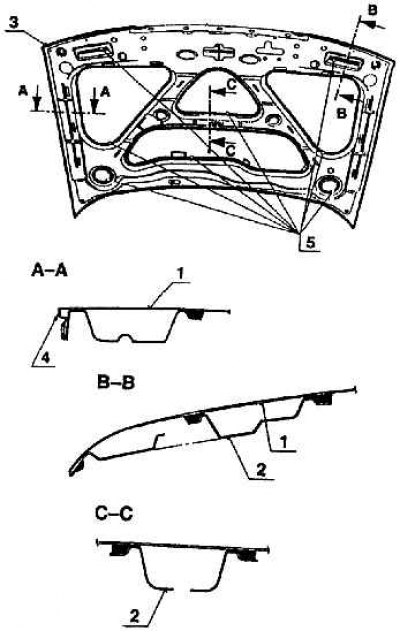
1 – outer hood sheet; 2 – inner hood sheet; 3 – edge adhesive; 4 – wall facing the gap; 5 – adhesive and sealing mastic
Mounting the radiator grille to the engine compartment cover – hood
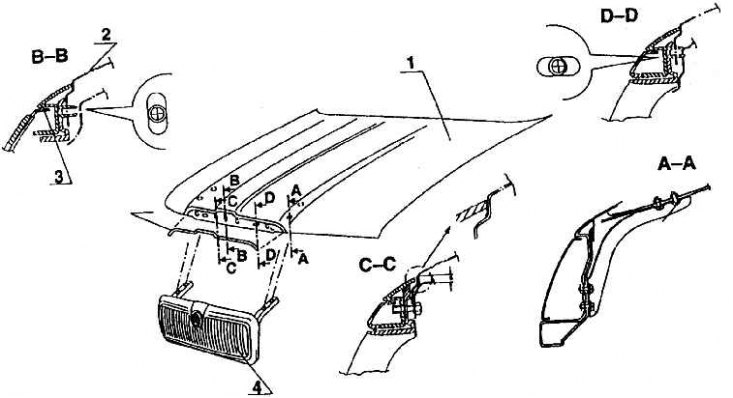
1 – engine compartment cover – hood; 2 – outer hood sheet; 3 – radiator trim; 4 – protective film
Strengthening the anti-noise insulation plate
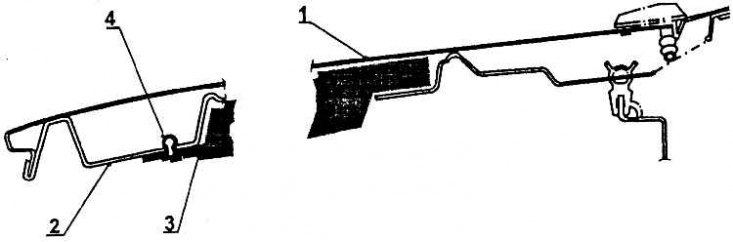
1 – hood surface sheet; 2 – bonnet stiffener; 3 – noise insulation; 4 – clamps (7 pcs.)
The engine compartment cover (see Fig. Sealing and bonding mastic on the engine compartment cover - hood, Fig. Mounting the radiator trim to the engine compartment cover - hood) consists of a surface steel stamping, stamping of the lower stiffener, fastening of the lock hole and fastening at the hinges. The lock hole is a closed hook, which is the latch of the cover lock. On the upper sheet of the hood, stiffeners are pressed out, which are also an element of the aesthetic perception of the body.
The stamping of the upper sheet is welded to the lower stiffener in the front part and a flanging is made along the contour. Adhesive mastic is applied to the flanging surfaces. Since it is necessary that the visible edge and the wall of the cover contour in the gaps be smooth, without traces after flanging, the flanging is made in the form of a stepped wall, i.e. on the vertical wall.
The hood is suspended at the rear on two single-axis hinges, each screwed with two bolts to the lid and two to the frame. Thanks to the holes for the bolts, the lid can be moved and thus adjust both the gaps and the surface overhang. When opening the hood, it can be supported by a folding support made of round steel. The support is attached with a turn on the right side (in the direction of movement) on the front cross wall. It extends towards the hood with its hook-shaped end.
The radiator grille is attached to the front of the hood with four bolts. On the sides, the grille is held in place by two brackets attached with two bolts. It follows that the grille is part of the lid and moves with it. The radiator grille consists of three plastic stampings, two of which are welded together. The outer part of the grille is varnished to match the color of the car and a decorative trim with a chrome effect is attached to it. The lid lock belongs to the front wall mounting unit.
In some cars, sound insulation is also attached to the lower surface of the hood. It is a non-flammable sandwich consisting of a polyurethane part and non-woven textile. The sandwich is placed behind the protrusions of the stamping of the hood stiffener near its rear edge. On the sides and in front, the insulating plate is grabbed by elastic plastic clamps pressed into rectangular cutouts in the lower sheet of the hood. The insulating element can be removed without damaging either the sandwich or the clamps (see fig. Strengthening the noise insulation plate).