



Scheme of strengthening the contact in the connector housing
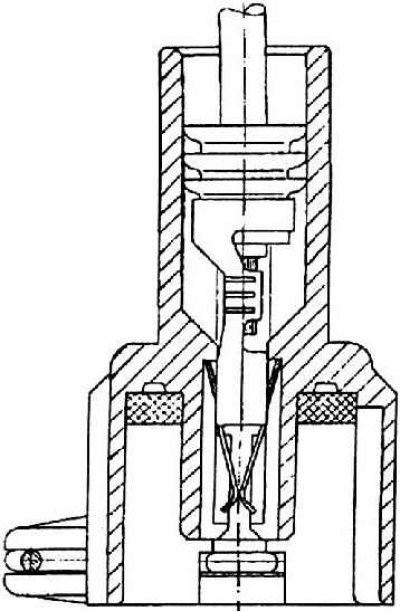
The contact is secured in the connector housing without secondary fixation by an additional cartridge.
Contact
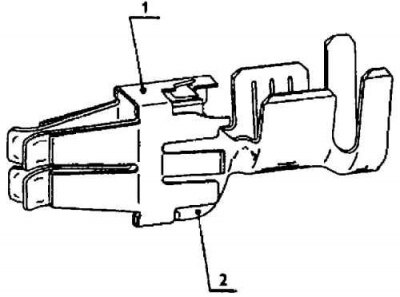
1– fixing part (stainless steel);
2 – contact body (tinned bronze)
Circuit connection diagram
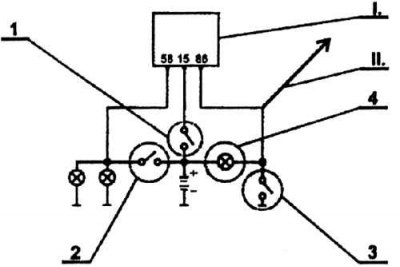
1 – ignition switch; 2 – headlight switch; 3 – door switch; 4 – interior lighting; I – alternative; II – alternative
The electrical wiring is designed for a nominal voltage of 12 V (working voltage 14 V) single-wire system. This means that one wire – the minus pole – is replaced by a metal frame and metal parts of the car. The wiring is made of copper braided wire of the FLRY type. The wire cross-section is from 0.35 to 35 mm. The wire insulation is made of hardened plastic of different colors. The color is determined according to the wire function and is specified by the standard (DIN).
The wires are collected in bundles and wrapped with adhesive tape. In the car cabin, the bundles are wrapped exclusively with textile tape, in the engine compartment in some parts with textile tape, in other places with PVC tape. One bundle runs through the entire car from the engine compartment to the rear lights. The next two bundles are in the engine compartment, four bundles lead to the side doors and two or even three (depending on the vehicle specification) to the rear flap. Along the way, the bundles are attached with plastic clamps, which are either inserted with spikes into the punched holes in the sheets, or thrown over bolts welded to the body. In two places - the engine compartment and along the central tube under the dashboard - the bundles are passed through dismembered figured plastic channels. Interestingly, the washer tubes are also a component of the cable bundles. The wiring routes are specified by the manufacturer and cannot be further changed. This position meets all the instructions and its implementation is supported.
This layout concept, firstly, increases reliability, and secondly, allows the wiring to be made up of separate simple bundles in different variants (when installing special equipment or another version of the car - LX, GLX, SLX), as well as in the case of further expansion or new functions, so that there is no need to redesign the entire wiring system or change it on the finished car. Cable wiring includes all connectors, terminal blocks, fuse panel with small and large fuses, relay panel and switch box as installation units.
The connectors have reliable contact with the wires, then fixation of the contact in the terminal block housing and, in addition, further mechanical secondary fixation with an additional cartridge. The contact is fixed with two elastic tabs. After inserting the terminal blocks, the housings are mechanically fixed from falling out. The contact material is binary. The contact part is made of tinned bronze, the fixing part is made of stainless steel. Connectors of extremely important connections and connections in the engine compartment are gold-plated. In Fig. Scheme of strengthening the contact in the connector housing, Fig. Contact schematically shows the fixation of the contact in the connector body and the contact itself. This solution is of high quality both from a design point of view and from a production point of view and guarantees defect-free operation of the electrical system. Complete bundles of wires after production are 100% checked and controlled by a tester for operability.
There are a great many types and combinations of cable wiring. They differ according to the type of car, its version, modification, equipment, etc. Connection diagrams are available in the ŠKODA service department, which you should contact in case of a malfunction of the electrical system.
In all cars that are not equipped with SPDP (an abbreviation for cars intended for a country that requires driving with permanently switched on headlights - headlights for daytime use), the instrument panel is equipped with an AKIN circuit - a headlights-on indicator. The AKIN circuit indicates with an acoustic signal that the headlights are switched on if the driver has the doors open and the ignition is switched off at the same time. The AKIN circuit connection diagram is shown in Fig. Circuit connection diagram. The first connection option applies to cars in the LX version, i.e. without a central lock.
The second connection option is used in cars with central locking.
Wire N 86 is connected to the central lock control unit (serial in GLX and SLX versions).
The car is also equipped with an X-contact or unloading relay. It is located on the relay panel (position 2). The relay with the X function ensures automatic shutdown of all consumers except for the parking lights during engine start-up. This is to unload the battery when the starter draws a large current.
Further enhancing the comfort for the consumer is the automatic connection of the sleeper, which controls the interior lighting. When the doors are left open, it switches off the interior lighting after 30 minutes. If the lighting is on with the doors closed and is not switched off within 60 minutes, it switches off automatically. Thanks to this, the battery does not discharge due to the lighting not being switched off.