



Safety symbols on the battery cover
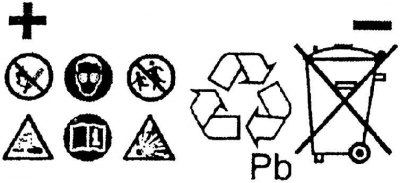
Four types of batteries are installed in Skoda Octavia cars in primary production. For cars with a carburetor engine 1.6–55 kW; 1.6–74 kW; 1.8–92 kW alternatively (depending on the equipment, sometimes at the customer's request) 44 A-hour batteries are installed (weight 14 kg) or 60 A-hour (weight 17.7 kg). For cars with 1.9 SDI and 1.9 TDI diesel engines, 70 A-hour batteries are again installed as an alternative (weight 19.4 kg) or 80 A-hour (weight 21.8 kg). The battery mass includes the mass of the electrolyte.
They comply with DIN 72 311 and DIN 43 539, including the lower reinforcing flange. The battery cases are made of natural polypropylene, the elements are closed with a common lid made of the same material and separated from each other by partitions. The screw caps are recessed flush with the upper surface of the lid. The lid is integrally united with the case. Thin-walled stampings of the case and lid, together with the low density of polypropylene, reduce the weight of the battery. The case has protrusions with the designation MAX and MIN, corresponding to the highest and lowest permissible electrolyte levels.
The batteries are referred to as non-repairable. (They have the designation W, which is an abbreviation of the German word Wartungsfrei – maintenance-free). This refers to a design with low self-discharge, stable charging characteristics and a long interval for adding distilled water (once or twice a year, depending on operating conditions and the condition of the charging equipment). In no case does this mean that topping up with distilled water is completely excluded! When the electrolyte level drops below the limit indicated by MIN, the battery undergoes irreversible sulfation of the plates, which is a chemical change that permanently reduces the operational capacity of the battery and completely damages it.
A fully charged battery can withstand temperatures down to -50°C, while a discharged battery freezes at just a few degrees below 0°C. The density of the electrolyte in a fully charged battery is 1.28 g/cm³. The battery's charge level can be roughly determined using a hydrometer, which has both the electrolyte density and the charge level marked in its own units (measured at a temperature of 25°C).
Maintenance of the battery consists of adding distilled water and checking the cleanliness of the terminals. The terminals must be clean and properly tightened. It is permissible to protect the metal parts with a thin layer of preservative grease.
View the original on the website skodabook
Qualified battery maintenance is provided by a qualified Skoda and Akuma service center.
Safety regulations
When working with a battery, it is necessary to protect your eyes with glasses or a shield.
Because the electrolyte is a caustic substance (contains sulfuric acid), skin affected by electrolyte should be immediately washed and neutralized. Wool and cotton fabrics decompose under the influence of electrolyte, and silone dissolves.
When charging the battery, oxygen and hydrogen are released from the electrolyte in an explosive ratio. Therefore, do not use open fire nearby or engage in activities that may generate sparks. When short-circuiting, the battery will become very hot and an explosion may occur. When performing any work on electrical equipment, the battery must be disconnected. In this case, first disconnect the body contact (-) and only then the contact (+). When connecting, do the opposite: first connect the plus contact (+), then the minus contact (-). Contacts must NEVER be mixed up! With the (-) contact connected and ALL consumers in the car disconnected, a spark must not be produced by touching the contact to the pole tip. The appearance of a spark indicates a short circuit in the vehicle's electrical system. This can also be detected by placing a light bulb between the terminal of the (-) battery pole and the unconnected contact of the body wire.
At the end of the battery's service life, it CANNOT be thrown away, but must be handed over to the service's collectors for restoration.
The symbols on the battery cover remind you of all the safety precautions listed above.