



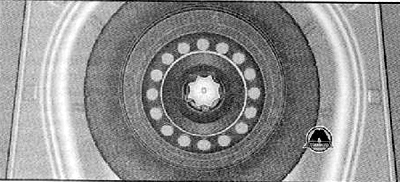
Before proceeding with the replacement of the wheel, it is necessary to carry out the following preparatory work:
- in the event of a tire puncture, park the vehicle as far away as possible from passing vehicles. It is good that this place is located horizontally.
- ask all passengers to get out of the car. During repairs, they must be off the road (e.g. behind the road barrier).
- firmly tighten the hand brake lever.
- engage first gear or adjust the automatic transmission selector lever to position "R".
- Unhitch the trailer if you are using a vehicle with a trailer.
- remove the tool kit and spare wheel from the trunk.
Attention.
- If you are on the road in a normal traffic area, turn on your hazard warning lights and place the warning triangle at an appropriate distance from your vehicle - in accordance with the relevant legal provisions. This way you protect not only yourself, but also other road users.
- When the vehicle is raised, never start the engine - risk of injury.
- When changing a wheel on a vehicle that is on a slope, block the opposite wheel with a rock or the like to prevent the vehicle from moving suddenly.
Carry out the wheel change, if possible, on a horizontal surface:
- remove the solid wheel cap or wheel bolt caps.
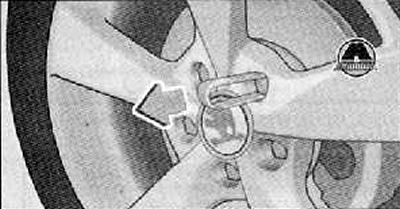
- for light alloy wheels, remove the trim cap.
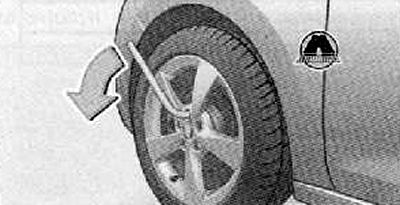
- loosen the wheel bolts.
- raise the vehicle until the relevant wheel is no longer in contact with the ground.
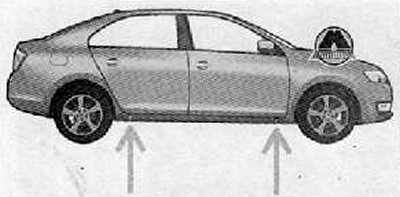
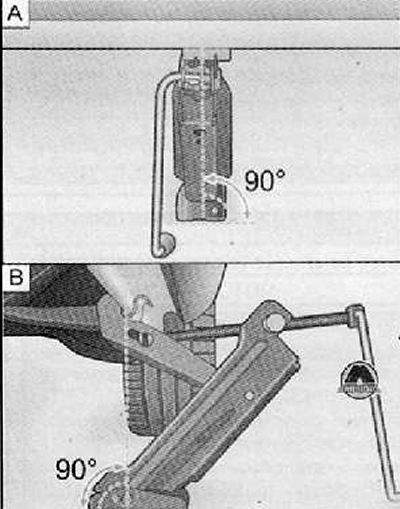
Position the jack in such a way that the claw covers the vertical post in the recess under the threshold (A) and so that the bearing area of the base of the jack (IN) rested its entire area on a flat surface of the base.
- remove the wheel bolts and place them on a clean base (rag, paper, etc.).
- remove the wheel.
- put on a new spare wheel and lightly tighten the bolts.
- lower the car down.
- tighten the opposite wheel bolts alternately with a wrench (crosswise).
- put back the solid wheel cap and the decorative cap or the caps of the wheel bolts.
Note:
- All bolts must be clean and turn freely in the thread
- Never lubricate the bolts with grease or oil!
- When installing a tire with a certain direction of rotation, observe this direction.
Tires with directional tread pattern
Wheels with such tires must be set correctly.
Tires with a directional tread pattern have arrows on the sidewall to indicate the direction in which the tire rotates. The specified direction should be ensured when mounting the wheels on the vehicle. At the same time, all the advantages of such tires in terms of grip, wear, noise and aquaplaning are realized.
If the wheel is set so that it rotates against the arrows, move carefully, as in this case the tire does not work well. This is especially evident when driving on wet surfaces. To take full advantage of a directional tyre, replace the wheel with one that has the desired tire position as soon as possible.
Attention
- Incorrect tightening of wheel bolts and defective wheel bolts can cause an accident.
- When changing a wheel, make sure that the wheel bolts and their threaded holes are clean. The wheel bolts should be relatively easy to screw in.
- Wheel bolts and hub threads should never be lubricated. Otherwise, the wheel bolts, even if tightened to the correct torque, may come loose while driving.
- Use the hex key in the screwdriver handle to loosen or screw in the wheel bolts, not to loosen or tighten them.