



Warning: The sealant in the tire repair kit is harmful to health, if the sealant gets on your skin, wash it off immediately with plenty of water. When driving with a tire repaired with the kit, do not exceed 80 km/h, avoid sudden acceleration/braking and fast cornering.
The tire repair kit is located under the luggage compartment floor covering (see illustration 4).
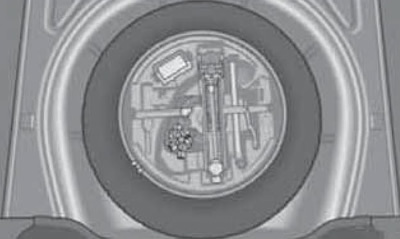
4 On-board tool kit in spare wheel
The purpose of the kit is only to enable the driver to get to the nearest service station, since a tire restored in this way does not provide the previous driving characteristics of the car and is subject to immediate replacement or, if possible, repair. With this kit, you can plug punctures up to 4 mm in diameter in one tire, while the object that damaged the tire should not be removed.
The sealant included in the kit should not be used in the following cases:
- in case of damage to the wheel rim;
- at outside temperatures below -20°C;
- for cuts or punctures greater than 4 mm;
- if the sidewall of the tire is damaged;
- after driving on a very flat tire;
- after the sealant's expiration date;
The composition of the tire repair kit is shown in Illustration 8.
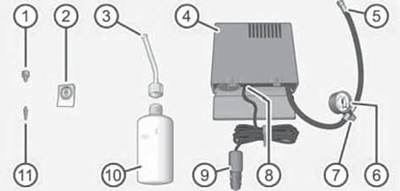
8 Composition of the tire repair kit
1 Device for unscrewing the valve core
2 Sticker with inscription "max. 80 km/h " or "max. 50 mph "
3 Hose with plug
4 Compressor
5 Tire inflation hose
6 Manometer
7 Pressure relief screw plug (air release)
8 Switch
9 Cable connector for 12 Volt socket
10 Container with sealant
11 Spare valve
Before using the kit, stop the car in a safe place on a level, horizontal surface, if possible with a hard surface. If necessary, turn on the hazard warning lights and put out the emergency stop sign. Set the front wheels to the straight-ahead position and apply the parking brake. On models with DSG, set the selector lever to the "P" position, and on models with a manual transmission, set the gearshift lever to the 1st gear or reverse gear position. Switch off the ignition and ask the passengers to leave the car. If the luggage compartment is loaded, remove the load. If there is a trailer, disconnect it and ensure that it does not create a threat or obstruction to other road users.
Make sure the tire can be repaired with a repair kit and get a tire repair kit. Stick the sticker from the kit so that it is visible from the driver's seat. Support it with wheel chocks on both sides (see subsection above) or other suitable objects, the wheel located diagonally from the one to be replaced. Do not remove the foreign object that damaged the tire, do not lift the car on a jack!
The following describes the sequence of actions for repairing a tire. Also, instructions for using the tire repair kit are included with the kit itself.
Note: The numbers in brackets indicate positions in Figure 8.
1 Remove the nipple cap and use the tool (1) to unscrew the valve core. Place the valve core on a clean surface.
2 Shake the container 110) with the sealant vigorously several times.
3 Screw the hose (3) tightly onto the cylinder clockwise - the hose pierces the sealing foil. Remove the plug from the other end of the hose and put it on the tire valve.
4 Holding the container with the sealant upside down, pour all the sealant into the tire, then disconnect the empty container from the valve.
5 Using the tool (1), screw the valve back into the nipple and screw the compressor hose (5) tightly onto it.
6 Make sure that the air bleed plug (7) is tightened.
7 Start the engine, insert the connector (9) into a 12 Volt socket and turn on the compressor using the switch (8).
8 Inflate the tire to 2.0-2.5 bar and turn off the compressor.
Note: Do not allow the compressor to operate continuously for more than 8 minutes; allow it to cool for a few minutes before turning it back on. Avoid burning yourself on the compressor or its hose, which may become hot during operation.
9 If you are unable to inflate the tire to the specified pressure, disconnect the hose from it, move the car 10 meters forward or backward so that the sealant is distributed over the tire, screw the compressor hose back onto the valve and try to inflate the tire again.
10 If the tire still cannot be inflated to the required pressure, the puncture is too large and there is no point in using the kit. In this case, you should install a spare wheel or call for technical assistance.
11 Disconnect the compressor hose and connector from the tire/socket, then start driving as soon as possible, without exceeding 80 km/h.
12 After 10 minutes of driving with a tire repaired using the kit, you should check its condition again: reconnect the compressor hose and check the pressure on the pressure gauge. If the pressure is 1.3 bar or less, you should stop driving, since the tire could not be repaired. If the pressure is 1.4 bar or more, go to step 7 to adjust the pressure to the desired value (see sticker on back of fuel filler flap).
13 Go to the nearest service station to replace the tire repaired with the kit. The container with the used or expired sealant should be disposed of; a new container of sealant can be purchased from a Skoda representative.