



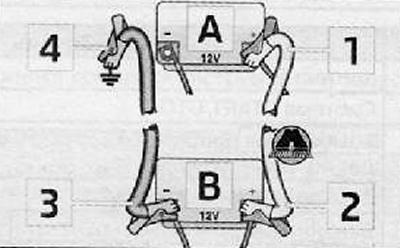
Connection of positive terminals:
- connect end (1) to the positive terminal of the discharged battery (A).
- connect the opposite end (2) to the positive terminal of the auxiliary battery.
Negative terminal connection:
- connect end (3) to the negative terminal of the auxiliary battery (B).
- connect the opposite end (4) to a part of the vehicle being started that is firmly connected to its engine block, or connect it directly to the engine block itself.
Engine start:
- start the engine of the auxiliary vehicle and let it idle.
- now start the engine of a car with a discharged battery.
- if the engine does not start, stop starting the engine after 10 seconds and try again after 30 seconds.
- disconnect the wires in exactly the reverse order to that described above.
Mutual contact between bare, non-insulated parts of the terminals must not be allowed. In addition, the wire connected to the positive terminal of the battery must not be allowed to come into contact with live parts of the vehicle - risk of short circuit!
Do not connect the cable to the negative terminal of a discharged battery, otherwise the strong sparking that occurs when starting the engine may cause the battery to explode.
Do not connect the end of the wire to any part of the power supply system or to the brake system.
Position the jumper cables so that they cannot be damaged by rotating parts in the engine compartment.
Do not lean over the battery - risk of injury from corrosive electrolyte!
The battery cell caps must be screwed in securely.
Do not use open flames near the battery (a burning candle, a lit cigarette, etc.) - danger of explosion!