



Note: Below is a description of possible faults for all turbochargers. This is a general description, so some problems may not apply to your engine.
If problems with engine operation occur - loss of power, poor response to accelerator pedal operation, abnormal engine noise or engine oil leaks - it is necessary to perform procedures to identify the causes of malfunctions:
1. Check the correctness and reliability of the assembly and connection of the turbocharger to the exhaust pipe.
- A. Check and ensure that new gaskets are installed.
- B. Check and ensure that the bolts and nuts are securely tightened
- C. Check connections for exhaust leaks.
- D. Check all elements of the intake and exhaust system for damage and breakage.
Exhaust gas leaks due to a damaged or un-installed gasket, as well as bolts (or nuts) that are not properly tightened, can lead to abnormal engine sounds.
If these faults are detected, it is necessary to unscrew and tighten the bolts and nuts of the fastening with the required tightening torque. If necessary, replace the damaged gasket.
2. Check the correctness and reliability of the turbocharger assembly with the exhaust manifold.
- A. Check and ensure that the gasket between the turbocharger and manifold is installed.
- B. Check and ensure that the bolts and nuts are securely tightened.
- C. Check connections for exhaust leaks.
- D. Check all elements of the intake and exhaust system for damage and breakage.
Exhaust gas leaks due to a damaged or un-installed gasket, as well as bolts (or nuts) that are not properly tightened, can lead to abnormal engine sounds.
If these faults are detected, it is necessary to unscrew and tighten the bolts and nuts of the fastening with the required tightening torque. If necessary, replace the damaged gasket.
3. Check the correctness and reliability of the installation of the exhaust manifold on the cylinder head.
- A. Check and ensure that a new gasket is installed between the manifold and the cylinder head.
- B. Check and ensure that the bolts and/or nuts are securely tightened.
- C. Check connections for exhaust leaks.
Exhaust gas leaks due to a damaged or un-installed gasket, as well as bolts (or nuts) that are not properly tightened, can lead to abnormal engine sounds
If these faults are detected, it is necessary to unscrew and tighten the bolts and nuts of the fastening with the required tightening torque. If necessary, replace the damaged gasket.
4. Check the reliability and correctness of the connection of the supply and return oil pipes to the turbocharger and to the engine.
- A. Check and ensure that new hose gaskets are installed.
- B. Check and ensure that the bolts and/or nuts are securely tightened.
- C. Check the oil pipes for damage (excessive bending, twisting or cracking).
Exhaust leaks due to a damaged or loose gasket, or loose mounting bolts, can result in engine oil leaks.
If the supply pipe is damaged, there may be a shortage of oil pumped into the central body of the turbocharger, which may lead to its damage. If the return pipe is damaged or clogged, the process of oil drainage from the turbocharger is disrupted, which may lead to engine oil leaks.
If these faults are detected, it is necessary to unscrew and tighten all fastening bolts (or nuts) with the required tightening torque. Replace the pipe gaskets or pipes, if necessary.
5. Check for engine oil leaks at the connection between the central housing and the compressor housing.
- A. Check and ensure that the fastening elements are secure.
- B. Check for engine oil leaks.
Engine oil leaks can be caused by damage to the sealing ring (gasket) between the central housing and the compressor housing.
If engine oil leaks are detected, the turbocharger assembly must be replaced
6. Check the actuator vacuum hose, as well as the turbocharger hoses and pipes.
- A. Make sure the vacuum hose is properly and securely connected to the turbocharger actuator.
- B. Check and ensure that the vacuum hoses and fittings are not blocked (excessively bent, twisted or torn).
- C. Check vacuum lines for cracks.
- D. Check and make sure the vacuum hoses are connected to the outlet and inlet on the solenoid valve properly.
Loss of power and poor response to the accelerator pedal may be caused by damaged or disconnected vacuum hoses and pipes.
If this fault is detected, it is necessary to replace all damaged pipes.
7. Check the operation of the turbocharger actuator.
A. Electronic actuator (depending on the configuration): check and ensure that the rod moves smoothly and without jamming when a control signal is applied to the actuator, using special equipment.
Note: The turbocharger shown below is a schematic and may differ from the actual one.
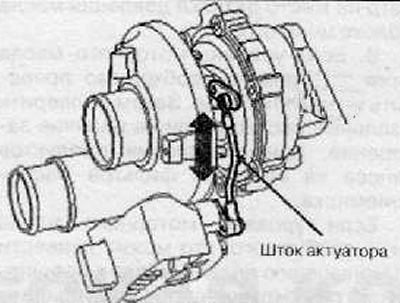
Loss of engine power and poor response to the accelerator pedal may be caused by damage to the turbocharger actuator.
If this defect is detected, the turbocharger assembly must be replaced.
8. Check the compressor impeller.
- A. Check the compressor impeller for damage to the blades as shown in the figure below
- B. Check the smooth rotation of the compressor.
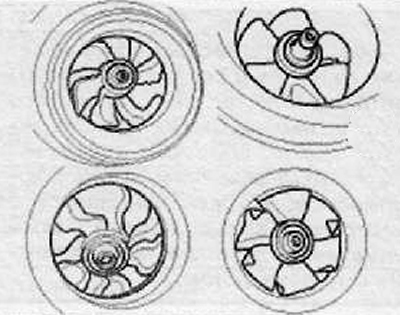
The cause of abnormal engine operation sound and weak response to the accelerator pedal may be damage to the compressor impeller.
If any defects are found in the compressor impeller, the turbocharger assembly must be replaced.
9. Check the technical condition of the turbine impeller.
- A. Check the turbine impeller for damage to the blades as shown in the figure below.
- B. Check the smooth rotation of the turbine.
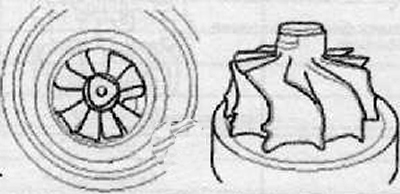
The cause of abnormal engine noise and weak response to the accelerator pedal may be damage to the turbine impeller.
If any defects are found in the turbine impeller, the turbocharger assembly must be replaced.
If the cause of the engine malfunction is not directly related to the turbocharger, it is necessary to check all systems related to supercharging.
1. Check the excess pressure relief hose.
- A. Check the ventilation hose for damage or improper installation.
- B. Check the positive crankcase ventilation (PCV) valve for clogging.
If the ventilation hose is damaged or clogged, the internal pressure in the engine may increase, which will lead to a deterioration in the supply of engine oil to the turbocharger and its subsequent failure and/or oil leaks.
If these defects are detected, it is necessary to replace the ventilation hose or system components.
2. Check the reliability of the connection of the air pipe to the turbocharger.
- A. Check the technical condition of the air duct (for damage, cracks or compression).
If the cross-section of the air duct is reduced due to damage, twisting or excessive bending, the air pressure at the intake will drop sharply. This can lead to turbocharger failure or engine oil leaks. If the air duct is torn or disconnected, foreign objects can enter the turbocharger, which will lead to its failure.
If any defects are found in the air duct, it must be replaced with a new one.
3. Check the air filter.
- A. Check the filter element.
- B. Check the air filter for water in its housing.
- C. Check the air filter cover for contamination.
- D. Check and ensure that the filter element part number matches the required one.
If the air filter becomes clogged, the air pressure at the intake will drop sharply. This can lead to turbocharger failure or engine oil leaks.
If any malfunctions in the turbocharger are detected, the air filter must be replaced with a new one.
4. Check the technical condition of the hoses and pipes of the intermediate cooler.
- A. Check and ensure that the intercooler hoses and pipes are connected correctly and securely.
- B. Check the intercooler pipes and hoses for damage (excessive twisting, bending or breaking).
- C. Check the intercooler hoses for cracks (depending on the configuration).
- D. Check and ensure that all mounting clamps are properly positioned.
If the pipes or hoses of the intermediate cooler are damaged or disconnected, engine oil may leak through the hoses and pipes, and the maximum permissible rotation speed of the turbocharger may increase, causing it to fail.
If any defects are found in the intercooler pipes and hoses, they must be replaced with new ones.
Note: When replacing the intercooler pipes and hoses, it is necessary to replace their fastening clamps.
5. Check the technical condition of the intermediate cooler.
- A. Check the coolant tubes and tanks for damage.
If the intermediate cooler is damaged, the maximum permissible rotation speed of the turbocharger may increase, leading to its failure.
If any defects are found in the intercooler, it must be replaced with a new one.
Note: When replacing the intercooler, it is necessary to replace the clamps that secure the pipes and hoses.
6. Check the technical condition of the engine oil.
- A. Check the engine oil level.
- B. Check the engine oil for discoloration, water contamination and loss of viscosity characteristics.
- C. Check that the engine oil meets the recommended standards.
If the engine oil level is below the required level, this may result in reduced oil supply to the turbocharger bearings and poor heat dissipation.
If this violation is detected, it is necessary to add engine oil to the required level or replace it.
Note: Check the oil to ensure it meets the required specifications.
7. Check the engine oil pressure in the engine system.
- A. Measure the engine oil pressure in the system by installing a pressure gauge in place of the oil pressure sensor in the cylinder block.
- B. If the engine oil level is below the required level, it is necessary to check the oil receiver. Then check the oil sprayers for blockages, if wear products accumulate on the mesh filter of the oil receiver.
If the engine oil level is below the required level, this may result in reduced oil supply to the turbocharger bearings and poor heat dissipation.
If this fault is detected, it is necessary to top up the engine oil to the required level or replace it. If wear products accumulate, it is necessary to wash and clean the mesh filter of the oil receiver, it is also necessary to replace the gaskets of the oil sprayers, having first checked the cleanliness of the sprayer channels. Check the technical condition of all elements of the lubrication system, for example, the oil pump (see the chapter "Lubrication system"),
Attention. Always pay special attention to the quality and condition of the engine oil, as the loss of its viscosity and other characteristics can lead to serious damage to the turbocharger, which rotates at a frequency of 100 thousand rpm. Also pay attention to the entire lubrication system as a whole.
8. Check the technical condition of the turbocharger electromagnetic valve.
- A. Check and ensure that there is a vacuum in the actuator vacuum hose when switching the turbine operating mode, using special diagnostic equipment (checking the operation of the electromagnetic valve).
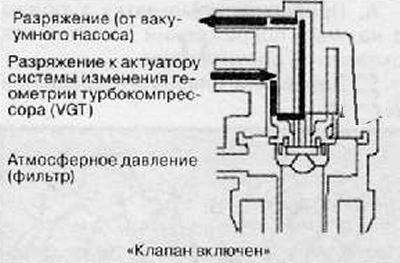
- B. When changing the turbine operating mode (using special diagnostic equipment) on forced - the vacuum in the actuator vacuum hose should be quickly released. If the electromagnetic valve filter is clogged, the vacuum will either not be released or will decrease very slowly.
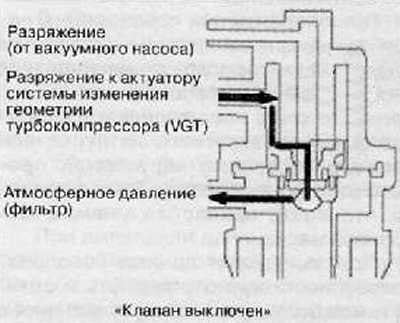
If the solenoid valve is damaged, the VGT actuator will not work properly, resulting in loss of engine power and poor response to the accelerator pedal. If the solenoid valve filter is clogged, the turbocharger assembly may fail due to excessive speed.
If defects are found in the electromagnetic valve, it must be replaced with a new one.
9. Check the technical condition of fuel injectors, sensors, exhaust gas recirculation valve, etc.
- A. Check the operation of the fuel injectors.
- B. Check the condition of the engine management system sensors, such as the mass air flow sensor (MAPS), intake air temperature sensor (IATS), and boost air pressure sensor (BPS).
- C. Check and ensure that the Exhaust Gas Recirculation (EGR) valve is operating properly.
Malfunctions in fuel injectors, sensors, exhaust gas recirculation (EGR) valve, etc. can result in loss of vehicle power.
If any faults or defects are detected, it is necessary to replace the damaged elements with new ones.