



Note.
- Necessary special devices, control and measuring instruments, as well as auxiliary means:
- Remote control device, for example (VAG 1348/ZA).
- Adapter (s). (V.A.G 1348/3-2).
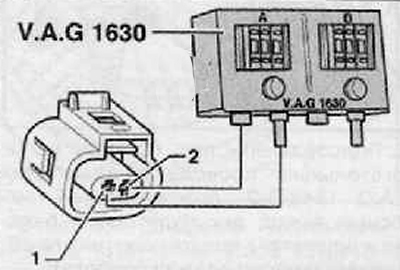
- Digital potentiometer, (V.A.G 1630).
- Auxiliary measuring kit (VAG 1594 A, B nebo C).
- Measuring cylinders. (V.A.G 1602).
Note.
- Make sure the fuel pump relay is OK. Also make sure the fuel pump is working properly.
- The fuel temperature at which the tests must be carried out must be 15-20°C, the fuel must comply with current standards.
1. Remove, if necessary, the decorative engine cover together with the air filter.
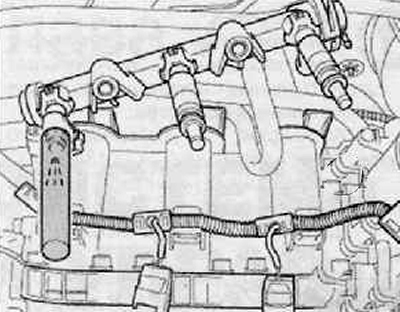
2. Remove the fuel rail together with the fuel injectors without disconnecting the fuel hoses from the rail (for more details, see the relevant section in this chapter).
Checking the fuel injection jet and tightness
3. Disconnect the wiring harness connector at the coolant temperature sensor "G62".
4. Connect the digital potentiometer using an auxiliary wire to both contacts of the wiring harness connector, set the connected side to 15 kOhm.
5. Place a special container under one fuel injector, as shown in the figure below. Disconnect the wiring harness connectors from the remaining injectors.
6. Turn on the ignition and starter (assistance from a second mechanic is required). The fuel injector should inject in pulses.
7. Repeat the check for the remaining fuel injectors. Make sure to connect only the fuel injector being tested.
8. Then check the tightness of the fuel injectors. If the injector is in normal condition, then no more than two drops should appear within one minute.
If the fuel leak is larger:
9. Turn off the ignition.
10. Replace the faulty fuel injector.
Checking the amount of fuel injected
Note: When checking the injected quantity, it is also necessary to check the jet of injected fuel. The latter should be the same for all fuel injectors.
11. Install the fuel injector being tested into a special measuring cylinder.
12. Connect one terminal of the fuel injector to the negative terminal of the battery.
13. Connect the second terminal of the fuel injector to the remote control device.
14. Connect the clamp to the positive terminal of the battery.
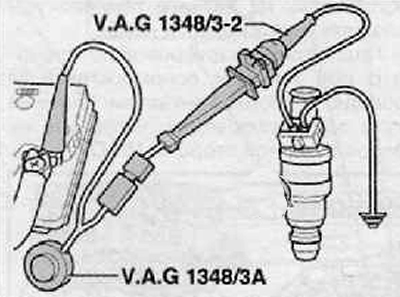
15. Connect using auxiliary cable with adapter "V.A.G 1348/3-2" positive battery terminal and fuse holder #30. The fuel pump should operate.
16. Press the button of the remote control device for 30 seconds.
17. Repeat the check for the remaining fuel injectors. Always use a new measuring cylinder.
18. After all fuel injectors have been energized (activated), all measuring cylinders should be placed on a horizontal base.
19. Disconnect the power supply to the fuel pump.
20. Compare individual quantities of injected fuel.
Required value: 84...91 ml for each fuel injector.
If the measured value of one or more fuel injectors is outside the permissible required value:
Replace the faulty fuel injector.
1. Installation is carried out in the reverse order of removal.
Replace the O-rings on all fuel injectors and lubricate lightly with clean engine oil.
After installing the fuel injectors vertically and in the correct position in the fuel rail, secure them with retaining clips.
After installing the fuel rail with the fuel injectors fixed on the cylinder head, tighten the rail mounting bolts evenly, applying the required tightening torque