
Company vehicles Hyundai Company vehicles Kia Company vehicles Lada Company vehicles Mazda Company vehicles Mercedes-Benz Company vehicles Opel Company vehicles Mitsubishi
English Русский
Български
Беларускі
Український
Српски
Hrvatski
Română
Polski
Slovenský
Magyar
Articles   
Bookmark Contacts Sitemap
SkodaBook.ru


Fabia Rapid Octavia Superb Kodiaq Yeti Others
Octavia 1 (1996-2004) Octavia 3 (2013-2019)

Fuel system deaeration system in a gasoline engine (Skoda Octavia 1U)

  • Main
  • Octavia
  • 1U (1996-2004)
  • Power unit
  • Fuel system
  • Fuel system deaeration system in a gasoline engine
0

Deaeration scheme (gasoline engine)
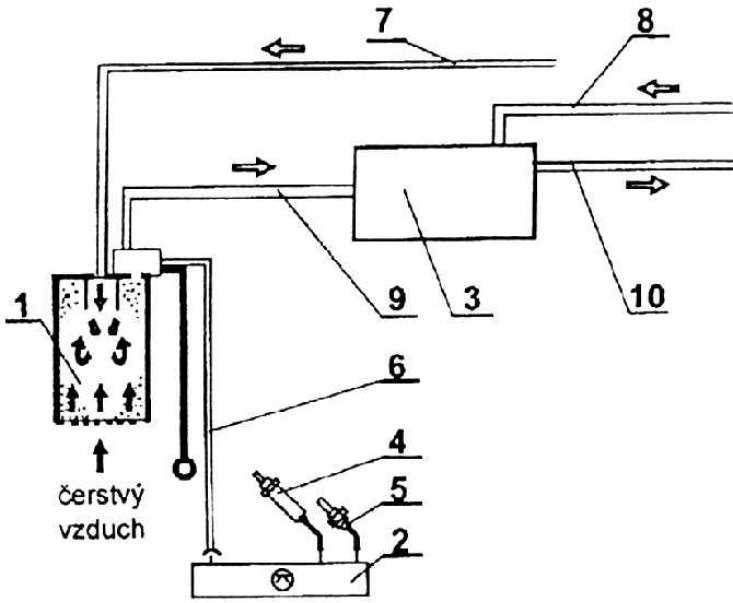


1 – tank with activated carbon and…

1 – tank with activated carbon and electromagnetic valve; 2 – control unit; 3 – fuel injection system; 4 – oxygen probe (lambda); 5 – coolant temperature sensor; 6 – electrical connection of the electromagnetic valve to the control unit; 7 – Ventilating the fuel tank; 8 – fuel supply to the injection system; 9 – connection of the activated carbon tank via the electromagnetic valve to the fuel injection system; 10 – fuel drain line; the arrow indicates the direction of fresh air


Activated carbon tank and its fastening (cars with gasoline engines)
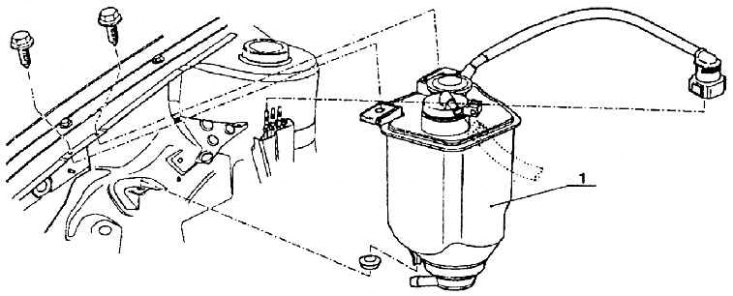


1 – tank with activated carbon

1 – tank with activated carbon


The deaeration system with a tank with activated carbon is normally closed. When the gasoline is heated, the vapors formed enter the tank with activated carbon. There they are regenerated by fresh air sucked in due to the vacuum through the electromagnetic valve. The fuel captured by the activated carbon goes back into the suction line for subsequent combustion. The electromagnetic valve is controlled by the control unit of the fuel and ignition system.


Text copied from this resource (www.skodabook.ru)

It all works as follows: while there is no voltage at the terminals of the electromagnetic valve, the valve is open for bypass even with a small vacuum. (The deaeration electromagnetic valve can only be in working condition when the ignition is on). When voltage is applied to the solenoid valve coil, the valve closes. The duration of the opening is controlled by the control unit evaluating the signal from the throttle opening angle sensor and the signal from the oxygen probe (lambda). At engine operating temperatures below 60°C, the valve remains closed. The solenoid valve is part of the activated carbon tank.

Valve operation: the locking spring presses the anchor with the seal into the seat. The bypass is closed even under vacuum. When the control unit sends an impulse to the valve coil winding, the anchor will be attracted, overcoming the resistance of the spring, the valve will open, and fuel vapors will be able to get from the activated carbon tank into the engine.
This article is available at russian, bulgarian, belarusian, ukrainian, serbian, croatian, romanian, polish, slovak, hungarian
Article verified: Eleonora Afanasyeva
Share with friends:
◀ Previous
Skoda Octavia 1: Fuel system
Next ►

Electric fuel pump (petrol engines only)
Fuel lines — design description
Fuel tank assembly
Air suction and filtration (1.6–55 kW motors)
Air intake and filtration (1.8–92 kW and 1.9 TDI–66 kW engines)
Read similar articles on other Skoda models

➧ Diesel engine fuel injection system control unit, fuel temperature… Skoda Fabia 1 (1999-2007)
➧ Elements of the fuel system — external appearance (1.4 l TSI engine) Skoda Rapid 1 (2012-2022)
➧ Fuel system, engine management and exhaust specifications Skoda Superb 2 (2008-2015)
➧ Malfunctions of the gasoline engine control system Skoda Kodiaq 1 (2016-2024)
➧ Removal and installation of fuel injection system parts, except for… Skoda Yeti (2009-2017)
➧ General fuel system checks Skoda Favorit (1987-1994)
Link to this article in various formats
Reviews and comments of visitors
No comments yet


Add two numbers: 18 + 32


Octavia 3 (2013-2019) 
  • General information
  • User manual
  • Car driving
  • Maintenance
  • Petrol engines 1.2 l
  • Engine repair
  • Cooling system
  • Supply system
  • Petrol engines 1.4 l
  • Engine repair
  • Supply system
  • Petrol engines 1.8/2.0 l
  • Engine repair
  • Cooling system
  • Supply system
  • Diesel engines 1.6/2.0 l
  • Engine repair
  • Cooling system
  • Supply system
  • Transmission
  • Mechanical gearbox 02S
  • Automatic gearbox 0CW
  • Automatic gearbox 0D9
  • Chassis (running gear)
  • Front suspension
  • Rear suspension
  • Brake system
  • Steering
  • Body and interior
  • Doors, locks and windows
  • Exterior (external elements)
  • Interior (internal elements)
  • Ventilation and air conditioning
  • Electrical equipment
  • Equipment and devices
  • Headlights and lighting
  • Wiring diagrams (basic)
  • Wiring diagrams (comfort)
Octavia 1 (1996-2004) 
  • General information
  • Vehicle details
  • Maintenance
  • Power unit
  • Petrol engines 1.6 l AEE
  • Petrol engines 1.8 l AGN
  • Diesel engines 1.9 l AGR
  • Fuel system
  • Exhaust system
  • Cooling system
  • Transmission
  • Clutch
  • Car gearbox
  • Gearbox repair 02J
  • Gearbox repair 02K
  • Chassis (running gear)
  • Wheels and tires
  • Suspension and axles
  • Brake system
  • Body and interior
  • Exterior (external elements)
  • Interior (internal elements)
  • Doors, locks and windows
  • Electrical equipment
  • Equipment and devices
  • Electrical circuits
SkodaBook.ru © 2018–2026 | Mobile version | Articles on Skoda | Sitemap EN BG BY UA RS HR RO PL SK HU | Feedback | Site search | Bookmark
Fabia 1 (1999-2007) | Fabia 2 (2007-2014) | Rapid 1 (2012-2022) | Octavia 1 (1996-2004) | Octavia 3 (2013-2019) | Superb 2 (2008-2015) | Kodiaq 1 (2016-2024) | Yeti (2009-2017) | Favorit (1987-1994) | Felicia (1994-2001) |
By continuing to use the site, you agree to the use of cookies.