



Note: After disconnecting and then reconnecting the wire connecting the battery terminal to the vehicle ground (body), some additional work must be performed.
1. Remove, if necessary, the upper decorative engine cover.
2. Remove the battery assembly (for more details, see the relevant section in the chapter Engine electrical equipment).
3. Remove the air filter assembly (for more details, see the relevant section in the chapter Intake and exhaust system).
4. Remove the engine control unit from the front wall of the body separating the engine compartment from the passenger compartment if the master cylinder of the clutch drive control amplifier is not accessible.
5. Place a rag under the clutch master cylinder.
6. Disconnect the compensation hose (1) from the master cylinder of the hydraulic clutch release drive, seal it with a suitable device, e.g. the "T10249/1" shut-off device.
Note.
- Do not use the tube clamp -MP7-602-, as this may damage the compensation hose (1).
- When performing the following work, make sure that no brake fluid gets on the longitudinal beam or gearbox. If this happens, it is necessary to thoroughly clean such areas.
7. Pull out the safety clip (2) on the clutch booster master cylinder as far as it will go, as shown in the figure below.
Note: The safety clip (2) can also be removed from the side on some clutch booster master cylinders.
8. Remove the pipe and hose line (3) from the clutch release hydraulic master cylinder as shown in the figure below. Plug it.
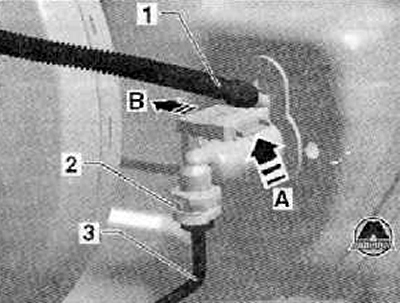
Cars with Start-Stop system
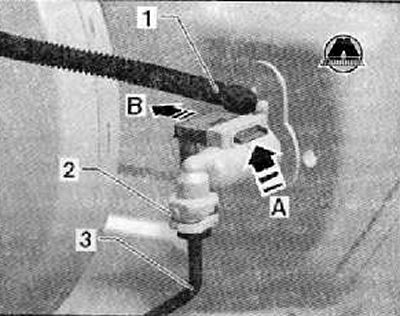
9. Release the clutch pedal position sensor "G476" from the clamps on the clutch booster master cylinder (arrow A) and (arrow B), as shown in the figure below.
10. Remove the clutch pedal position sensor from the clutch release hydraulic master cylinder with the plug connectors attached.
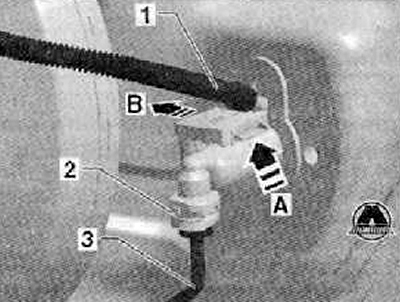
Continued for all cars
Note: When working in the footwell, protect the floor mats from leaking brake fluid with a rag.
11. Remove the air duct nozzle into the footwell (for more details, see the relevant section in the chapter Heating, ventilation and air conditioning system).
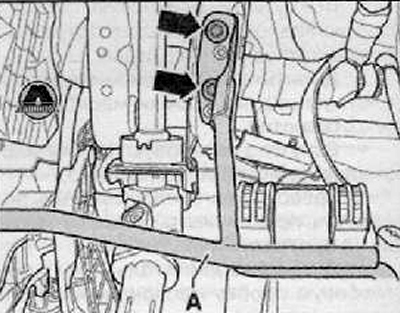
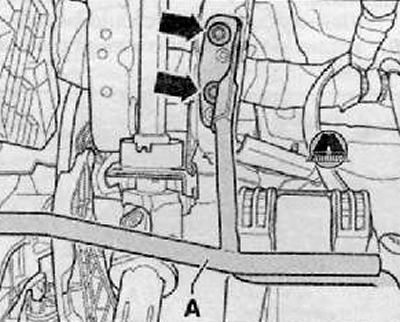
12. Unscrew the mounting bolts (arrows) and remove the safety support (A), if present, as shown in the figure below.
13. Set the steering wheel to the highest position.
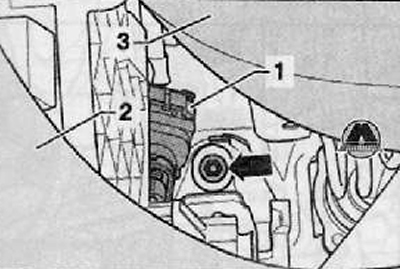
14. Remove the clutch pedal switch "F36" (1) shown in the figure below.
(This material is published on the portal: SkodaBook)
15. Unscrew the upper lock nut arrow) of the mounting bracket as shown in the illustration below. To do this, install an extension through the hole between the instrument panel (2) and the lower steering shaft trim (3) onto the nut as shown below.
16. Loosen both lower lock nuts (arrows) shown in the figure below.
17. Remove the mounting bracket (A) from the front body wall separating the engine compartment from the passenger compartment (B), as shown in the figure below.
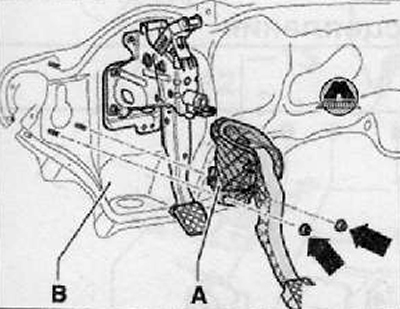
Installation
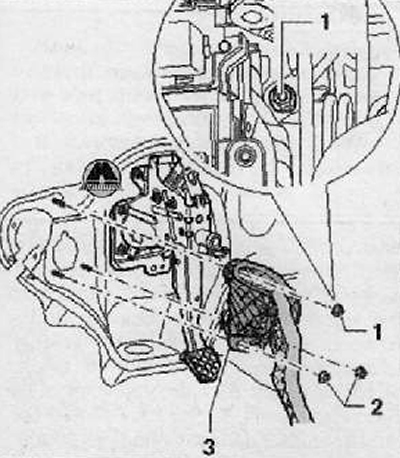
Note: Install the self-locking nuts (I) and (2) securing the mounting bracket (3) to the front body wall separating the engine compartment from the passenger compartment, as shown in the figure below.
1. Installation is carried out in the reverse order, and the following instructions must be observed:
2. Install the clutch pedal switch "F36".
3. Install the safety support (A), if present, by tightening the mounting screws (arrows) to the required tightening torque as shown in the figure below.
4. Install the air duct nozzle into the footwell (for more details, see the relevant section in the chapter Heating, ventilation and air conditioning system).
Cars with Start-Stop system
5. Install the clutch pedal position sensor "G476" with the connected wiring harness connector onto the clutch master cylinder until it stops. The clutch pedal position sensor must engage in the locked position (arrow A) as shown in the figure below.
6. The engagement of the clutch pedal position sensor should be checked by pulling (arrow B).
Continued for all cars
7. Press the pipe and hose line (3) into the connection point of the master cylinder of the hydraulic clutch release drive so that the safety clip (2) enters the fixed position with a characteristic click.
8. Install the additional hose (1) to the clutch master cylinder as shown in the figure below. Make sure it is correctly locked in place by pulling the wire.
10. Remove air from the hydraulic clutch release drive.
11. Install the engine control unit on the front wall of the body separating the engine compartment from the passenger compartment, if it has been removed.
12. Install the battery (for more details, see the relevant section in the chapter Engine electrical equipment).
13. Install the air filter housing assembly (see the corresponding section in Chapter Intake and exhaust system).