



Note: Replacement of the accessory drive belt and timing belt is described in Chapter 2.
1. The belt tension is adjusted by automatic tensioners. However, the tension should be checked periodically along with the condition of the belt. To gain access to the belt, lift the car and remove the right underbody guard. If necessary, turn the crankshaft by the bolt of its pulley.
2. Feel the belt with your fingers along its entire length, checking for cracks and delamination (see accompanying illustrations). Also check for abrasions and polished areas on the belt. The belt should be inspected from both sides, which means it needs to be twisted. At the same time, make sure there is no rust, cracks or burrs on the pulleys. Shallow perpendicular cracks are allowed on the working surface of the belt. If these cracks do not extend beyond the boundaries of one rib, are not very deep and their number does not exceed 15 by 10 cm of the belt length, there is no need to replace the belt.
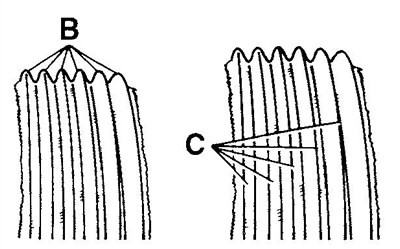
18.2a Wear of the edges of the drive belt ribs
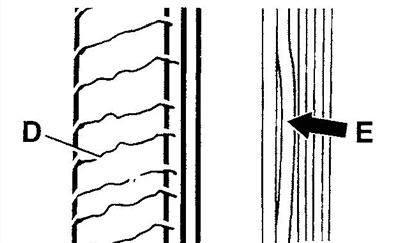
18.2b Transverse cracks (D) on the back side of the belt and rib separation (E)
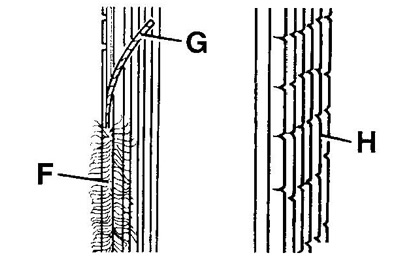
18.2c Fraying of side ribs (F), cracks (H) and delamination of side ribs (G)
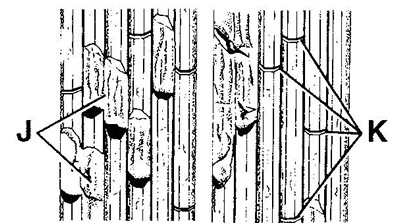
18.2d Rib breakage (J), cracks (K)
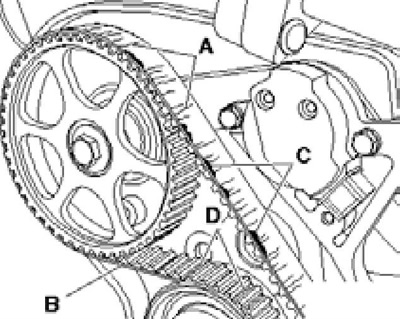
18.2e Timing belt damage
A Cracks in the coating, transverse fractures
In Lateral wear
With Cord wear
D Cracks on the teeth
3. Make sure that the belt is correctly positioned on the pulleys and gears.
(Information published on the website: skodabook.ru)
4. If necessary, replace the drive belt (see Chapter 2).
5. The tension is checked using a special device.