



Warning: Contact with brake fluid is hazardous to health. Do not suck it out with your mouth through a hose. Store brake fluid only in a container that is out of the reach of children.
1. Brake fluid has the ability to absorb moisture, as a result of which its boiling point decreases over time, which, under significant load on the brakes, can lead to the formation of steam bubbles in the brake lines and reduce the effectiveness of the brakes.
2. To replace the brake fluid, you will need the help of an assistant, but this procedure can be done without outside help using a special device (for example, the branded VAS5234), - see the instructions supplied with such a device. When using the device, the pressure in the brake system should not exceed 2 bar. When bleeding the brake system, the car should be in a horizontal position to properly monitor the level of brake fluid in the reservoir.
3. Turn off the ignition and disconnect the negative cable from the battery.
4. Remove the cap from the brake fluid reservoir.
5. Mark the current brake fluid level on the tank wall with a felt-tip pen to prevent it from being exceeded when replacing the brake pads. Pump out the brake fluid from the tank, leaving a layer of liquid approximately 10 mm deep at the bottom.
Note: Do not remove all the fluid from the reservoir, otherwise air will enter the hydraulic drive of the brake and clutch system.
6. Fill the reservoir with fresh brake fluid up to the "MAX" mark.
7. On models with manual transmission, remove the cap of the clutch hydraulic drive bleed nipple (on the clutch slave cylinder) and put a hose on it (see accompanying illustration). To access the bleed nipple, you need to remove the air cleaner (see Chapter 4) and the battery with its holder (see Chapter 5). Open the bleed nipple and let about 100 grams of brake fluid flow out. Close the nipple, quickly press the clutch pedal 10-15 times. Open the nipple again and let about 50 grams of brake fluid flow out. Close the nipple, remove the hose and press the clutch pedal several times. Put on the protective cap.
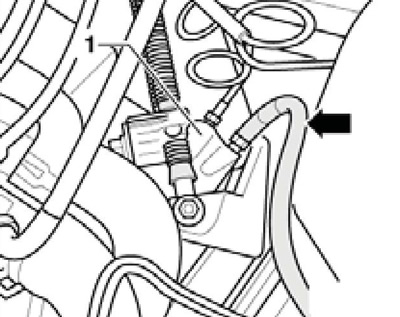
9.7 Bleeding the clutch hydraulic drive
8. Jack up the vehicle. Clean and remove the protective caps of the bleed nipples thoroughly. Attach one end of a clean, transparent hose to the bleed nipple of the rear right brake mechanism (see accompanying illustration), and insert the other end into a container for collecting brake fluid. Pour some brake fluid into the container and constantly ensure that the end of the hose is immersed in it. Also, the container should be raised at least 30 cm above the bleed nipple to ensure pressure and prevent air from entering it.
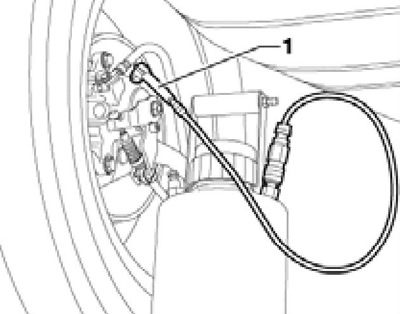
9.8 Bleeding the brake mechanism
9. Ask an assistant to sharply press the brake pedal 3-5 times at intervals of 2-3 seconds and release the nipple half a turn with the pedal depressed. After the brake pedal hits the floor, tighten the nipple. Remove your foot from the pedal. Repeat this process to pump out the old brake fluid (until a new one appears, which can be recognized by its light color). Approximately 0.2 liters of brake fluid should be pumped out of each rear bleed nipple.
Note: If the liquid layer at the bottom of the tank is less than 10 mm, the system will have to be bled.
10. Tighten the bleed screw, close its protective cap and add new brake fluid to the reservoir.
11. In the same way, pump out the old brake fluid sequentially from the rear left, front right and front left brake mechanisms. To access the rear bleed nipples, you may need to remove the rear wheels. About 0.3 l of brake fluid should be pumped out of each front bleed nipple, and about 0.2 l from each rear bleed nipple.
Caution: The drained brake fluid must in any case be clean and free of air bubbles.
12. Adjust the brake fluid level according to the previously applied mark. Press the brake pedal and check its free travel. Make sure that the brake pedal does not "fall through" when you press it - the free travel of the pedal should be no more than ⅓ of its full travel.
13. Connect the negative cable to the battery and test the brakes on a road with light traffic. To do this, you should perform at least one strong braking, checking the ABS at the same time (with appropriate equipment). A sign that the ABS is working properly is the pulsation of the brake pedal when braking.
Note: The effect of ABS is best demonstrated on unpaved roads.