



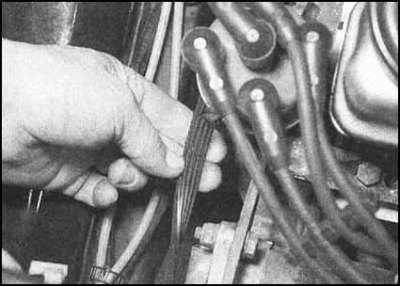
1. The condition of the auxiliary drive belt can be checked visually. Pay attention to the presence of abrasions, cracks, delamination, etc. Defects. To inspect the ribbed side of the belt, twist it.
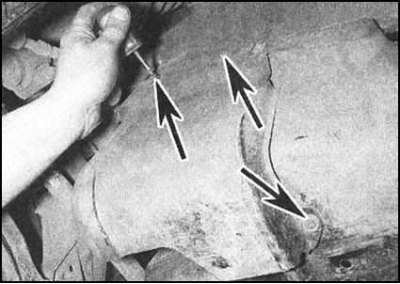
2. To provide better access to the belt, jack up the right front corner of the car, then unscrew the screws securing the metal cover that covers the belt.
3. To inspect the belt along its entire length, turn the crankshaft by the bolt of its pulley.
4. If any defects are detected, the belt must be replaced (see Chapter Engine repair).
5. On 1.6L models (and 1.3L models equipped with CV) the belt is equipped with an automatic tensioner and therefore does not require tension adjustment.
6. On 1.3L models without CV, the belt tension can be checked by pressing on the belt in the area between the alternator and water pump pulleys. When pressing firmly with your thumb, the belt deflection should be between 10mm and 15mm. If not, an adjustment should be made (see Chapter Engine repair).
7. Finally, if removed, reinstall the belt cover, then lower the vehicle to the ground.
[Information published on the website skodabook.ru]