



Gasoline engines
1. Remove the upper engine cover (see subsection 2.1).
2. Disconnect the wiring harness from the throttle actuator.
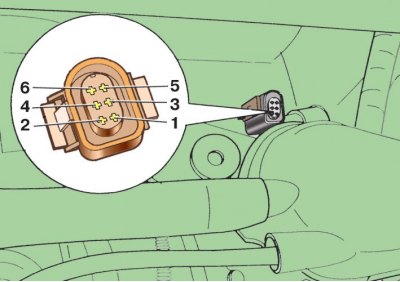
3. Connect an ohmmeter to pins 3 and 5 of the drive and measure the drive resistance. The ohmmeter should read 3–200 ohms. If the measured resistance differs from the specified value, replace the throttle actuator.
Important! When installing a new throttle actuator, it must be coded to match it to the engine control unit. Therefore, it is recommended that the actuator be replaced at a service station.
4. Check the throttle actuator supply voltage. To do this, turn on the ignition and connect a voltmeter to contacts 2 and 6 of the connector with wires disconnected from the drive, and then to contact 2 and the engine ground. In both cases, the voltage should be around 5 V. If the voltmeter shows 0, check the wires for open circuits and short circuits.
Data copied from the portal: www.SKODABOOK.ru
Diesel engine 1.9 l, 74 kW
1. Remove the upper engine cover (see subsection 2.1).
2. Start the engine and let it idle.
3. Turn off the ignition, at this point the throttle valve should close for about 3 seconds and then open again.
4. If this does not happen, press on the throttle actuator rod; it should move easily without sticking.
5. Check the tightness of the vacuum hose on the throttle actuator fitting.
6. Check the operation of the throttle actuator by pumping air out of it, for example, with a hand vacuum pump.
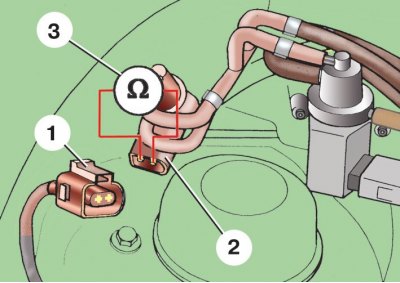
7. If the throttle actuator is OK, check the throttle actuator valve. To do this, disconnect connector 1 with the wires from valve 2. Connect ohmmeter 3 to the valve contacts and measure its resistance; it should be 25–45 ohms. If the measured resistance differs from the specified value, replace the valve.
8. If the valve is working properly, check its power supply circuit. To do this, connect a voltmeter to the contacts of block 1 and, with the engine idling, measure the voltage. The voltmeter should show the battery voltage.
9. Turn off the ignition, after about 3 seconds the voltage should drop to 0. If this does not happen, check the wires for open circuits and short circuits. If no faults are found in the wiring, the engine control unit must be replaced.