



Lateral force - skid dependence diagram and ABS adjustment operating range
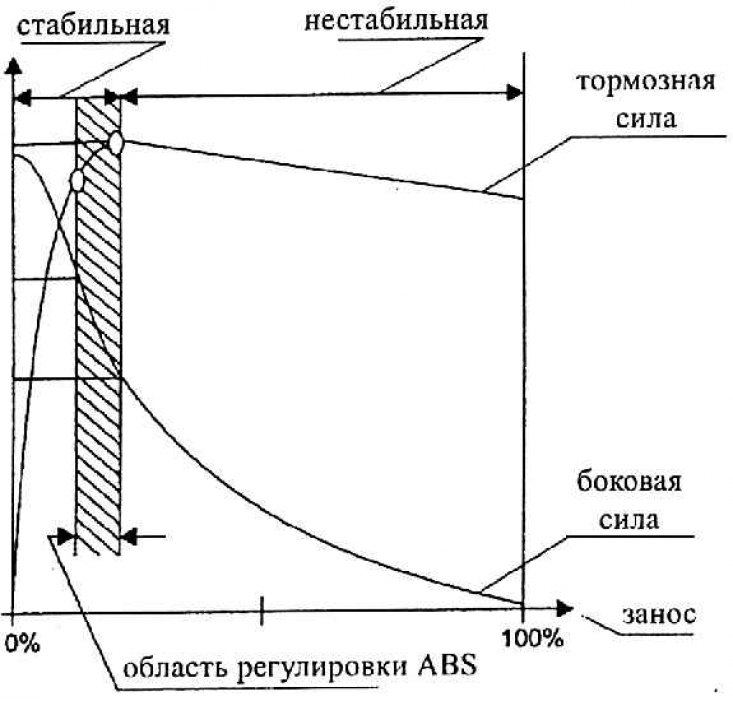
ABS (anti-block system) is equipment that helps ensure driving safety (during braking). ABS increases the active safety of the vehicle in the following situations: improves vehicle controllability even under full braking, increases vehicle stability both under full braking and when braking on a road with different adhesion under the right and left wheels, reduces tire wear, generally shortens the braking distance and thus reduces the physical load on the driver in critical situations.
The ABS system prevents the wheels from locking when braking fully. Its operating principle is based on the fact that the maximum braking effect is observed on a still rotating wheel. ABS controls the rotation of the wheels and regulates the braking in individual wheels so that the rear wheel does not lock. Interestingly, the ABS principle was patented at the beginning of the last century.
Due to the fact that the wheels rotate even under full braking, there is a sufficiently large force on the front wheels to maintain control of the car. Similarly, the rear axle wheels, when the wheels rotate, create the prerequisite for holding the road. (Slipping occurs when the rear wheels are locked and cannot transmit any lateral forces.)