



Parking brake lever assembly reaming
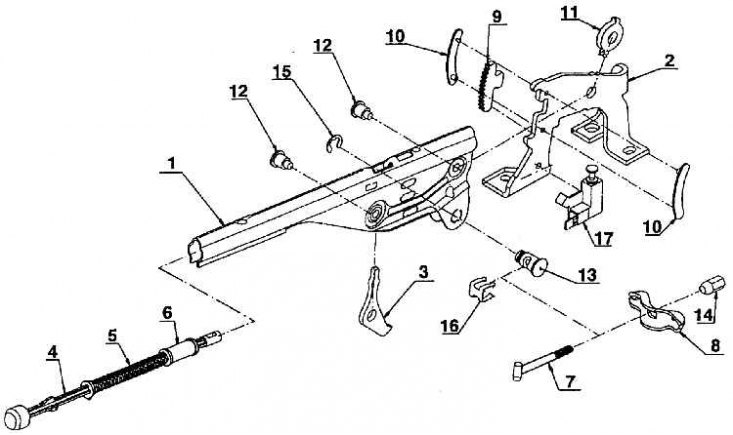
1 – lever; 2 – lever bracket; 3 – latch; 4 – button pull; 5 – button spring; 6 – button rod bushing; 7 – cable balance rod; 8 – balancer for securing cable tips; 9 – serrated segment of arrest; 10 – segment guide pad; 11 – segment guide washer; 12 – fingers; 13 – finger with a notch; 14 – balance rod adjusting nut; 15 – lock washer (8); 16 – elastic pad; 17 – push button switch
Parking brake lever, its casing and cable fastening
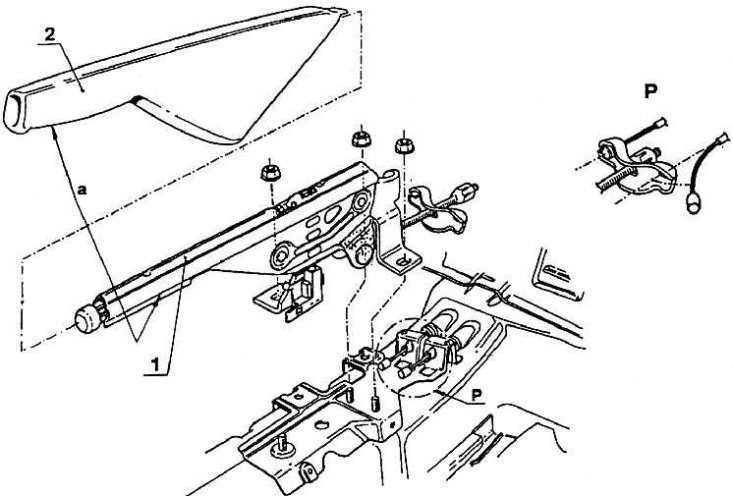
1 – parking brake lever; 2 – lever casing; a - fixed to the stand
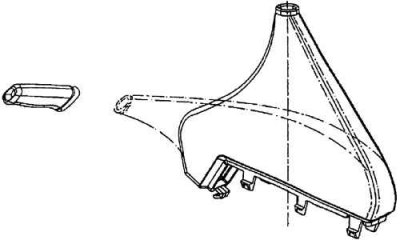
Parking brake lever bellows - shape before and after being placed on the lever and lever handle
The parking brake control lever is assembly related to the body group, but thematically it is related to the brakes and therefore is disassembled here.
The design of the lever does not allow it to deviate to the sides and at the same time the toothed arrestment of its movement is very reliable. The handbrake part also includes a rod with a balancer for fixing the brake cable tips. The balancer, and with it the limitation of the cable gap, can be adjusted by turning the nut on the threaded part of the rod. There is a arrestment button on the front part of the lever.
A push-button switch is attached to the lever bracket, which controls the light indicator of the lever position. When the lever is moved, (to the braked position) and when the ignition is on, the indicator light on the dashboard lights up.
The handbrake kit is secured to the bolts of the central side member of the body frame with three nuts. The cables in a flexible sheath are secured in two clamps welded to the central side member behind the lever mounting unit. The flexible cables passing into the space under the body floor are sealed with rubber cuffs.
The moving part of the lever is covered either by a solid plastic casing, or in the front part of it there is a plastic casing, forming a handrail for gripping the lever, and the rest is covered by fur. At the bottom of the fur there is a plastic frame with spikes, snapped into the back of the central panel.