



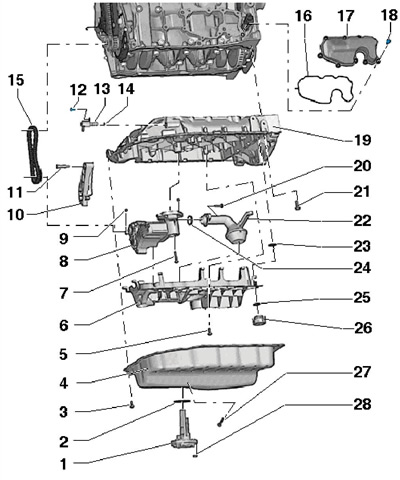
32.1a Installation details of the oil pan and oil pump
1 Sensor "G266" engine oil level and temperature
2 O-ring, to be replaced
3 Bolt, to be replaced, 8 Nm, then retighten 45°
4 Lower part of the oil pan
5 Bolt, 9 Nm
6 Stilling plate, to be replaced
7 Oil pan bolts, 9 Nm
8 Oil pump
9 Centering sleeve
10 Chain tensioner
11 Bolt, 9 Nm
12 Bolt, 9 Nm, on CDAA, CDAB and CCZA engines only
13 Valve "N428" engine oil pressure adjustment, only on CDAA, CDAB and CCZA engines
14 O-ring, replaceable, only on engines CDAA, CDAB and CCZA
15 Oil pump drive chain, mark the direction of travel before removing
16 Gasket, to be replaced
17 Coarse oil separator filter
18, 20 Bolt, 9 Nm
19 Upper part of the oil pan
21 Bolt, to be replaced, 15 Nm, then retighten 90'
22 Suction tube
23-25 O-ring, to be replaced
26 Return flow control tube (check valve)
27 Drain plug, replaceable, 30 Nm
28 Nut, 9 Nm
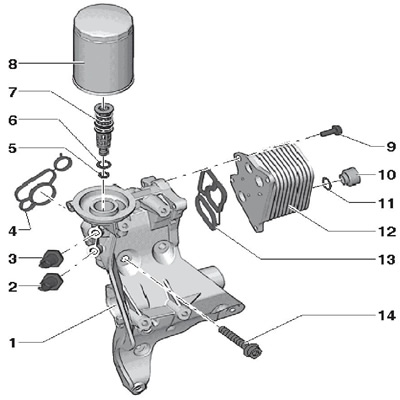
32.1b Oil filter, oil cooler and sensor installation details "F1"
1 Auxiliary bracket, with integrated oil filter holder
2 D/V "F22" high pressure engine oil, on the BZB engine - black (at 1.2-1.6 bar), and on engines CDAA, CDAB and CCZA - blue (at 2.15 + 2.95 bar), 20 Nm
3 D/V "F378" low pressure engine oil, only on engines CDAA/CDAB/CCZA, brown, at 0.55 + 0.85 bar, 20 Nm
4, 13 Gasket, to be replaced
5, 6 O-ring, replaceable, part of module 7
7 Valve module
8 Oil filter, 22 Nm
9 Bolt, 15 Nm
10 Connection
11 O-ring, to be replaced
12 Oil cooler
14 Bolt, to be replaced, 20 Nm, then retighten 90°
Coarse Oil Separator Filter
2. Remove the sound insulation under the engine compartment (see chapter 11).
3. Turn out bolts (1-9 on resist. illustrations), remove the oil separator coarse filter and plug the exposed holes to prevent dirt from entering the lubrication system.
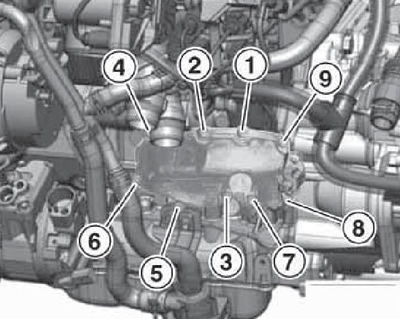
32.3 Coarse filter mounting bolts
4. Replace gasket and install coarse filter. Tighten the filter mounting bolts in the sequence (1-9 in illustration 32.3) with a force of 9 Nm.
Oil pan (Bottom part)
5. Remove the sound insulation under the engine compartment (see chapter 11).
6. Drain engine oil (see Section 6 of Chapter 1).
7. Disconnect the sensor connector "G266" temperature and oil level on the underside of the sump.
8. Turn out bolts (1-20 per resist. illustrations) and remove the lower part of the oil pan. If necessary, lightly tap the pan with a rubber-faced hammer.
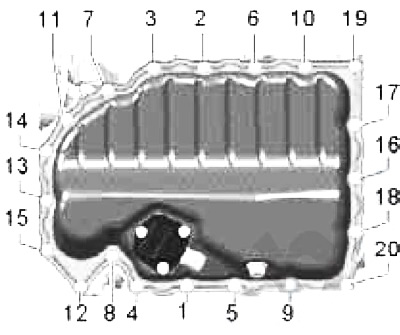
32.8 Sequence of loosening and tightening the bolts securing the lower part of the oil pan
9. Remove the remnants of sealing materials from the mating surfaces of the lower and upper parts of the oil pan and clean them of oil and grease. The use of a chemical sealant and grease remover is recommended.
10. Apply a bead of silicone sealant D174 003A2 with a diameter of 2-3 mm to the mating surface of the lower part of the oil pan (see resist. illustration) and install the oil pan within 5 minutes after that.
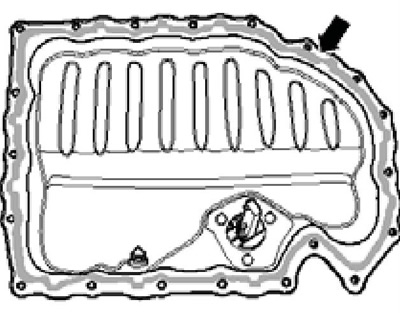
32.10 Sealant application schedule
Note: The layer of sealant must not be too thick, otherwise the excess sealant will be squeezed inward and may come to clog the oil passages.
Tighten the new pan bolts in the sequence (1-20 in illustration 32.8) in several approaches: first by hand, then with a force of 8 Nm, and then pull them to an angle of 45°.
11. Further installation is carried out in the reverse order. Allow the sealant to dry for at least 30 minutes before adding oil.
Oil pump
12. Remove the lower part of the oil pan (see subsection above).
13. Turn out bolts (see resist. illustration) and remove the damping plate. Invite an assistant.
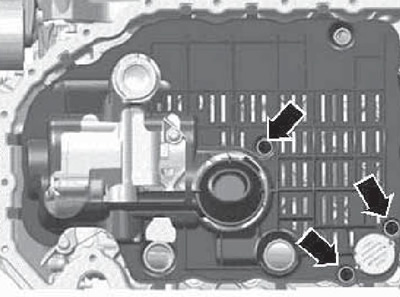
32.13 Fixing the damping plate
14. Turn out bolts (see illustration 33.14a), pull the chain tensioner back with tool T10118 (see illustration 33.14b) and have an assistant remove the pump.
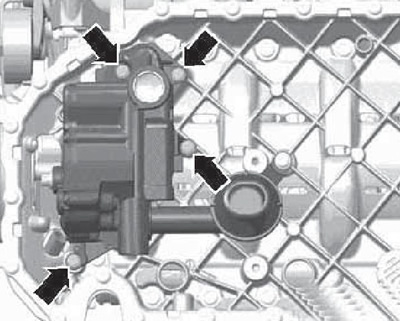
32.14a Oil pump fasteners
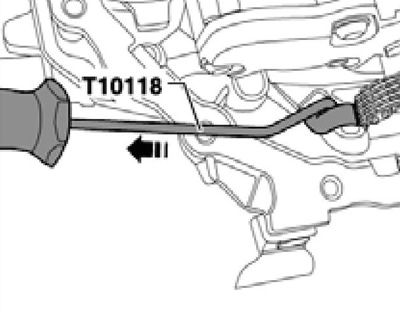
32.14b Removing the oil pump
15. Before installing the oil pump, make sure that the mesh of the suction pipe and oil galleries in the upper part of the oil pan are passable. Make sure both centering sleeves are installed.
16. Pull the chain tensioner back with tool T10118 (see illustration 32.14b) and install the pump, putting the chain on its sprocket.
17. Further installation is carried out in the reverse order. Use a new resting plate as when tightening its fasteners, the plastic ribs break, providing a fit without play.
Oil pan (top part)
18. Remove the sealing flange with the crankshaft rear oil seal (see Section 26).
19. Remove the oil pump (see subsection above).
20. Remove the right front wheel arch locker (see chapter 11).
21. On models with an additional heater, loosen the clamp (1 in illustration 15.14), remove the bolt (2) and remove the auxiliary heater muffler.
22. Remove the bolts (arrows in illustration 25.4) and remove the pressure air tube by lifting the clamps (1 and 2). Give fixture of a pressure head air tube and an arm of electroconducting on the top part of the pallet crankcase.
23. On engines CDAA/CDAB/CCZA, disconnect the connector (1 per resist. illustrations) sea otter "N428" fuel pressure adjustment (3).
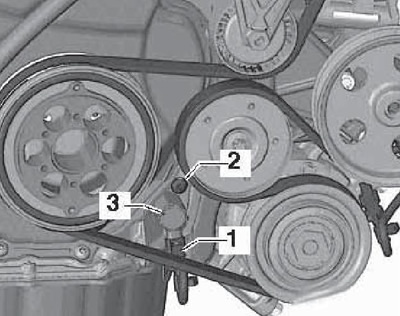
32.23 Valve connector "N428"
24. Remove the bolts (14 and 15 in illustration 27.10) lower timing chain cover.
25. Remove the bolts (1-14 on resist. illustrations) and remove the upper part of the oil pan. If necessary, lightly tap it with a rubber-faced hammer.
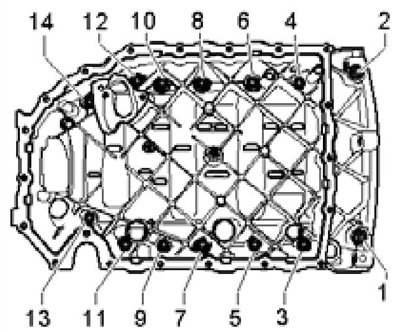
32.25 The sequence of turning out and tightening the bolts securing the upper part of the oil pan
Note: When removing the top of the oil pan, the oil pump chain tensioner spring pops out from the top of the oil pan into the bottom timing chain cover, so do not grasp the area between the top of the oil pan and the bottom timing chain cover. Pry off the transmission side oil pan first and be careful not to damage the timing chain cover.
26. Remove the remnants of sealing materials from the mating surfaces of the upper part of the oil pan, cylinder block and lower timing chain cover. Clean them of oil and grease. The use of a chemical sealant and grease remover is recommended. Make sure that the oil galleries at the top of the oil pan and in the cylinder block are open.
27. Make a fixture by bending the welding electrode with a diameter of 1.8-2.0 mm, as indicated on the resist. illustrations. Size (A) should be approximately 10 mm. Pull the tensioner spring with tool T10118 in the direction of the arrow and fix the spring by inserting the manufactured tool into the hole in the tensioner.
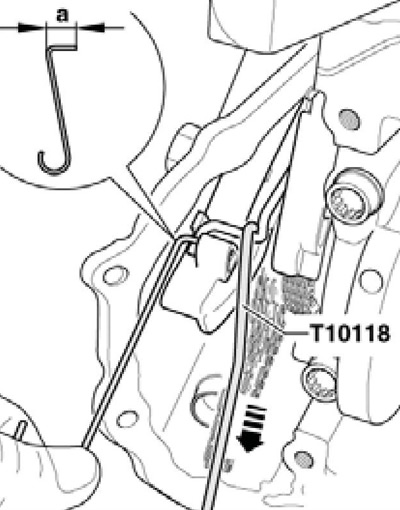
32.27 Retraction of the oil pump chain tensioner spring
28. Apply a bead of silicone sealant D174 003A2 with a diameter of 2-3 mm to the mating surface of the upper part of the oil pan (see resist. illustration) and within 5 minutes after that, install the oil pan flush with the cylinder block on the transmission side.
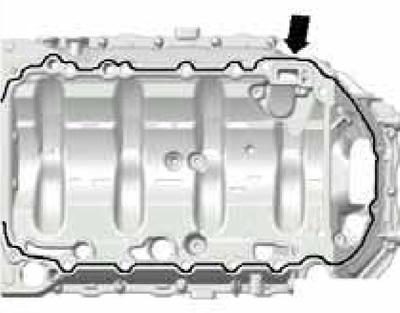
32.28 Sealant application schedule
Note: The layer of sealant must not be too thick, otherwise the excess sealant will be squeezed inward and may come to clog the oil passages.
Tighten the new pan bolts in the sequence (1-20 in illustration 32.25) with a force of 15 Nm, and then tighten them at an angle of 90°.
29. Tighten the new lower timing chain cover lower bolts to 8 Nm, and then tighten them to an angle of 45°.
30. Using a screwdriver, pull the bent electrode out of the tensioner - the spring will bounce back to the installation position.
31. Further installation is carried out in reverse order. Allow the sealant to dry for at least 30 minutes before adding oil.
Oil cooler
32. Remove auxiliary bracket (see Section 24).
33. Remove the bolts (4 and 5 on resist. illustrations) and remove the oil cooler (3) along with gasket (2).
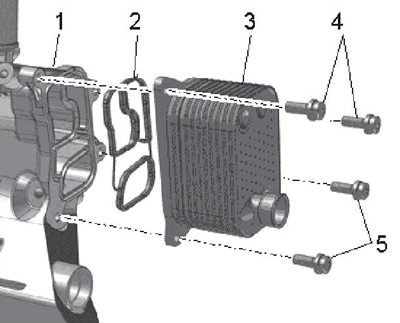
32.33 Oil cooler installation details
34. Installation is carried out in the reverse order. Use new seals.