



Wheel speed sensor for ABS
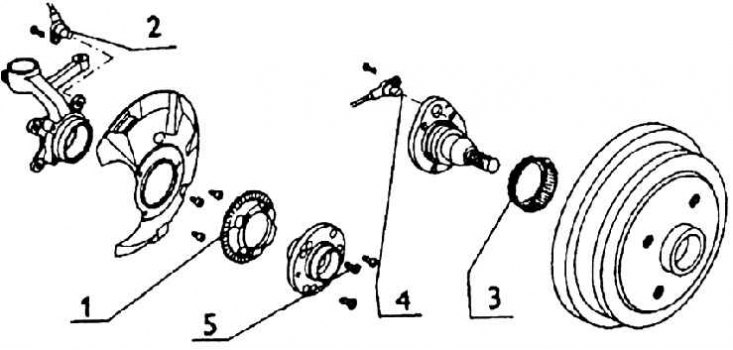
1 – impulse wheel for removing the front wheel speed; 2 – front wheel speed sensor; 3 – impulse wheel for removing rear wheel speed; 4 – rear wheel speed sensor; 5 – bolts
Connection diagram of the brake system with ABS
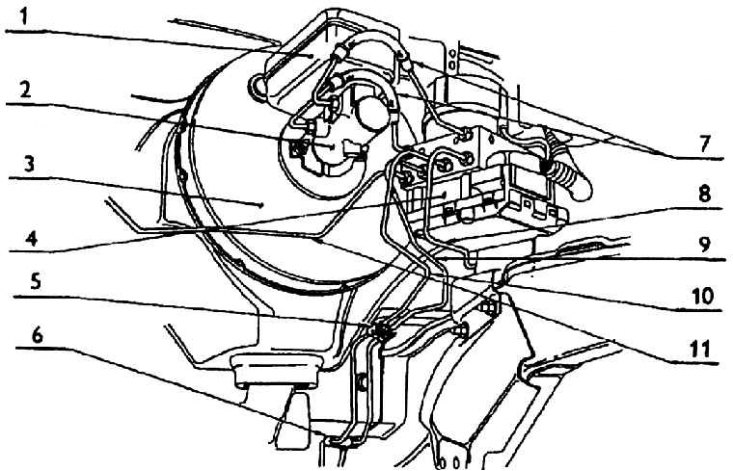
1 – liquid tank; 2 – main tandem brake cylinder; 3 – vacuum brake booster; 4 – ABS hydraulic and control unit; 5 – brake pipe clamp; 6 – brake pipe clamp; 7 – tube connecting THV with hydraulic and ABS control unit (first and second brake circuit); 8, 9, 10, 11 – pipelines to the brake devices of individual wheels
Wiring diagram of hydraulic and electrical elements of ABS
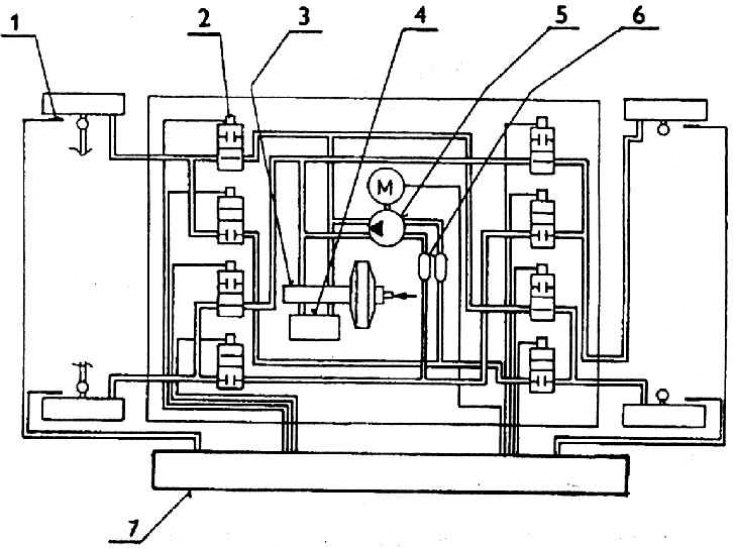
1 – sensor; 2 – electromagnetic valve; 3 – foot brake tandem cylinder; 4 – brake fluid reservoir; 5 – pump; 6 – reservoir; 7 – hydraulic and electronic control unit
The original article is located on: skodabook.ru
The installed ABS is a product of ITT AUTOMOTIVE EUROPE, type MK 20 I. This is a closed four-channel system, which means that braking is regulated on all four wheels. On the front wheels, the brakes are controlled separately, on the rear wheels according to the select low principle, i.e. with the wheel that is closer to blocking.
At the same time, the second wheel can transmit greater lateral force, which ensures greater stability of the car.
The action of ABS is as follows: induction sensors (sensors) constantly monitor the movement of the pulse wheels (in individual wheels of the car) and transmit information about the rotation speed to the ABS control unit. This information is processed and simultaneously the values of wheel skid, wheel rotation lag and vehicle speed are calculated.
As soon as the control unit detects a tendency for a wheel to lock, it issues a control signal to the electromagnetic valves, which adjust the brake fluid pressure in the brake device of the corresponding wheel. This means that when adjusted by ABS, the brake pressure on the given wheel is maintained constant, but if the skid increases, the pressure in the brake device of the wheel is reduced by the ABS pump. This reduces the braking effect and the rotation of the wheel is resumed.
Conversely, if the wheel brakes too little, the system increases the pressure and thus increases the braking effect. The process is repeated in different variations depending on the mode the wheel is in.
If a fault occurs in the ABS, the system will automatically disconnect and the vehicle can continue to brake in the normal way, as if ABS were not installed.
The brake system with ABS, compared to the system without ABS, differs in the foot brake tandem cylinder and, of course, the brake lines and hoses.
Before adjusting the ABS or if the ABS fails, the braking effect on the rear axle wheels is limited by the electrical brake force limiter EBV (Elektronischer Bremskraftverteiler), which uses ABS electromagnetic valves. A load regulator is not installed on a vehicle equipped with ABS. In the event of an EBV malfunction, the pressure limitation on the rear axle brakes does not work and its wheels are overbraked compared to the state with the EBV operating.
In the interests of driving safety and the use of ABS, in the event of any malfunction, you should seek help from a ŠKODA service center.