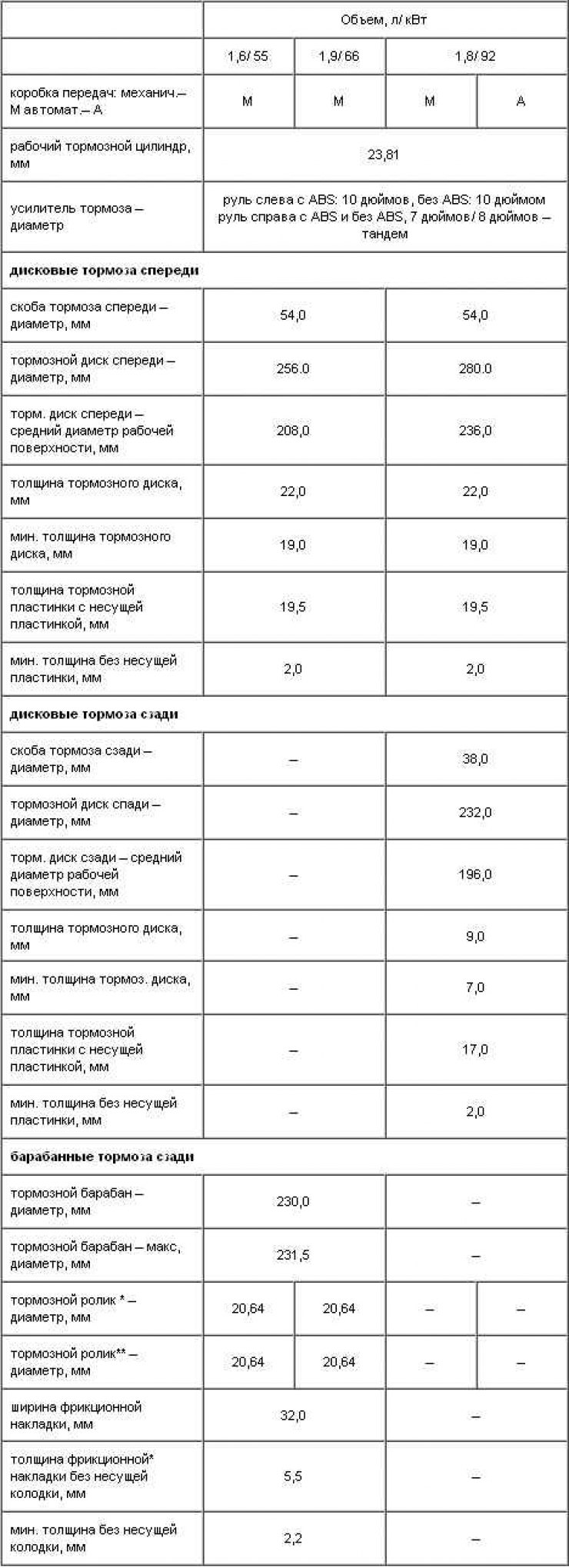
The foot brake is liquid with a diagonal connection and a brake booster. The influence of the first and second circuits is in the ratio 1:1. The first circuit acts on the brakes of the right front and left rear wheels, the second circuit controls the brakes of the left front and right rear wheels. On the main tandem brake cylinder, the first circuit has outputs at the back (in the direction of movement), the second one is in the front. The front wheel brakes are always disc brakes with internal air cooling of the disc. Depending on the engine the car is equipped with, the discs have a diameter of 256 or 280 mm. In cars with 1.9 TDI–66 kW and 1.8–92 kW engines, the disc diameter is 280 mm.
The rear brakes can be drum or disc. Which ones? Again, it depends on the type of engine installed in the car. In cars with 1.6–55 kW and 1.9 TDI–66 kW engines, the rear brakes are drum as standard. Cars with 1.8–92 kW engines are equipped with rear disc brakes and always with ABS. The action of the brakes on the rear axle in all versions of cars not equipped with ABS or ABS/EDS is regulated by a load regulator.
Brake system in both versions (with rear drum and disc brakes) can be equipped with ABS or ABS/EDS or without them at all (EDS = electronic differential lock).
The brake fluid storage tank is connected to the brake master cylinder (THV) in a single assembly unit. It contains a built-in float-type electrical signaling system for the fluid level.
The parking brake is mechanical, the connection between the lever and the brake elements of the rear wheels is carried out through a cable in a flexible casing.