



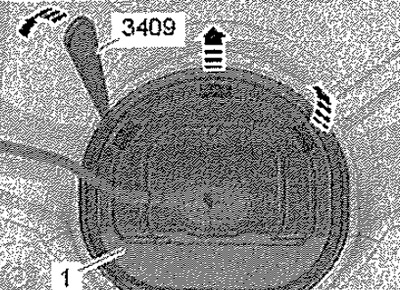
Disconnect connector "2" from the connecting flange, releasing the connector locks. -Positions 1, 3- ignore.
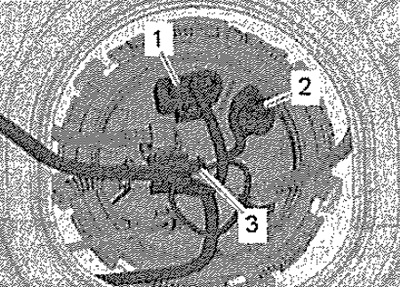
Fuel level sensor "G" is installed
Note: To achieve accurate resistance readings with a "full fuel tank" when the sensor is installed, the fuel tank must be completely filled. After filling the fuel tank completely, drive at least another 500 m to allow any air bubbles to escape from the fuel tank. Then add more fuel.
Connect a multimeter to measure the resistance between terminals -B1 - and "B2": fuel tank empty: approximately 270 ohms, fuel tank full: approximately 70 ohms. Connect a multimeter to measure the resistance between terminals "B1" and "B3": fuel tank empty: approximately 70 ohms, fuel tank full: approximately 270 ohms. Connect a multimeter to measure the resistance between terminals "B2" and "B3": any position of the sensor: approximately 340 ohms.
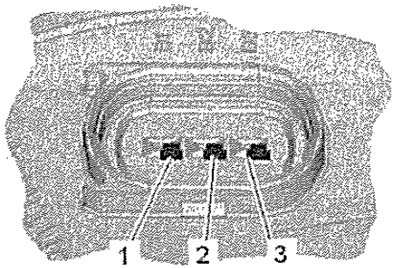
Fuel level sensor "G" removed
Note: When checking the resistance values "Fuel tank full" or "Fuel tank empty", the fuel level sensor "G" must be removed and the float lever must be moved up or down to the stop. The resistance of the removed fuel level sensor due to the extreme positions of the float lever has the following values.
Connect a multimeter to measure the resistance between terminals "B1" and "B2": fuel tank empty: approximately 300 ohms, fuel tank full: approximately 52 ohms. Connect a multimeter to measure the resistance between terminals "B1" and "B3": fuel tank empty: approximately 52 ohms, fuel tank full: approximately 300 ohms. Connect a multimeter to measure the resistance between terminals "B2" and "B3": any position of the sensor: approximately 340 ohms.
Fuel level sensor "G" is faulty if the following facts are detected: large deviations in measured values, value 0 Ohm (short circuit), value ∞ Ohm (conductor break), no faults in electrical wires. Install fuel level sensor "G".