



Note: The connections for the fuel hoses on the fuel filter "1", on the fuel temperature sensor "2" and the quick-release couplings are equipped with a two-wave "arrow" profile and a crushable edge. This improves the tightness of the fuel system. When removing the fuel hoses, the thin insulating layer on the inside of the fuel hoses is destroyed. This damage is not noticeable from the outside. However, after some time, this can lead to a depressurization of the fuel system. If the fuel filter only needs to be removed to make room, the hoses from the fuel filter and high-pressure pump can be left connected. Place the fuel filter with the connected hoses on the engine to avoid unnecessary replacement of the hoses. If possible, disconnect the fuel system in other places in the engine compartment. Unlocking and disconnecting the quick-release couplings.
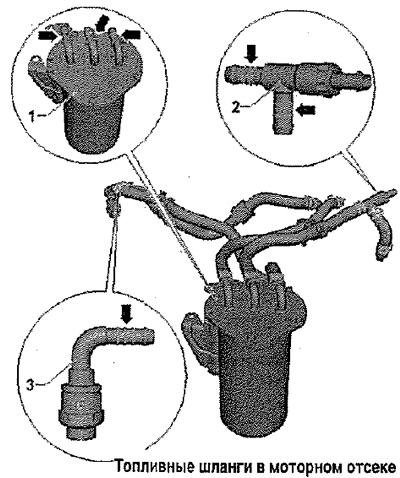
Caution! After removing the fuel hoses from the fittings with a double-wave profile and a crushable edge, such hoses must be replaced.
If the fuel hose cannot be removed from the fitting by hand
Caution! Never insert a screwdriver or other similar tool between the hose and the fitting: risk of damaging the hose fittings - the unit must be replaced.
Using suitable pliers, twist the fuel hose and remove it.
If the fuel hose still does not come off the fitting
Cut the hose along the nipple only to the textile layer and remove the hose. The inner rubber layer cannot be cut. Damage to the nipple will require replacement of the entire unit.
Note: Before installing a new fuel hose, thoroughly clean the nipple from grease, oil and dirt. Do not use metal tools for this, which can damage the nipple. Install the fuel hose without using grease and secure with a spring clamp.